SUBSCRIBE TO OUR FREE NEWSLETTER
Daily news & progressive opinion—funded by the people, not the corporations—delivered straight to your inbox.
5
#000000
#FFFFFF
To donate by check, phone, or other method, see our More Ways to Give page.
Daily news & progressive opinion—funded by the people, not the corporations—delivered straight to your inbox.
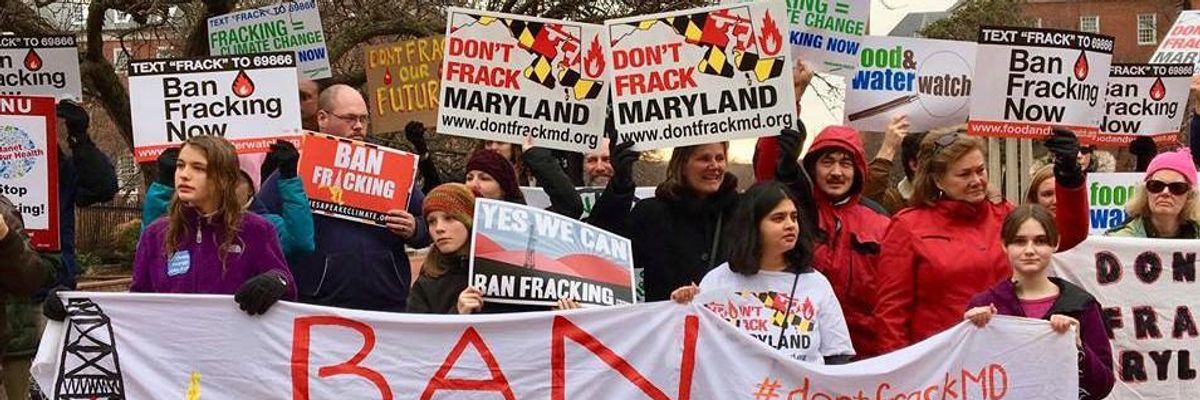
In February of 2017, legislation to impose a statewide, permanent fracking ban was introduced in the Maryland Senate. (Photo: Food & Water Watch/Facebook)
A new report out Monday challenges the fossil fuel industry narrative that fracked gas is a "bridge fuel," calling its development instead a path towards planetary destruction and an obstacle to achieving a renewables-based energy system.
Released by Washington, D.C.-based advocacy group Food and Water Watch, the analysis is entitled "Fracking's Bridge to Climate Chaos: Exposing the Fossil Fuel Industry's Deadly Spin" (pdf).
"This new research makes one thing absolutely clear," said Food & Water Watch executive director Wenonah Hauter. "Unless we ban fracking, these terrifying climate trends will intensify."
Among the problems with fracking is that it's responsible for gas leaks at "every stage of the sprawling natural gas network," including wellhead bases, underground storage facilities and compressor stations, processing plants, and end stages such as liquified natural gas (LNG) export ports and industrial plants.
That's bad news for the climate because the leaks include methane--a potent greenhouse gas that can also help create the ground-level pollutant ozone.
" Methane leaks in the 2.4 to 3.2 percent range are likely to completely neutralize any purported climate benefits of natural gas used in place of coal for electricity generation," says the report. It references research from Cornell University that found a 3.5 percent leak rate for shale gas production.
The report also notes that fracked natural gas does not just go towards electricity production but also to plastics generation. Plastics production was responsible in 2015 for nearly 4 percent of global emissions. As plastics break down, adds the report, they release methane.
Methane leaks aside, the claim of fracked gas serving as bridge towards renewables just doesn't hold water. From the report:
Abundant gas breaks the carbon budget even for the insufficient Paris Agreement climate targets. Long-term projections by the U.S. Energy Information Administration (EIA) find that even with continued fracking, coal's share of generation will stabilize in the 2020s. As coal use stabilizes, large supplies of natural gas will continue to increase carbon emissions.
That abundance means fracked gas is standing in the way of renewables, says the report.
Since fossil fuels and renewables compete to provide energy, gas supplies depress the production of renew-able energy. A 2017 study found that low natural gas prices shifted investment from wind power to gas turbines, which resulted in 6 percent higher average emissions, and solar power companies blame fracking for stifling domestic projects.
But achieving a transition to 100 percent renewables is both necessary and doable, says the report, and just relying on the fossil fuel industry to commit to voluntary measures or calling for band-aid approaches won't get the nation there.
"Regulated fracking still results in public health impacts, accidental spills of toxic waste, air pollution, earthquakes, drinking water contamination, and unavoidable methane leaks that fuel climate change," says the report.
The report also issues a number of recommendations:
"If we are serious about clean air and drinking water, if we are serious about combating climate change, the only safe and sane way to move forward is to ban fracking nationwide."
--Sen. Bernie SandersThe organization's first proposal got a boost last week after Sen. Bernie Sanders (I-Vt.) introduced legislation to ban on- and offshore fracking by 2025.
The measure, which has Sen. Jeff Merkley (D-Ore.) as a co-sponsor, calls out the health impacts of communities on the frontlines of fracking and says "hydraulic fracturing is not in the national interest of the United States."
Sanders, in response to the new Food & Water Watch publication, said: "Fracking is a danger to our water supply. It's a danger to the air we breathe, it has resulted in more earthquakes, and it's highly explosive. To top it all off, it's contributing to climate change."
"This should be a no-brainer," he continued. "If we are serious about clean air and drinking water, if we are serious about combating climate change, the only safe and sane way to move forward is to ban fracking nationwide."
Not taking that step, said Hauter, is a path to more climate chaos.
"Fracked gas is not a bridge to a cleaner future," she said, "it is a foolish perpetuation of the very dangerous fossil fuel status quo."
Dear Common Dreams reader, It’s been nearly 30 years since I co-founded Common Dreams with my late wife, Lina Newhouser. We had the radical notion that journalism should serve the public good, not corporate profits. It was clear to us from the outset what it would take to build such a project. No paid advertisements. No corporate sponsors. No millionaire publisher telling us what to think or do. Many people said we wouldn't last a year, but we proved those doubters wrong. Together with a tremendous team of journalists and dedicated staff, we built an independent media outlet free from the constraints of profits and corporate control. Our mission has always been simple: To inform. To inspire. To ignite change for the common good. Building Common Dreams was not easy. Our survival was never guaranteed. When you take on the most powerful forces—Wall Street greed, fossil fuel industry destruction, Big Tech lobbyists, and uber-rich oligarchs who have spent billions upon billions rigging the economy and democracy in their favor—the only bulwark you have is supporters who believe in your work. But here’s the urgent message from me today. It's never been this bad out there. And it's never been this hard to keep us going. At the very moment Common Dreams is most needed, the threats we face are intensifying. We need your support now more than ever. We don't accept corporate advertising and never will. We don't have a paywall because we don't think people should be blocked from critical news based on their ability to pay. Everything we do is funded by the donations of readers like you. When everyone does the little they can afford, we are strong. But if that support retreats or dries up, so do we. Will you donate now to make sure Common Dreams not only survives but thrives? —Craig Brown, Co-founder |
A new report out Monday challenges the fossil fuel industry narrative that fracked gas is a "bridge fuel," calling its development instead a path towards planetary destruction and an obstacle to achieving a renewables-based energy system.
Released by Washington, D.C.-based advocacy group Food and Water Watch, the analysis is entitled "Fracking's Bridge to Climate Chaos: Exposing the Fossil Fuel Industry's Deadly Spin" (pdf).
"This new research makes one thing absolutely clear," said Food & Water Watch executive director Wenonah Hauter. "Unless we ban fracking, these terrifying climate trends will intensify."
Among the problems with fracking is that it's responsible for gas leaks at "every stage of the sprawling natural gas network," including wellhead bases, underground storage facilities and compressor stations, processing plants, and end stages such as liquified natural gas (LNG) export ports and industrial plants.
That's bad news for the climate because the leaks include methane--a potent greenhouse gas that can also help create the ground-level pollutant ozone.
" Methane leaks in the 2.4 to 3.2 percent range are likely to completely neutralize any purported climate benefits of natural gas used in place of coal for electricity generation," says the report. It references research from Cornell University that found a 3.5 percent leak rate for shale gas production.
The report also notes that fracked natural gas does not just go towards electricity production but also to plastics generation. Plastics production was responsible in 2015 for nearly 4 percent of global emissions. As plastics break down, adds the report, they release methane.
Methane leaks aside, the claim of fracked gas serving as bridge towards renewables just doesn't hold water. From the report:
Abundant gas breaks the carbon budget even for the insufficient Paris Agreement climate targets. Long-term projections by the U.S. Energy Information Administration (EIA) find that even with continued fracking, coal's share of generation will stabilize in the 2020s. As coal use stabilizes, large supplies of natural gas will continue to increase carbon emissions.
That abundance means fracked gas is standing in the way of renewables, says the report.
Since fossil fuels and renewables compete to provide energy, gas supplies depress the production of renew-able energy. A 2017 study found that low natural gas prices shifted investment from wind power to gas turbines, which resulted in 6 percent higher average emissions, and solar power companies blame fracking for stifling domestic projects.
But achieving a transition to 100 percent renewables is both necessary and doable, says the report, and just relying on the fossil fuel industry to commit to voluntary measures or calling for band-aid approaches won't get the nation there.
"Regulated fracking still results in public health impacts, accidental spills of toxic waste, air pollution, earthquakes, drinking water contamination, and unavoidable methane leaks that fuel climate change," says the report.
The report also issues a number of recommendations:
"If we are serious about clean air and drinking water, if we are serious about combating climate change, the only safe and sane way to move forward is to ban fracking nationwide."
--Sen. Bernie SandersThe organization's first proposal got a boost last week after Sen. Bernie Sanders (I-Vt.) introduced legislation to ban on- and offshore fracking by 2025.
The measure, which has Sen. Jeff Merkley (D-Ore.) as a co-sponsor, calls out the health impacts of communities on the frontlines of fracking and says "hydraulic fracturing is not in the national interest of the United States."
Sanders, in response to the new Food & Water Watch publication, said: "Fracking is a danger to our water supply. It's a danger to the air we breathe, it has resulted in more earthquakes, and it's highly explosive. To top it all off, it's contributing to climate change."
"This should be a no-brainer," he continued. "If we are serious about clean air and drinking water, if we are serious about combating climate change, the only safe and sane way to move forward is to ban fracking nationwide."
Not taking that step, said Hauter, is a path to more climate chaos.
"Fracked gas is not a bridge to a cleaner future," she said, "it is a foolish perpetuation of the very dangerous fossil fuel status quo."
A new report out Monday challenges the fossil fuel industry narrative that fracked gas is a "bridge fuel," calling its development instead a path towards planetary destruction and an obstacle to achieving a renewables-based energy system.
Released by Washington, D.C.-based advocacy group Food and Water Watch, the analysis is entitled "Fracking's Bridge to Climate Chaos: Exposing the Fossil Fuel Industry's Deadly Spin" (pdf).
"This new research makes one thing absolutely clear," said Food & Water Watch executive director Wenonah Hauter. "Unless we ban fracking, these terrifying climate trends will intensify."
Among the problems with fracking is that it's responsible for gas leaks at "every stage of the sprawling natural gas network," including wellhead bases, underground storage facilities and compressor stations, processing plants, and end stages such as liquified natural gas (LNG) export ports and industrial plants.
That's bad news for the climate because the leaks include methane--a potent greenhouse gas that can also help create the ground-level pollutant ozone.
" Methane leaks in the 2.4 to 3.2 percent range are likely to completely neutralize any purported climate benefits of natural gas used in place of coal for electricity generation," says the report. It references research from Cornell University that found a 3.5 percent leak rate for shale gas production.
The report also notes that fracked natural gas does not just go towards electricity production but also to plastics generation. Plastics production was responsible in 2015 for nearly 4 percent of global emissions. As plastics break down, adds the report, they release methane.
Methane leaks aside, the claim of fracked gas serving as bridge towards renewables just doesn't hold water. From the report:
Abundant gas breaks the carbon budget even for the insufficient Paris Agreement climate targets. Long-term projections by the U.S. Energy Information Administration (EIA) find that even with continued fracking, coal's share of generation will stabilize in the 2020s. As coal use stabilizes, large supplies of natural gas will continue to increase carbon emissions.
That abundance means fracked gas is standing in the way of renewables, says the report.
Since fossil fuels and renewables compete to provide energy, gas supplies depress the production of renew-able energy. A 2017 study found that low natural gas prices shifted investment from wind power to gas turbines, which resulted in 6 percent higher average emissions, and solar power companies blame fracking for stifling domestic projects.
But achieving a transition to 100 percent renewables is both necessary and doable, says the report, and just relying on the fossil fuel industry to commit to voluntary measures or calling for band-aid approaches won't get the nation there.
"Regulated fracking still results in public health impacts, accidental spills of toxic waste, air pollution, earthquakes, drinking water contamination, and unavoidable methane leaks that fuel climate change," says the report.
The report also issues a number of recommendations:
"If we are serious about clean air and drinking water, if we are serious about combating climate change, the only safe and sane way to move forward is to ban fracking nationwide."
--Sen. Bernie SandersThe organization's first proposal got a boost last week after Sen. Bernie Sanders (I-Vt.) introduced legislation to ban on- and offshore fracking by 2025.
The measure, which has Sen. Jeff Merkley (D-Ore.) as a co-sponsor, calls out the health impacts of communities on the frontlines of fracking and says "hydraulic fracturing is not in the national interest of the United States."
Sanders, in response to the new Food & Water Watch publication, said: "Fracking is a danger to our water supply. It's a danger to the air we breathe, it has resulted in more earthquakes, and it's highly explosive. To top it all off, it's contributing to climate change."
"This should be a no-brainer," he continued. "If we are serious about clean air and drinking water, if we are serious about combating climate change, the only safe and sane way to move forward is to ban fracking nationwide."
Not taking that step, said Hauter, is a path to more climate chaos.
"Fracked gas is not a bridge to a cleaner future," she said, "it is a foolish perpetuation of the very dangerous fossil fuel status quo."