SUBSCRIBE TO OUR FREE NEWSLETTER
Daily news & progressive opinion—funded by the people, not the corporations—delivered straight to your inbox.
5
#000000
#FFFFFF
To donate by check, phone, or other method, see our More Ways to Give page.
Daily news & progressive opinion—funded by the people, not the corporations—delivered straight to your inbox.
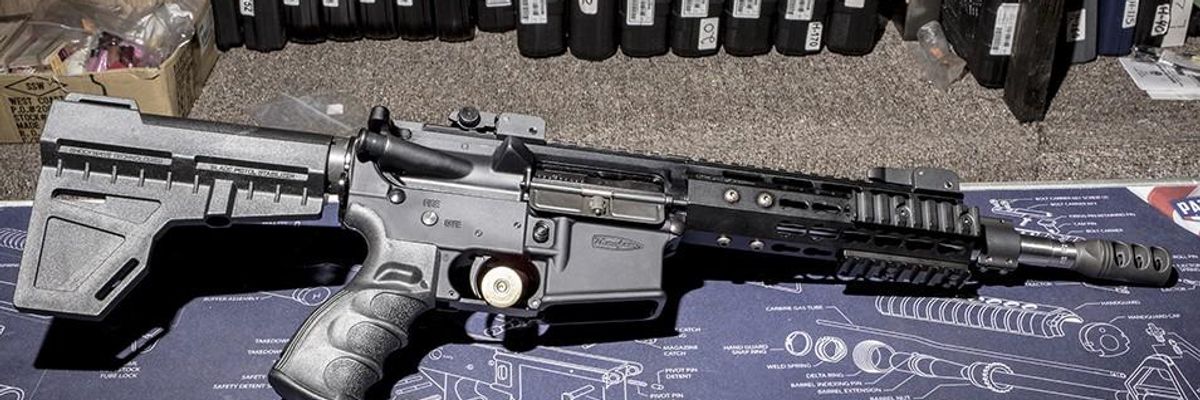
An AR-15 style rifle at Kahr Arms' Tommy Gun Warehouse on Kahr Ave., in Greeley, Penn., on Thursday, April 26, 2018. (Photo: Bryan Anselm/Redux For The Washington Post via Getty Images)
Gun control advocates slammed the Trump administration Thursday for siding with gun manufacturers and lobbyists after the White House slashed the oversight process for exporting weapons overseas.
In a new rule entered into the Federal Register on Thursday, the administration shifted oversight of many arms exports from the U.S. State Department to the Department of Commerce, a move expected to boost sales of ammunition and weapons including sniper rifles, AR-15s, and other semi-automatic firearms.
Gun manufacturers have lobbied for the shift, which will lower the industry's costs.
The gun control group Giffords Law Center denounced the new rule, which is set to take effect in March, on social media.
"Once again, the Trump administration chose gun industry profits over public safety," said Adzi Vokhiwa, the group's federal affairs manager. "Since this ill-conceived proposal was first announced nearly two years ago, human rights, arms control, and gun safety organizations repeatedly made it clear that oversight of firearms exports should remain with the State Department, which has the expertise to ensure that weapons do not fall into the wrong hands. The sale of firearms--domestically and abroad--deserves the highest level of scrutiny, and this regulation fails to offer much scrutiny at all."
Under the new system, gun manufacturers will have to meet fewer regulatory requirements to obtain an export license from the Commerce Department than they have from the State Department. Commerce is also not required to disclose to Congress when a commercial firearm sale exceeds $1 million.
Last May, as the administration was considering the change, more than 100 organizations including Amnesty International, Newtown Action Alliance, and the Arms Control Association wrote to members of Congress calling on them to support measures that would maintain oversight of arms exports.
Shifting oversight to Commerce, the groups wrote, would further contribute to humanitarian crises overseas.
"Although proponents of the proposed changes argue that small arms are 'less dangerous' because many can be bought in U.S. retail outlets, the fact is that armies are built from these firearms," the letter reads. "Small arms are the weapons of mass destruction in countries and regions such as Congo, Burma, Mexico, and Central America. AR- and AK-type rifles and their ammunition that would be transferred to Commerce control are weapons of choice for criminal organizations in Mexico and other Central American countries, contributing to the humanitarian catastrophe that drives many migrants north as guns flow south."
In December, Sen. Robert Menendez (D-N.J.) wrote to the State Department demanding a hold on the new rule shifting oversight of the exports.
When the administration announced last week that the rules would be entered into the Federal Register, Menendez said President Donald Trump was timing the "reckless" decision so that his representatives could "tout the new rules at the annual gunmakers' Las Vegas convention next week."
"As I tried to repeatedly explain to the Trump administration, semi-automatic firearms and ammunition--especially those derived from military models and widely in-use by military and security services--are uniquely dangerous," the senator said. "They are easily modified, diverted, and proliferated, and are the primary means of injury, death, and destruction in civil and military conflicts throughout the world. As such, they should be subject to more rigorous export controls and oversight, not less."
Dear Common Dreams reader, It’s been nearly 30 years since I co-founded Common Dreams with my late wife, Lina Newhouser. We had the radical notion that journalism should serve the public good, not corporate profits. It was clear to us from the outset what it would take to build such a project. No paid advertisements. No corporate sponsors. No millionaire publisher telling us what to think or do. Many people said we wouldn't last a year, but we proved those doubters wrong. Together with a tremendous team of journalists and dedicated staff, we built an independent media outlet free from the constraints of profits and corporate control. Our mission has always been simple: To inform. To inspire. To ignite change for the common good. Building Common Dreams was not easy. Our survival was never guaranteed. When you take on the most powerful forces—Wall Street greed, fossil fuel industry destruction, Big Tech lobbyists, and uber-rich oligarchs who have spent billions upon billions rigging the economy and democracy in their favor—the only bulwark you have is supporters who believe in your work. But here’s the urgent message from me today. It's never been this bad out there. And it's never been this hard to keep us going. At the very moment Common Dreams is most needed, the threats we face are intensifying. We need your support now more than ever. We don't accept corporate advertising and never will. We don't have a paywall because we don't think people should be blocked from critical news based on their ability to pay. Everything we do is funded by the donations of readers like you. When everyone does the little they can afford, we are strong. But if that support retreats or dries up, so do we. Will you donate now to make sure Common Dreams not only survives but thrives? —Craig Brown, Co-founder |
Gun control advocates slammed the Trump administration Thursday for siding with gun manufacturers and lobbyists after the White House slashed the oversight process for exporting weapons overseas.
In a new rule entered into the Federal Register on Thursday, the administration shifted oversight of many arms exports from the U.S. State Department to the Department of Commerce, a move expected to boost sales of ammunition and weapons including sniper rifles, AR-15s, and other semi-automatic firearms.
Gun manufacturers have lobbied for the shift, which will lower the industry's costs.
The gun control group Giffords Law Center denounced the new rule, which is set to take effect in March, on social media.
"Once again, the Trump administration chose gun industry profits over public safety," said Adzi Vokhiwa, the group's federal affairs manager. "Since this ill-conceived proposal was first announced nearly two years ago, human rights, arms control, and gun safety organizations repeatedly made it clear that oversight of firearms exports should remain with the State Department, which has the expertise to ensure that weapons do not fall into the wrong hands. The sale of firearms--domestically and abroad--deserves the highest level of scrutiny, and this regulation fails to offer much scrutiny at all."
Under the new system, gun manufacturers will have to meet fewer regulatory requirements to obtain an export license from the Commerce Department than they have from the State Department. Commerce is also not required to disclose to Congress when a commercial firearm sale exceeds $1 million.
Last May, as the administration was considering the change, more than 100 organizations including Amnesty International, Newtown Action Alliance, and the Arms Control Association wrote to members of Congress calling on them to support measures that would maintain oversight of arms exports.
Shifting oversight to Commerce, the groups wrote, would further contribute to humanitarian crises overseas.
"Although proponents of the proposed changes argue that small arms are 'less dangerous' because many can be bought in U.S. retail outlets, the fact is that armies are built from these firearms," the letter reads. "Small arms are the weapons of mass destruction in countries and regions such as Congo, Burma, Mexico, and Central America. AR- and AK-type rifles and their ammunition that would be transferred to Commerce control are weapons of choice for criminal organizations in Mexico and other Central American countries, contributing to the humanitarian catastrophe that drives many migrants north as guns flow south."
In December, Sen. Robert Menendez (D-N.J.) wrote to the State Department demanding a hold on the new rule shifting oversight of the exports.
When the administration announced last week that the rules would be entered into the Federal Register, Menendez said President Donald Trump was timing the "reckless" decision so that his representatives could "tout the new rules at the annual gunmakers' Las Vegas convention next week."
"As I tried to repeatedly explain to the Trump administration, semi-automatic firearms and ammunition--especially those derived from military models and widely in-use by military and security services--are uniquely dangerous," the senator said. "They are easily modified, diverted, and proliferated, and are the primary means of injury, death, and destruction in civil and military conflicts throughout the world. As such, they should be subject to more rigorous export controls and oversight, not less."
Gun control advocates slammed the Trump administration Thursday for siding with gun manufacturers and lobbyists after the White House slashed the oversight process for exporting weapons overseas.
In a new rule entered into the Federal Register on Thursday, the administration shifted oversight of many arms exports from the U.S. State Department to the Department of Commerce, a move expected to boost sales of ammunition and weapons including sniper rifles, AR-15s, and other semi-automatic firearms.
Gun manufacturers have lobbied for the shift, which will lower the industry's costs.
The gun control group Giffords Law Center denounced the new rule, which is set to take effect in March, on social media.
"Once again, the Trump administration chose gun industry profits over public safety," said Adzi Vokhiwa, the group's federal affairs manager. "Since this ill-conceived proposal was first announced nearly two years ago, human rights, arms control, and gun safety organizations repeatedly made it clear that oversight of firearms exports should remain with the State Department, which has the expertise to ensure that weapons do not fall into the wrong hands. The sale of firearms--domestically and abroad--deserves the highest level of scrutiny, and this regulation fails to offer much scrutiny at all."
Under the new system, gun manufacturers will have to meet fewer regulatory requirements to obtain an export license from the Commerce Department than they have from the State Department. Commerce is also not required to disclose to Congress when a commercial firearm sale exceeds $1 million.
Last May, as the administration was considering the change, more than 100 organizations including Amnesty International, Newtown Action Alliance, and the Arms Control Association wrote to members of Congress calling on them to support measures that would maintain oversight of arms exports.
Shifting oversight to Commerce, the groups wrote, would further contribute to humanitarian crises overseas.
"Although proponents of the proposed changes argue that small arms are 'less dangerous' because many can be bought in U.S. retail outlets, the fact is that armies are built from these firearms," the letter reads. "Small arms are the weapons of mass destruction in countries and regions such as Congo, Burma, Mexico, and Central America. AR- and AK-type rifles and their ammunition that would be transferred to Commerce control are weapons of choice for criminal organizations in Mexico and other Central American countries, contributing to the humanitarian catastrophe that drives many migrants north as guns flow south."
In December, Sen. Robert Menendez (D-N.J.) wrote to the State Department demanding a hold on the new rule shifting oversight of the exports.
When the administration announced last week that the rules would be entered into the Federal Register, Menendez said President Donald Trump was timing the "reckless" decision so that his representatives could "tout the new rules at the annual gunmakers' Las Vegas convention next week."
"As I tried to repeatedly explain to the Trump administration, semi-automatic firearms and ammunition--especially those derived from military models and widely in-use by military and security services--are uniquely dangerous," the senator said. "They are easily modified, diverted, and proliferated, and are the primary means of injury, death, and destruction in civil and military conflicts throughout the world. As such, they should be subject to more rigorous export controls and oversight, not less."