SUBSCRIBE TO OUR FREE NEWSLETTER
Daily news & progressive opinion—funded by the people, not the corporations—delivered straight to your inbox.
5
#000000
#FFFFFF
To donate by check, phone, or other method, see our More Ways to Give page.
Daily news & progressive opinion—funded by the people, not the corporations—delivered straight to your inbox.
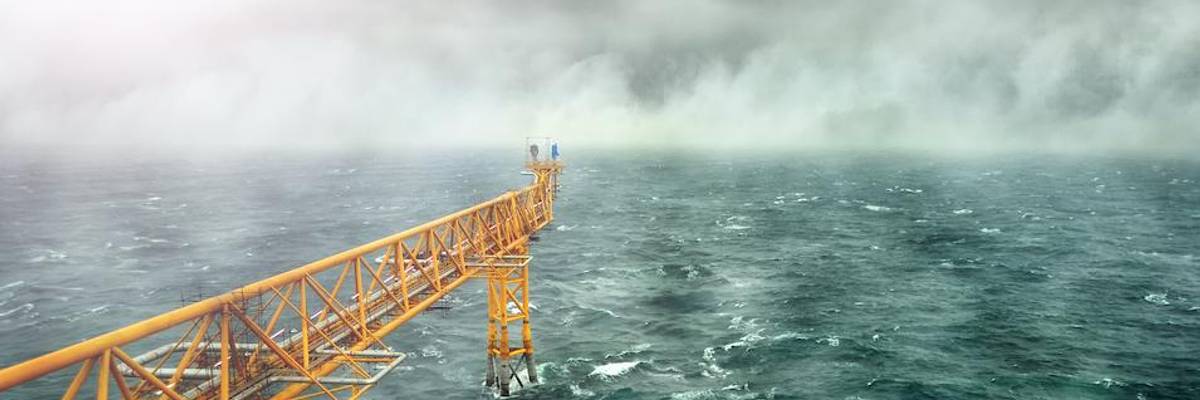
A gas platform for flaring of gas at offshore during bad weather. (Photo: Puneet Vikram Singh/Getty Images)
A new study published Monday shows that the Earth's oceans reached the highest temperatures and warmed the fastest since records began, highlighting the urgent need for global action to address the climate crisis before it's too late.
The study (pdf), "Record-Setting Ocean Warmth Continued in 2019," which was published in Advances in Atmospheric Studies, found the oceans have warmed by around 0.075 degrees C above the average of 1981-2010.
That level of warming, the paper found, is equal to 228,000,000,000,000,000,000,000 (228 Sextillion) Joules of heat. Study lead author Lijing Cheng, associate professor with the International Center for Climate and Environmental Sciences at the Institute of Atmospheric Physics of the Chinese Academy of Sciences analogized the level of heating to something more manageable for the human mind.
"The amount of heat we have put in the world's oceans in the past 25 years equals to 3.6 billion Hiroshima atom-bomb explosions," said Cheng. "This measured ocean warming is irrefutable and is further proof of global warming. There are no reasonable alternatives aside from the human emissions of heat trapping gases to explain this heating."
The warming is speeding up, the scientists found.
"We are now at five to six Hiroshima bombs of heat each second," study co-author John Abraham, a professor of mechanical engineering at the University of St. Thomas, told CNN.
Abraham said in a statement Monday announcing the study's publication that the public needs to be aware "how fast things are changing."
"The key to answering this question is in the oceans--that's where the vast majority of heat ends up," said Abraham. "If you want to understand global warming, you have to measure ocean warming."
The ocean warms slowly, said Cheng, but due to its vast size has dire consequences.
"The price we pay is the reduction of ocean-dissolved oxygen, the harmed marine lives, strengthening storms and reduced fisheries and ocean-related economies," Cheng said. "However, the more we reduce greenhouse gasses, the less the ocean will warm."
Dear Common Dreams reader, It’s been nearly 30 years since I co-founded Common Dreams with my late wife, Lina Newhouser. We had the radical notion that journalism should serve the public good, not corporate profits. It was clear to us from the outset what it would take to build such a project. No paid advertisements. No corporate sponsors. No millionaire publisher telling us what to think or do. Many people said we wouldn't last a year, but we proved those doubters wrong. Together with a tremendous team of journalists and dedicated staff, we built an independent media outlet free from the constraints of profits and corporate control. Our mission has always been simple: To inform. To inspire. To ignite change for the common good. Building Common Dreams was not easy. Our survival was never guaranteed. When you take on the most powerful forces—Wall Street greed, fossil fuel industry destruction, Big Tech lobbyists, and uber-rich oligarchs who have spent billions upon billions rigging the economy and democracy in their favor—the only bulwark you have is supporters who believe in your work. But here’s the urgent message from me today. It's never been this bad out there. And it's never been this hard to keep us going. At the very moment Common Dreams is most needed, the threats we face are intensifying. We need your support now more than ever. We don't accept corporate advertising and never will. We don't have a paywall because we don't think people should be blocked from critical news based on their ability to pay. Everything we do is funded by the donations of readers like you. When everyone does the little they can afford, we are strong. But if that support retreats or dries up, so do we. Will you donate now to make sure Common Dreams not only survives but thrives? —Craig Brown, Co-founder |
A new study published Monday shows that the Earth's oceans reached the highest temperatures and warmed the fastest since records began, highlighting the urgent need for global action to address the climate crisis before it's too late.
The study (pdf), "Record-Setting Ocean Warmth Continued in 2019," which was published in Advances in Atmospheric Studies, found the oceans have warmed by around 0.075 degrees C above the average of 1981-2010.
That level of warming, the paper found, is equal to 228,000,000,000,000,000,000,000 (228 Sextillion) Joules of heat. Study lead author Lijing Cheng, associate professor with the International Center for Climate and Environmental Sciences at the Institute of Atmospheric Physics of the Chinese Academy of Sciences analogized the level of heating to something more manageable for the human mind.
"The amount of heat we have put in the world's oceans in the past 25 years equals to 3.6 billion Hiroshima atom-bomb explosions," said Cheng. "This measured ocean warming is irrefutable and is further proof of global warming. There are no reasonable alternatives aside from the human emissions of heat trapping gases to explain this heating."
The warming is speeding up, the scientists found.
"We are now at five to six Hiroshima bombs of heat each second," study co-author John Abraham, a professor of mechanical engineering at the University of St. Thomas, told CNN.
Abraham said in a statement Monday announcing the study's publication that the public needs to be aware "how fast things are changing."
"The key to answering this question is in the oceans--that's where the vast majority of heat ends up," said Abraham. "If you want to understand global warming, you have to measure ocean warming."
The ocean warms slowly, said Cheng, but due to its vast size has dire consequences.
"The price we pay is the reduction of ocean-dissolved oxygen, the harmed marine lives, strengthening storms and reduced fisheries and ocean-related economies," Cheng said. "However, the more we reduce greenhouse gasses, the less the ocean will warm."
A new study published Monday shows that the Earth's oceans reached the highest temperatures and warmed the fastest since records began, highlighting the urgent need for global action to address the climate crisis before it's too late.
The study (pdf), "Record-Setting Ocean Warmth Continued in 2019," which was published in Advances in Atmospheric Studies, found the oceans have warmed by around 0.075 degrees C above the average of 1981-2010.
That level of warming, the paper found, is equal to 228,000,000,000,000,000,000,000 (228 Sextillion) Joules of heat. Study lead author Lijing Cheng, associate professor with the International Center for Climate and Environmental Sciences at the Institute of Atmospheric Physics of the Chinese Academy of Sciences analogized the level of heating to something more manageable for the human mind.
"The amount of heat we have put in the world's oceans in the past 25 years equals to 3.6 billion Hiroshima atom-bomb explosions," said Cheng. "This measured ocean warming is irrefutable and is further proof of global warming. There are no reasonable alternatives aside from the human emissions of heat trapping gases to explain this heating."
The warming is speeding up, the scientists found.
"We are now at five to six Hiroshima bombs of heat each second," study co-author John Abraham, a professor of mechanical engineering at the University of St. Thomas, told CNN.
Abraham said in a statement Monday announcing the study's publication that the public needs to be aware "how fast things are changing."
"The key to answering this question is in the oceans--that's where the vast majority of heat ends up," said Abraham. "If you want to understand global warming, you have to measure ocean warming."
The ocean warms slowly, said Cheng, but due to its vast size has dire consequences.
"The price we pay is the reduction of ocean-dissolved oxygen, the harmed marine lives, strengthening storms and reduced fisheries and ocean-related economies," Cheng said. "However, the more we reduce greenhouse gasses, the less the ocean will warm."