SUBSCRIBE TO OUR FREE NEWSLETTER
Daily news & progressive opinion—funded by the people, not the corporations—delivered straight to your inbox.
5
#000000
#FFFFFF
To donate by check, phone, or other method, see our More Ways to Give page.
Daily news & progressive opinion—funded by the people, not the corporations—delivered straight to your inbox.
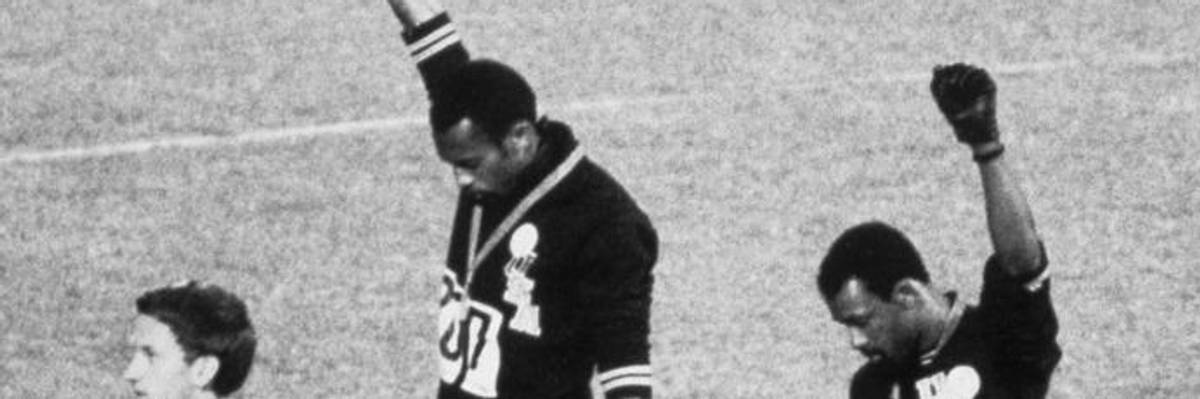
American sprinters Tommie Smith and John Carlos raise their fists and give the Black Power Salute at the 1968 Olympic Games in Mexico City. The move was a symbolic protest against racism in the United States. Smith, the gold medal winner, and Carlos, the bronze medal winner, were subsequently suspended from their team for their actions. (Photo: Bettman via Getty)
The International Olympic Committee drew sharp criticism from rights advocates Thursday after the organization issued revised guidelines banning athletes at the 2020 Tokyo Games from staging protests at the event including kneeling during their national anthem or raising their fists into the air.
"So the IOC is doubling down on the disgraceful treatment of athletes in 1968?" asked Sherrilyn Ifill, president and director-counsel of the NAACP Legal Defense and Educational Fund. Ifill was referring to the iconic moment at the Mexico City Olympics when black Americans Tommie Smith and John Carlos, as they were awarded their gold and bronze medals, respectively, wore black gloves, took off their shoes, and held their fists high to protest poverty and racism. The IOC responded by expelling Smith and Carlos.
The IOC announced the guidelines for Rule 50 of the Olympic Charter Thursday. Among the specific actions (pdf) now banned are:
"When an individual makes their grievances, however legitimate, more important than the feelings of their competitors and the competition itself, the unity and harmony as well as the celebration of sport and human accomplishment are diminished," the guidelines read. The new rules still allow athletes to express their views on social media and in interviews and at press conferences, the new document states.
Failure to abide by the guidelines will result in the athlete's action being evaluated by their "respective National Olympic Committee, International Federation, and the IOC, and disciplinary action will be taken on a case-by-case basis as necessary."
The update comes less than five months after the U.S. Olympic and Paralympic Committee (USOPC) reprimanded U.S. athletes Race Imboden and Gwen Berry for their act of protest at the medal podium. Imboden kneeled to protest "the multiple shortcomings of the country I hold so dear to my heart" including "a president who spreads hate," and Berry protested social injustice in America.
Tennis legend Martina Navratilova was in the chorus of opposition to the IOC's new guidelines, tweeting, "God how I despise these Olympic politician opportunists. I wouldn't last one day on one of these committees..."
Critics pointed to the fact that while the new document asserts that the podium and playing field must be a politics-free zone, the IOC itself is not politically neutral.
"The truth is, it's not the mixing of politics and sports that [IOC president Thomas] Bach and the IOC don't like," Nancy Armour opined Thursday at USA Today. "It's the mixing of politics they don't like with sports."
She continued:
It's just fine for Bach to lobby for the issues he finds important. Or to foster good relationships with world leaders who might someday bankrupt their economies in exchange for sparkling venues, five-star hotels, and Olympic traffic lanes that allow IOC members to avoid the general populace on the roads and in the airports.
But God forbid athletes should stay silent about racism, homophobia, inequality, or murderous regimes. You know, issues that have a direct effect on their lives.
That the types of protest now barred appear to take specific aim at black athletes wasn't lost on other critics either.
The decision to ban protests (which is common beyond the Olympics) reflects the whiteness of all major institutions. Thus proving the point that indeed nothing is neutral. What a privilege to not need to protest for your liberation. This is a racist policy. https://t.co/1jFXwEnzGr
-- Kike Ojo-Thompson (@mskikeojo) January 10, 2020
Advocacy group People for the American Way rejected the new guidelines in a Twitter thread Friday that drew attention to an op-ed published at HuffPost in 2017 by Diallo Brooks, the group's director of outreach and public engagement.
"The right to raise our voices, make a speech, march in a rally, or take a knee in protest--whether in front of a government building or a football field--is at the heart of what it means to live in a free country," wrote Brooks.
"Young men of color who play sports are more than just entertainers, and they should not be penalized for speaking out peacefully against injustice," he wrote. "They must be allowed to have a voice. And when their voices are threatened, we have to raise our own and stand with them."
Dear Common Dreams reader, It’s been nearly 30 years since I co-founded Common Dreams with my late wife, Lina Newhouser. We had the radical notion that journalism should serve the public good, not corporate profits. It was clear to us from the outset what it would take to build such a project. No paid advertisements. No corporate sponsors. No millionaire publisher telling us what to think or do. Many people said we wouldn't last a year, but we proved those doubters wrong. Together with a tremendous team of journalists and dedicated staff, we built an independent media outlet free from the constraints of profits and corporate control. Our mission has always been simple: To inform. To inspire. To ignite change for the common good. Building Common Dreams was not easy. Our survival was never guaranteed. When you take on the most powerful forces—Wall Street greed, fossil fuel industry destruction, Big Tech lobbyists, and uber-rich oligarchs who have spent billions upon billions rigging the economy and democracy in their favor—the only bulwark you have is supporters who believe in your work. But here’s the urgent message from me today. It's never been this bad out there. And it's never been this hard to keep us going. At the very moment Common Dreams is most needed, the threats we face are intensifying. We need your support now more than ever. We don't accept corporate advertising and never will. We don't have a paywall because we don't think people should be blocked from critical news based on their ability to pay. Everything we do is funded by the donations of readers like you. When everyone does the little they can afford, we are strong. But if that support retreats or dries up, so do we. Will you donate now to make sure Common Dreams not only survives but thrives? —Craig Brown, Co-founder |
The International Olympic Committee drew sharp criticism from rights advocates Thursday after the organization issued revised guidelines banning athletes at the 2020 Tokyo Games from staging protests at the event including kneeling during their national anthem or raising their fists into the air.
"So the IOC is doubling down on the disgraceful treatment of athletes in 1968?" asked Sherrilyn Ifill, president and director-counsel of the NAACP Legal Defense and Educational Fund. Ifill was referring to the iconic moment at the Mexico City Olympics when black Americans Tommie Smith and John Carlos, as they were awarded their gold and bronze medals, respectively, wore black gloves, took off their shoes, and held their fists high to protest poverty and racism. The IOC responded by expelling Smith and Carlos.
The IOC announced the guidelines for Rule 50 of the Olympic Charter Thursday. Among the specific actions (pdf) now banned are:
"When an individual makes their grievances, however legitimate, more important than the feelings of their competitors and the competition itself, the unity and harmony as well as the celebration of sport and human accomplishment are diminished," the guidelines read. The new rules still allow athletes to express their views on social media and in interviews and at press conferences, the new document states.
Failure to abide by the guidelines will result in the athlete's action being evaluated by their "respective National Olympic Committee, International Federation, and the IOC, and disciplinary action will be taken on a case-by-case basis as necessary."
The update comes less than five months after the U.S. Olympic and Paralympic Committee (USOPC) reprimanded U.S. athletes Race Imboden and Gwen Berry for their act of protest at the medal podium. Imboden kneeled to protest "the multiple shortcomings of the country I hold so dear to my heart" including "a president who spreads hate," and Berry protested social injustice in America.
Tennis legend Martina Navratilova was in the chorus of opposition to the IOC's new guidelines, tweeting, "God how I despise these Olympic politician opportunists. I wouldn't last one day on one of these committees..."
Critics pointed to the fact that while the new document asserts that the podium and playing field must be a politics-free zone, the IOC itself is not politically neutral.
"The truth is, it's not the mixing of politics and sports that [IOC president Thomas] Bach and the IOC don't like," Nancy Armour opined Thursday at USA Today. "It's the mixing of politics they don't like with sports."
She continued:
It's just fine for Bach to lobby for the issues he finds important. Or to foster good relationships with world leaders who might someday bankrupt their economies in exchange for sparkling venues, five-star hotels, and Olympic traffic lanes that allow IOC members to avoid the general populace on the roads and in the airports.
But God forbid athletes should stay silent about racism, homophobia, inequality, or murderous regimes. You know, issues that have a direct effect on their lives.
That the types of protest now barred appear to take specific aim at black athletes wasn't lost on other critics either.
The decision to ban protests (which is common beyond the Olympics) reflects the whiteness of all major institutions. Thus proving the point that indeed nothing is neutral. What a privilege to not need to protest for your liberation. This is a racist policy. https://t.co/1jFXwEnzGr
-- Kike Ojo-Thompson (@mskikeojo) January 10, 2020
Advocacy group People for the American Way rejected the new guidelines in a Twitter thread Friday that drew attention to an op-ed published at HuffPost in 2017 by Diallo Brooks, the group's director of outreach and public engagement.
"The right to raise our voices, make a speech, march in a rally, or take a knee in protest--whether in front of a government building or a football field--is at the heart of what it means to live in a free country," wrote Brooks.
"Young men of color who play sports are more than just entertainers, and they should not be penalized for speaking out peacefully against injustice," he wrote. "They must be allowed to have a voice. And when their voices are threatened, we have to raise our own and stand with them."
The International Olympic Committee drew sharp criticism from rights advocates Thursday after the organization issued revised guidelines banning athletes at the 2020 Tokyo Games from staging protests at the event including kneeling during their national anthem or raising their fists into the air.
"So the IOC is doubling down on the disgraceful treatment of athletes in 1968?" asked Sherrilyn Ifill, president and director-counsel of the NAACP Legal Defense and Educational Fund. Ifill was referring to the iconic moment at the Mexico City Olympics when black Americans Tommie Smith and John Carlos, as they were awarded their gold and bronze medals, respectively, wore black gloves, took off their shoes, and held their fists high to protest poverty and racism. The IOC responded by expelling Smith and Carlos.
The IOC announced the guidelines for Rule 50 of the Olympic Charter Thursday. Among the specific actions (pdf) now banned are:
"When an individual makes their grievances, however legitimate, more important than the feelings of their competitors and the competition itself, the unity and harmony as well as the celebration of sport and human accomplishment are diminished," the guidelines read. The new rules still allow athletes to express their views on social media and in interviews and at press conferences, the new document states.
Failure to abide by the guidelines will result in the athlete's action being evaluated by their "respective National Olympic Committee, International Federation, and the IOC, and disciplinary action will be taken on a case-by-case basis as necessary."
The update comes less than five months after the U.S. Olympic and Paralympic Committee (USOPC) reprimanded U.S. athletes Race Imboden and Gwen Berry for their act of protest at the medal podium. Imboden kneeled to protest "the multiple shortcomings of the country I hold so dear to my heart" including "a president who spreads hate," and Berry protested social injustice in America.
Tennis legend Martina Navratilova was in the chorus of opposition to the IOC's new guidelines, tweeting, "God how I despise these Olympic politician opportunists. I wouldn't last one day on one of these committees..."
Critics pointed to the fact that while the new document asserts that the podium and playing field must be a politics-free zone, the IOC itself is not politically neutral.
"The truth is, it's not the mixing of politics and sports that [IOC president Thomas] Bach and the IOC don't like," Nancy Armour opined Thursday at USA Today. "It's the mixing of politics they don't like with sports."
She continued:
It's just fine for Bach to lobby for the issues he finds important. Or to foster good relationships with world leaders who might someday bankrupt their economies in exchange for sparkling venues, five-star hotels, and Olympic traffic lanes that allow IOC members to avoid the general populace on the roads and in the airports.
But God forbid athletes should stay silent about racism, homophobia, inequality, or murderous regimes. You know, issues that have a direct effect on their lives.
That the types of protest now barred appear to take specific aim at black athletes wasn't lost on other critics either.
The decision to ban protests (which is common beyond the Olympics) reflects the whiteness of all major institutions. Thus proving the point that indeed nothing is neutral. What a privilege to not need to protest for your liberation. This is a racist policy. https://t.co/1jFXwEnzGr
-- Kike Ojo-Thompson (@mskikeojo) January 10, 2020
Advocacy group People for the American Way rejected the new guidelines in a Twitter thread Friday that drew attention to an op-ed published at HuffPost in 2017 by Diallo Brooks, the group's director of outreach and public engagement.
"The right to raise our voices, make a speech, march in a rally, or take a knee in protest--whether in front of a government building or a football field--is at the heart of what it means to live in a free country," wrote Brooks.
"Young men of color who play sports are more than just entertainers, and they should not be penalized for speaking out peacefully against injustice," he wrote. "They must be allowed to have a voice. And when their voices are threatened, we have to raise our own and stand with them."