SUBSCRIBE TO OUR FREE NEWSLETTER
Daily news & progressive opinion—funded by the people, not the corporations—delivered straight to your inbox.
5
#000000
#FFFFFF
To donate by check, phone, or other method, see our More Ways to Give page.
Daily news & progressive opinion—funded by the people, not the corporations—delivered straight to your inbox.
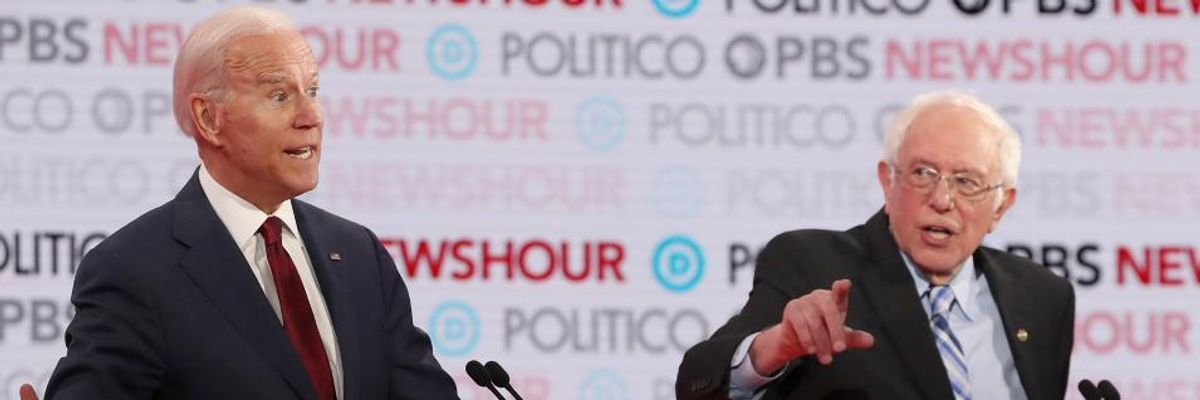
Sen. Bernie Sanders (I-Vt.) gestures as former Vice President Joe Biden listens during the Democratic presidential primary debate at Loyola Marymount University on December 19, 2019 in Los Angeles, California. (Photo: Justin Sullivan/Getty Images)
Sen. Bernie Sanders made a full-throated case for universal programs that leave no one behind during the 2020 Democratic presidential debate Thursday, favorably contrasting proposals like Medicare for All and tuition-free public college with complicated means-tested alternatives offered by rival candidates that would render large swaths of the population ineligible on the basis of income.
"I believe in the concept of universality," Sanders said during a discussion of the idea of tuition-free public colleges, universities, and trade schools. "One of the crises in America today is people are sick and tired of filling out forms. So you're not eligible for the program today because you're at $150,000, but you lost your job, are you eligible? You get a better job, you're eligible."
"One of the crises in America today is people are sick and tired of filling out forms."
--Sen. Bernie Sanders
"I think what we have to do is what we do with Social Security, what we do with public education," the Vermont senator added. "Donald Trump's kids can go to a public school. They should be able to go to a public school."
Sanders' defense of universal programs came after South Bend, Indiana Mayor Pete Buttigieg pitched his own education plan, which would make public colleges and universities tuition-free only for families that earn less than $150,000 per year.
"I do think that if you're in that lucky top 10 percent--I still wish you well, don't get me wrong," Buttigieg said. "I just want you to go ahead and pay your own tuition."
Observers applauded Sanders' willingness to advocate for universality over means-testing on the national stage. Zach Carter, reporter for HuffPost, tweeted Thursday night that "Sanders making a straightforward case for universality is good."
"This is the kind of rhetoric Democrats have been afraid to voice for decades," said Carter.
"The headache is part of the design: means-tested programs are designed to cut public spending by dropping people from the rolls on technicalities or intimidating them into giving up."
--Meagan Day, Jacobin
Meagan Day, staff writer for Jacobin and outspoken Sanders supporter, said "Bernie's right, means-tested social programs mean miles of red tape and people are sick of it".
"But the headache is part of the design: means-tested programs are designed to cut public spending by dropping people from the rolls on technicalities or intimidating them into giving up," Day tweeted.
After addressing attacks on the idea of tuition-free public college, Sanders also defended Medicare for All from former Vice President Joe Biden, who attacked the proposal as "unrealistic" and touted his public option alternative that--by his campaign's own admission--would leave millions of people uninsured.
"The average worker in America, their family makes $60,000 a year. That family is now paying $12,000 a year for healthcare," said Sanders. "Under Medicare for all, that family will be paying $1,200 a year, because we're eliminating the profiteering of the drug companies and the insurance companies and ending this byzantine and complex administration of thousands of separate healthcare plans."
When Biden responded that Medicare for All would raise taxes, Sanders said "that's right, we are going to increase personal taxes."
"But we're eliminating premiums, we're eliminating co-payments, we're eliminating deductibles, we're eliminating all out-of-pocket expenses, and no family in America will spend more than $200 a year on prescription drugs," said the Vermont senator.
Watch the exchange:
Dear Common Dreams reader, It’s been nearly 30 years since I co-founded Common Dreams with my late wife, Lina Newhouser. We had the radical notion that journalism should serve the public good, not corporate profits. It was clear to us from the outset what it would take to build such a project. No paid advertisements. No corporate sponsors. No millionaire publisher telling us what to think or do. Many people said we wouldn't last a year, but we proved those doubters wrong. Together with a tremendous team of journalists and dedicated staff, we built an independent media outlet free from the constraints of profits and corporate control. Our mission has always been simple: To inform. To inspire. To ignite change for the common good. Building Common Dreams was not easy. Our survival was never guaranteed. When you take on the most powerful forces—Wall Street greed, fossil fuel industry destruction, Big Tech lobbyists, and uber-rich oligarchs who have spent billions upon billions rigging the economy and democracy in their favor—the only bulwark you have is supporters who believe in your work. But here’s the urgent message from me today. It's never been this bad out there. And it's never been this hard to keep us going. At the very moment Common Dreams is most needed, the threats we face are intensifying. We need your support now more than ever. We don't accept corporate advertising and never will. We don't have a paywall because we don't think people should be blocked from critical news based on their ability to pay. Everything we do is funded by the donations of readers like you. When everyone does the little they can afford, we are strong. But if that support retreats or dries up, so do we. Will you donate now to make sure Common Dreams not only survives but thrives? —Craig Brown, Co-founder |
Sen. Bernie Sanders made a full-throated case for universal programs that leave no one behind during the 2020 Democratic presidential debate Thursday, favorably contrasting proposals like Medicare for All and tuition-free public college with complicated means-tested alternatives offered by rival candidates that would render large swaths of the population ineligible on the basis of income.
"I believe in the concept of universality," Sanders said during a discussion of the idea of tuition-free public colleges, universities, and trade schools. "One of the crises in America today is people are sick and tired of filling out forms. So you're not eligible for the program today because you're at $150,000, but you lost your job, are you eligible? You get a better job, you're eligible."
"One of the crises in America today is people are sick and tired of filling out forms."
--Sen. Bernie Sanders
"I think what we have to do is what we do with Social Security, what we do with public education," the Vermont senator added. "Donald Trump's kids can go to a public school. They should be able to go to a public school."
Sanders' defense of universal programs came after South Bend, Indiana Mayor Pete Buttigieg pitched his own education plan, which would make public colleges and universities tuition-free only for families that earn less than $150,000 per year.
"I do think that if you're in that lucky top 10 percent--I still wish you well, don't get me wrong," Buttigieg said. "I just want you to go ahead and pay your own tuition."
Observers applauded Sanders' willingness to advocate for universality over means-testing on the national stage. Zach Carter, reporter for HuffPost, tweeted Thursday night that "Sanders making a straightforward case for universality is good."
"This is the kind of rhetoric Democrats have been afraid to voice for decades," said Carter.
"The headache is part of the design: means-tested programs are designed to cut public spending by dropping people from the rolls on technicalities or intimidating them into giving up."
--Meagan Day, Jacobin
Meagan Day, staff writer for Jacobin and outspoken Sanders supporter, said "Bernie's right, means-tested social programs mean miles of red tape and people are sick of it".
"But the headache is part of the design: means-tested programs are designed to cut public spending by dropping people from the rolls on technicalities or intimidating them into giving up," Day tweeted.
After addressing attacks on the idea of tuition-free public college, Sanders also defended Medicare for All from former Vice President Joe Biden, who attacked the proposal as "unrealistic" and touted his public option alternative that--by his campaign's own admission--would leave millions of people uninsured.
"The average worker in America, their family makes $60,000 a year. That family is now paying $12,000 a year for healthcare," said Sanders. "Under Medicare for all, that family will be paying $1,200 a year, because we're eliminating the profiteering of the drug companies and the insurance companies and ending this byzantine and complex administration of thousands of separate healthcare plans."
When Biden responded that Medicare for All would raise taxes, Sanders said "that's right, we are going to increase personal taxes."
"But we're eliminating premiums, we're eliminating co-payments, we're eliminating deductibles, we're eliminating all out-of-pocket expenses, and no family in America will spend more than $200 a year on prescription drugs," said the Vermont senator.
Watch the exchange:
Sen. Bernie Sanders made a full-throated case for universal programs that leave no one behind during the 2020 Democratic presidential debate Thursday, favorably contrasting proposals like Medicare for All and tuition-free public college with complicated means-tested alternatives offered by rival candidates that would render large swaths of the population ineligible on the basis of income.
"I believe in the concept of universality," Sanders said during a discussion of the idea of tuition-free public colleges, universities, and trade schools. "One of the crises in America today is people are sick and tired of filling out forms. So you're not eligible for the program today because you're at $150,000, but you lost your job, are you eligible? You get a better job, you're eligible."
"One of the crises in America today is people are sick and tired of filling out forms."
--Sen. Bernie Sanders
"I think what we have to do is what we do with Social Security, what we do with public education," the Vermont senator added. "Donald Trump's kids can go to a public school. They should be able to go to a public school."
Sanders' defense of universal programs came after South Bend, Indiana Mayor Pete Buttigieg pitched his own education plan, which would make public colleges and universities tuition-free only for families that earn less than $150,000 per year.
"I do think that if you're in that lucky top 10 percent--I still wish you well, don't get me wrong," Buttigieg said. "I just want you to go ahead and pay your own tuition."
Observers applauded Sanders' willingness to advocate for universality over means-testing on the national stage. Zach Carter, reporter for HuffPost, tweeted Thursday night that "Sanders making a straightforward case for universality is good."
"This is the kind of rhetoric Democrats have been afraid to voice for decades," said Carter.
"The headache is part of the design: means-tested programs are designed to cut public spending by dropping people from the rolls on technicalities or intimidating them into giving up."
--Meagan Day, Jacobin
Meagan Day, staff writer for Jacobin and outspoken Sanders supporter, said "Bernie's right, means-tested social programs mean miles of red tape and people are sick of it".
"But the headache is part of the design: means-tested programs are designed to cut public spending by dropping people from the rolls on technicalities or intimidating them into giving up," Day tweeted.
After addressing attacks on the idea of tuition-free public college, Sanders also defended Medicare for All from former Vice President Joe Biden, who attacked the proposal as "unrealistic" and touted his public option alternative that--by his campaign's own admission--would leave millions of people uninsured.
"The average worker in America, their family makes $60,000 a year. That family is now paying $12,000 a year for healthcare," said Sanders. "Under Medicare for all, that family will be paying $1,200 a year, because we're eliminating the profiteering of the drug companies and the insurance companies and ending this byzantine and complex administration of thousands of separate healthcare plans."
When Biden responded that Medicare for All would raise taxes, Sanders said "that's right, we are going to increase personal taxes."
"But we're eliminating premiums, we're eliminating co-payments, we're eliminating deductibles, we're eliminating all out-of-pocket expenses, and no family in America will spend more than $200 a year on prescription drugs," said the Vermont senator.
Watch the exchange: