SUBSCRIBE TO OUR FREE NEWSLETTER
Daily news & progressive opinion—funded by the people, not the corporations—delivered straight to your inbox.
5
#000000
#FFFFFF
To donate by check, phone, or other method, see our More Ways to Give page.
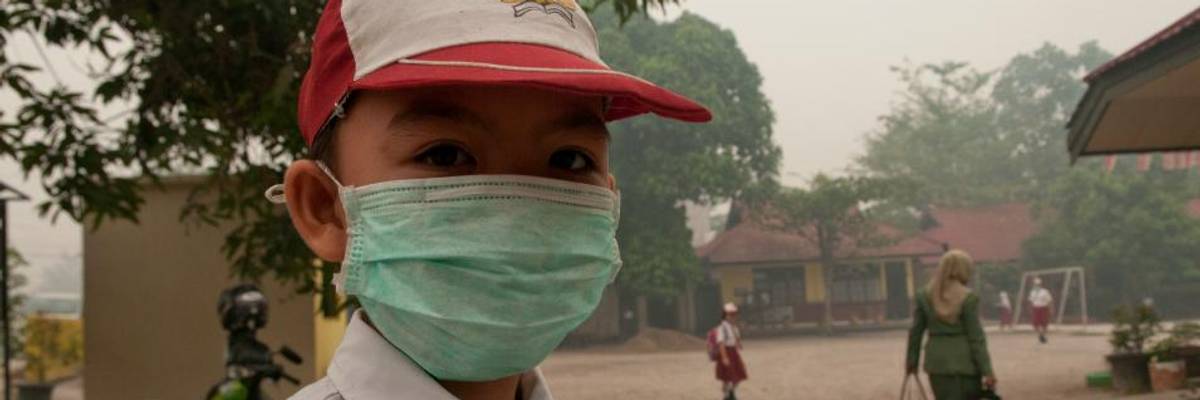
An analysis published Wednesday found that "exposure to toxic air, water, soil, and chemical pollution" kills 8.3 million people worldwide each year, with the United States among the 10 countries that have the most pollution-related premature deaths--underscoring the necessity of urgent, collaborative efforts to safeguard public health.
Putting the total mortality figure into context, 2019 Pollution and Health Metrics: Global, Regional, and Country Analysis (pdf) notes: "Pollution kills three times as many people a year as HIV/AIDS, tuberculosis, and malaria combined. Pollution is responsible for 15 times the number of deaths caused by war and other forms of violence each year."
Based on the findings, the group behind the new report, the Global Alliance on Health and Pollution (GAHP), has three main messages for both policymakers and the public:
Richard Fuller, chair of the GAHP board of directors and the report's co-author, emphasized the need for people across the globe to come together in the fight to prevent premature deaths from pollution.
"In order to tackle pollution, we must prioritize it as an issue that affects us all, integrating it into health planning, and increasing funding to allow more research into pollution, such as monitoring pollution and its effects, and developing ways to control pollution," he said in a statement Wednesday. "Pollution prevention can be highly cost-effective--helping to improve health and reduce climate impacts, while boosting economies."
For the analysis, GAHP used 2017 data from the Institute for Health Metrics and Evaluation, which shows a range of 7-10 million total premature deaths, with five million tied to air pollution. However, the report notes that some recent studies featured higher figures for air pollution deaths, referencing a World Health Organization (WHO) estimate of about seven million and a European study that settled on nearly nine million.
The report serves as an update to an October 2017 study published in the British medical journal The Lancet, which was based on 2015 data and found that pollution kills nine million people each year. The reductions over the two years "mostly reflect changes in calculations of methodology related to air pollution," according to GAHP.
Acknowledging the previous study, the report says that "overall, the results show an improvement in the number of premature deaths from traditional types of pollution--sanitation and household air contaminated by smoke from cook stoves--from 2015 to 2017."
"But premature deaths from modern pollution, those types of pollution caused by industrialization and urbanization, are on the rise," the report explains.
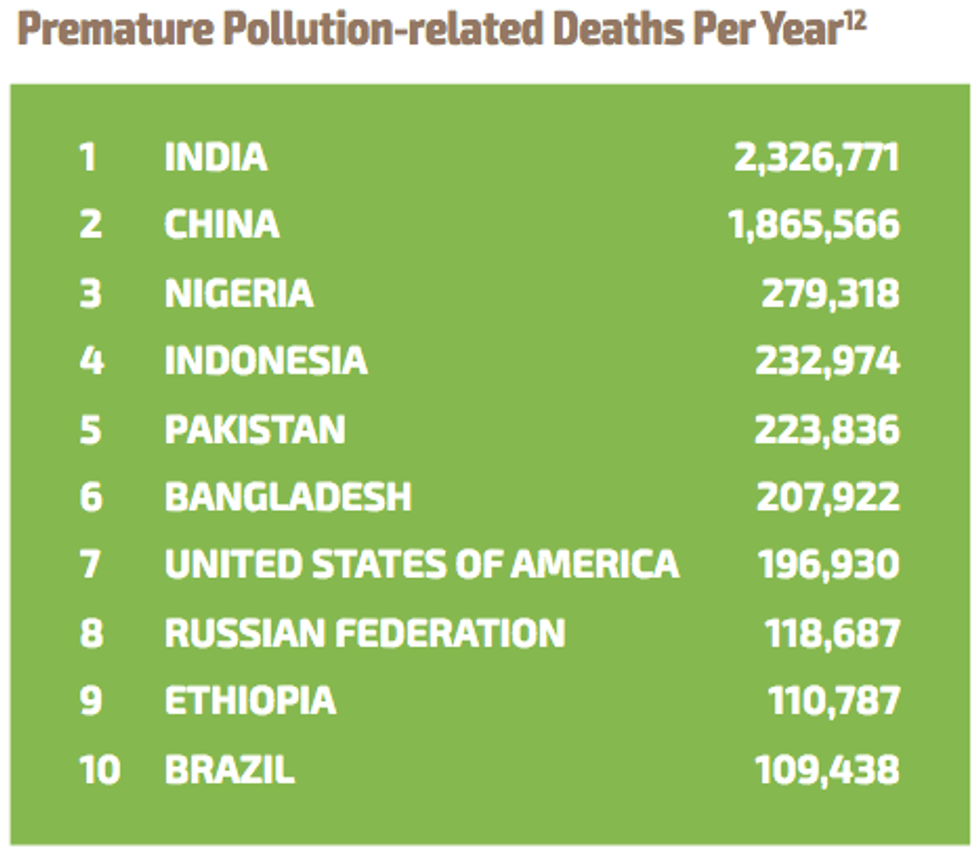
The more than eight million annual deaths tied to pollution "are spread unevenly amongst the countries of the world," with the top 10 countries accounting for about two-thirds of the total figure. An estimated 3.4 million of those deaths, or about 40%, are related to air pollution.
India and China have both the highest total annual deaths, with more than 2.3 million and 1.86 million respectively, as well as the highest figures for air pollution specifically, with each surpassing 1.24 million. The report frames those findings as unsurprising, considering that "they both have billion-plus populations and are industrializing rapidly."
"Other heavily populated countries--such as Pakistan, Bangladesh, and Indonesia--are also badly affected," the report says. "The United States, the world's third most populous country with 325 million people, makes the top 10 list by virtue of its size, while ranking 132nd in the number of deaths per 100,000 people. In the U.S., air pollution is responsible for more than half of the pollution-related premature deaths."
"Pollution is a leading cause of premature death in many smaller low- and middle-income countries where the death rates per 100,000 people are much higher than those in more populous, high-income nations," the report continues. "Poor water sanitation and contaminated indoor air are major killers in the world's poorest nations."
Rachael Kupka, GAHP's acting executive director, said that "the report reminds us all that pollution is a global crisis. It does not matter where you live. Pollution will find you."
Gina McCarthy, who served as administrator of the U.S. Environmental Protection Agency under former President Barack Obama, emphasized pollution's connections to the human-made climate crisis.
"We're facing serious risks from pollution and those risks are exacerbated by climate change," she said Wedneday. "The U.S. has historically been the gold standard in tackling pollution, and today we are sadly not doing enough, and the fact that we're going backward is unconscionable. This report reminds us that climate change isn't just about faraway countries or forest fires and floods--it's about our health and the health of our kids--here and now."
The GAHP report follows a study published last month in The Lancet which, as Common Dreams reported, warned that children are now "being born for the first time into a world where their health will be affected at every single stage of their life by a changing climate." Specific concerns highlighted in that report included crop failure, the spread of infectious diseases, and that air pollution will damage children's hearts and lungs over their lifetimes.
"We can get through the climate crisis. But it's too late for half measures," award-winning geneticist and broadcaster David Suzuki wrote in response to the November report. "We need an all-out effort as great as or greater than mobilizations for the 'great' wars. We need to kick our fossil fuel addiction now, for our sake and the children's."
An analysis published Wednesday found that "exposure to toxic air, water, soil, and chemical pollution" kills 8.3 million people worldwide each year, with the United States among the 10 countries that have the most pollution-related premature deaths--underscoring the necessity of urgent, collaborative efforts to safeguard public health.
Putting the total mortality figure into context, 2019 Pollution and Health Metrics: Global, Regional, and Country Analysis (pdf) notes: "Pollution kills three times as many people a year as HIV/AIDS, tuberculosis, and malaria combined. Pollution is responsible for 15 times the number of deaths caused by war and other forms of violence each year."
Based on the findings, the group behind the new report, the Global Alliance on Health and Pollution (GAHP), has three main messages for both policymakers and the public:
Richard Fuller, chair of the GAHP board of directors and the report's co-author, emphasized the need for people across the globe to come together in the fight to prevent premature deaths from pollution.
"In order to tackle pollution, we must prioritize it as an issue that affects us all, integrating it into health planning, and increasing funding to allow more research into pollution, such as monitoring pollution and its effects, and developing ways to control pollution," he said in a statement Wednesday. "Pollution prevention can be highly cost-effective--helping to improve health and reduce climate impacts, while boosting economies."
For the analysis, GAHP used 2017 data from the Institute for Health Metrics and Evaluation, which shows a range of 7-10 million total premature deaths, with five million tied to air pollution. However, the report notes that some recent studies featured higher figures for air pollution deaths, referencing a World Health Organization (WHO) estimate of about seven million and a European study that settled on nearly nine million.
The report serves as an update to an October 2017 study published in the British medical journal The Lancet, which was based on 2015 data and found that pollution kills nine million people each year. The reductions over the two years "mostly reflect changes in calculations of methodology related to air pollution," according to GAHP.
Acknowledging the previous study, the report says that "overall, the results show an improvement in the number of premature deaths from traditional types of pollution--sanitation and household air contaminated by smoke from cook stoves--from 2015 to 2017."
"But premature deaths from modern pollution, those types of pollution caused by industrialization and urbanization, are on the rise," the report explains.
The more than eight million annual deaths tied to pollution "are spread unevenly amongst the countries of the world," with the top 10 countries accounting for about two-thirds of the total figure. An estimated 3.4 million of those deaths, or about 40%, are related to air pollution.
India and China have both the highest total annual deaths, with more than 2.3 million and 1.86 million respectively, as well as the highest figures for air pollution specifically, with each surpassing 1.24 million. The report frames those findings as unsurprising, considering that "they both have billion-plus populations and are industrializing rapidly."
"Other heavily populated countries--such as Pakistan, Bangladesh, and Indonesia--are also badly affected," the report says. "The United States, the world's third most populous country with 325 million people, makes the top 10 list by virtue of its size, while ranking 132nd in the number of deaths per 100,000 people. In the U.S., air pollution is responsible for more than half of the pollution-related premature deaths."
"Pollution is a leading cause of premature death in many smaller low- and middle-income countries where the death rates per 100,000 people are much higher than those in more populous, high-income nations," the report continues. "Poor water sanitation and contaminated indoor air are major killers in the world's poorest nations."
Rachael Kupka, GAHP's acting executive director, said that "the report reminds us all that pollution is a global crisis. It does not matter where you live. Pollution will find you."
Gina McCarthy, who served as administrator of the U.S. Environmental Protection Agency under former President Barack Obama, emphasized pollution's connections to the human-made climate crisis.
"We're facing serious risks from pollution and those risks are exacerbated by climate change," she said Wedneday. "The U.S. has historically been the gold standard in tackling pollution, and today we are sadly not doing enough, and the fact that we're going backward is unconscionable. This report reminds us that climate change isn't just about faraway countries or forest fires and floods--it's about our health and the health of our kids--here and now."
The GAHP report follows a study published last month in The Lancet which, as Common Dreams reported, warned that children are now "being born for the first time into a world where their health will be affected at every single stage of their life by a changing climate." Specific concerns highlighted in that report included crop failure, the spread of infectious diseases, and that air pollution will damage children's hearts and lungs over their lifetimes.
"We can get through the climate crisis. But it's too late for half measures," award-winning geneticist and broadcaster David Suzuki wrote in response to the November report. "We need an all-out effort as great as or greater than mobilizations for the 'great' wars. We need to kick our fossil fuel addiction now, for our sake and the children's."
An analysis published Wednesday found that "exposure to toxic air, water, soil, and chemical pollution" kills 8.3 million people worldwide each year, with the United States among the 10 countries that have the most pollution-related premature deaths--underscoring the necessity of urgent, collaborative efforts to safeguard public health.
Putting the total mortality figure into context, 2019 Pollution and Health Metrics: Global, Regional, and Country Analysis (pdf) notes: "Pollution kills three times as many people a year as HIV/AIDS, tuberculosis, and malaria combined. Pollution is responsible for 15 times the number of deaths caused by war and other forms of violence each year."
Based on the findings, the group behind the new report, the Global Alliance on Health and Pollution (GAHP), has three main messages for both policymakers and the public:
Richard Fuller, chair of the GAHP board of directors and the report's co-author, emphasized the need for people across the globe to come together in the fight to prevent premature deaths from pollution.
"In order to tackle pollution, we must prioritize it as an issue that affects us all, integrating it into health planning, and increasing funding to allow more research into pollution, such as monitoring pollution and its effects, and developing ways to control pollution," he said in a statement Wednesday. "Pollution prevention can be highly cost-effective--helping to improve health and reduce climate impacts, while boosting economies."
For the analysis, GAHP used 2017 data from the Institute for Health Metrics and Evaluation, which shows a range of 7-10 million total premature deaths, with five million tied to air pollution. However, the report notes that some recent studies featured higher figures for air pollution deaths, referencing a World Health Organization (WHO) estimate of about seven million and a European study that settled on nearly nine million.
The report serves as an update to an October 2017 study published in the British medical journal The Lancet, which was based on 2015 data and found that pollution kills nine million people each year. The reductions over the two years "mostly reflect changes in calculations of methodology related to air pollution," according to GAHP.
Acknowledging the previous study, the report says that "overall, the results show an improvement in the number of premature deaths from traditional types of pollution--sanitation and household air contaminated by smoke from cook stoves--from 2015 to 2017."
"But premature deaths from modern pollution, those types of pollution caused by industrialization and urbanization, are on the rise," the report explains.
The more than eight million annual deaths tied to pollution "are spread unevenly amongst the countries of the world," with the top 10 countries accounting for about two-thirds of the total figure. An estimated 3.4 million of those deaths, or about 40%, are related to air pollution.
India and China have both the highest total annual deaths, with more than 2.3 million and 1.86 million respectively, as well as the highest figures for air pollution specifically, with each surpassing 1.24 million. The report frames those findings as unsurprising, considering that "they both have billion-plus populations and are industrializing rapidly."
"Other heavily populated countries--such as Pakistan, Bangladesh, and Indonesia--are also badly affected," the report says. "The United States, the world's third most populous country with 325 million people, makes the top 10 list by virtue of its size, while ranking 132nd in the number of deaths per 100,000 people. In the U.S., air pollution is responsible for more than half of the pollution-related premature deaths."
"Pollution is a leading cause of premature death in many smaller low- and middle-income countries where the death rates per 100,000 people are much higher than those in more populous, high-income nations," the report continues. "Poor water sanitation and contaminated indoor air are major killers in the world's poorest nations."
Rachael Kupka, GAHP's acting executive director, said that "the report reminds us all that pollution is a global crisis. It does not matter where you live. Pollution will find you."
Gina McCarthy, who served as administrator of the U.S. Environmental Protection Agency under former President Barack Obama, emphasized pollution's connections to the human-made climate crisis.
"We're facing serious risks from pollution and those risks are exacerbated by climate change," she said Wedneday. "The U.S. has historically been the gold standard in tackling pollution, and today we are sadly not doing enough, and the fact that we're going backward is unconscionable. This report reminds us that climate change isn't just about faraway countries or forest fires and floods--it's about our health and the health of our kids--here and now."
The GAHP report follows a study published last month in The Lancet which, as Common Dreams reported, warned that children are now "being born for the first time into a world where their health will be affected at every single stage of their life by a changing climate." Specific concerns highlighted in that report included crop failure, the spread of infectious diseases, and that air pollution will damage children's hearts and lungs over their lifetimes.
"We can get through the climate crisis. But it's too late for half measures," award-winning geneticist and broadcaster David Suzuki wrote in response to the November report. "We need an all-out effort as great as or greater than mobilizations for the 'great' wars. We need to kick our fossil fuel addiction now, for our sake and the children's."