
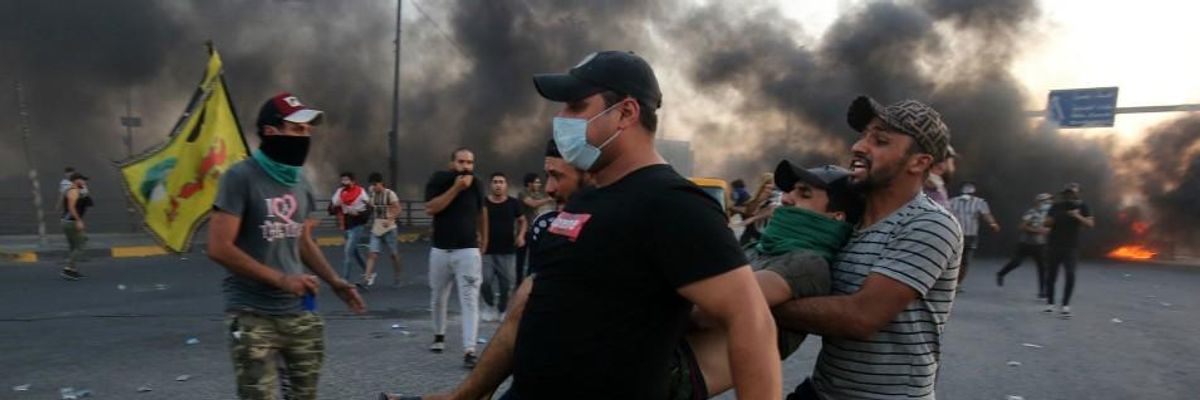
Iraqi protesters during clashes amid a demonstration against state corruption, failing public services, and unemployment in the Iraqi capital Baghdad on October 5, 2019. (Photo: Ahmad al-Rubaye/AFP/Getty Images)
Iraqi Prime Minister to Step Down as Human Rights Defenders Condemn Security Forces' Attacks on Anti-Government Protesters
The country's top Shiite cleric called for a change in leadership Friday "to preserve the blood of [Iraq's] children."
Iraqi Prime Minister Adel Abdul Mahdi announced Friday that he would resign following weeks of anti-government protests and a violent response from security forces which has been condemned by global human rights campaigners.
Protesters in Baghdad's Tahrir Square cheered after Abdul Mahdi said he would submit his resignation to Parliament. The announcement came a day after at least 25 people were killed by security forces wielding live ammunition and tear gas in the southern city of Nasiriyah.
Nationwide, more than 62 protesters were shot dead on Thursday and more than 400 people have been killed in the protests since they began October 1.
Earlier on Friday, the country's top Shiite cleric, Grand Ayatollah Ali al-Sistani, called for a change in leadership amid the demonstrations, which have been led largely by young people protesting high unemployment rates, government corruption, and weak public services.
"The Parliament, from which this current government is drawn, is asked to reconsider its choice in this regard and act according to Iraq's interest... [to] preserve the blood of its children," said al-Sistani.
The violence that erupted in Nasiriyah on Thursday led Amnesty International to repeat its demand that Iraq's government end its crackdown on unarmed protesters.
"This brutal onslaught is just the latest in a long series of deadly events where Iraqi security forces meted out appalling violence against largely peaceful protesters," said Lynn Maalouf, the organization's Middle East research director. "The international community must speak loudly and clearly, pressing for Iraq to rein in the security forces and launch effective and impartial investigations aimed at bringing to justice those responsible for unlawful killings and other serious violations."
We are at a crossroads
This country and this world are at a monumental crossroads. In a few short weeks, US voters will have an opportunity to beat back the forces of fascism and confront the billionaires who are rigging the economy, our media system, and our democracy, making it increasingly impossible for ordinary people to get by. We’re not just talking about the election. We’re talking about what must be done once these fascist elements are vanquished from power. We need a bolder set of solutions than what either major party has so far been willing to offer and a working-class movement ready to fight like hell for it. Trump didn't emerge from nowhere. The conditions that fueled MAGA authoritarianism were created by decades of radical neoliberal economic policies and a corrupt political system dominated by corporate interests. They slashed taxes on the super-rich, promising that the benefits would trickle down. They said giveaways to the corporate titans would make life more affordable for the rest of us. It was all bullshit. And when a bitter, betrayed populace searches for someone to blame, right-wing demagogues have little trouble finding scapegoats. People know when they're being lied to, but you won't hear any of this from the corporate media. Only independent journalism—powered and funded by people who believe in building a better world—can deliver truly trustworthy daily news. Our Fall Campaign is underway, and we need your help. To power our newsroom through the rest of the year, we need to raise $125,000 by midnight on October 31. So if you share our vision, please contribute whatever you can to sustain our work. |
Iraqi Prime Minister Adel Abdul Mahdi announced Friday that he would resign following weeks of anti-government protests and a violent response from security forces which has been condemned by global human rights campaigners.
Protesters in Baghdad's Tahrir Square cheered after Abdul Mahdi said he would submit his resignation to Parliament. The announcement came a day after at least 25 people were killed by security forces wielding live ammunition and tear gas in the southern city of Nasiriyah.
Nationwide, more than 62 protesters were shot dead on Thursday and more than 400 people have been killed in the protests since they began October 1.
Earlier on Friday, the country's top Shiite cleric, Grand Ayatollah Ali al-Sistani, called for a change in leadership amid the demonstrations, which have been led largely by young people protesting high unemployment rates, government corruption, and weak public services.
"The Parliament, from which this current government is drawn, is asked to reconsider its choice in this regard and act according to Iraq's interest... [to] preserve the blood of its children," said al-Sistani.
The violence that erupted in Nasiriyah on Thursday led Amnesty International to repeat its demand that Iraq's government end its crackdown on unarmed protesters.
"This brutal onslaught is just the latest in a long series of deadly events where Iraqi security forces meted out appalling violence against largely peaceful protesters," said Lynn Maalouf, the organization's Middle East research director. "The international community must speak loudly and clearly, pressing for Iraq to rein in the security forces and launch effective and impartial investigations aimed at bringing to justice those responsible for unlawful killings and other serious violations."
Iraqi Prime Minister Adel Abdul Mahdi announced Friday that he would resign following weeks of anti-government protests and a violent response from security forces which has been condemned by global human rights campaigners.
Protesters in Baghdad's Tahrir Square cheered after Abdul Mahdi said he would submit his resignation to Parliament. The announcement came a day after at least 25 people were killed by security forces wielding live ammunition and tear gas in the southern city of Nasiriyah.
Nationwide, more than 62 protesters were shot dead on Thursday and more than 400 people have been killed in the protests since they began October 1.
Earlier on Friday, the country's top Shiite cleric, Grand Ayatollah Ali al-Sistani, called for a change in leadership amid the demonstrations, which have been led largely by young people protesting high unemployment rates, government corruption, and weak public services.
"The Parliament, from which this current government is drawn, is asked to reconsider its choice in this regard and act according to Iraq's interest... [to] preserve the blood of its children," said al-Sistani.
The violence that erupted in Nasiriyah on Thursday led Amnesty International to repeat its demand that Iraq's government end its crackdown on unarmed protesters.
"This brutal onslaught is just the latest in a long series of deadly events where Iraqi security forces meted out appalling violence against largely peaceful protesters," said Lynn Maalouf, the organization's Middle East research director. "The international community must speak loudly and clearly, pressing for Iraq to rein in the security forces and launch effective and impartial investigations aimed at bringing to justice those responsible for unlawful killings and other serious violations."