SUBSCRIBE TO OUR FREE NEWSLETTER
Daily news & progressive opinion—funded by the people, not the corporations—delivered straight to your inbox.
5
#000000
#FFFFFF
To donate by check, phone, or other method, see our More Ways to Give page.
Daily news & progressive opinion—funded by the people, not the corporations—delivered straight to your inbox.
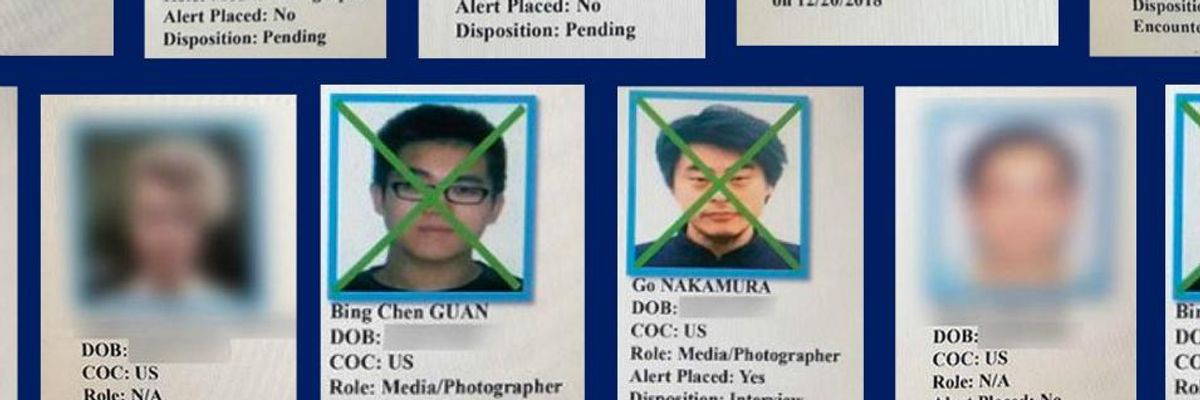
"When I saw my photo crossed out in a secret government database, I realized the secondary screening and interrogation wasn't random," said photojournalist Bing Guan. "I was being targeted by my own government for reporting on conditions at the border." (Image: NBC7 San Diego via ACLU)
Five journalists who were tracked, detained, and interrogated by the U.S. Department of Homeland Security for reporting on conditions at the southern border in 2018 and 2019 brought a federal lawsuit against the Trump administration Wednesday for what the ACLU called an "unprecedented, coordinated attack on the freedom of the press."
"When I saw my photo crossed out in a secret government database, I realized the secondary screening and interrogation wasn't random. I was being targeted by my own government for reporting on conditions at the border."
--Bing Guan, photojournalist
The national ACLU, joined by chapters in New York and California, filed the suit (pdf) in the U.S. District Court for the Eastern District of New York on behalf of Bing Guan, Go Nakamura, Mark Abramson, Kitra Cahana, and Ariana Drehsler. The five are all U.S. citizens who traveled to Mexico as professional photojournalists.
"A core principle of our democracy is the freedom of the press," Esha Bhandari, staff attorney with ACLU's Speech, Privacy, and Technology Project, said in a statement. "That freedom is imperiled when the government uses the pretext of border screening to interrogate journalists who were simply doing their jobs."
The named defendants in the case are acting Homeland Security Secretary Chad Wolf and the leaders of two agencies DHS oversees--Mark Morgan of U.S. Customs and Border Protection and Matthew Albence of U.S. Immigration and Customs Enforcement.
"Plaintiffs were each impermissibly compelled to disclose information about their journalism work and activities when they sought to re-enter the United States," the complaint explains. "The border officers' questioning aimed at uncovering plaintiffs' sources of information and their observations as journalists was unconstitutional."
Some of the journalists were asked to identify "instigators" from a book of headshots, questioned about previous reporting on conflict zones in the Middle East, and required to show U.S. government agents photographs they had taken of migrants on the Mexican side of the border.
"One of the journalists in the case was also denied entry to Mexico during the time period of the interrogations, preventing her from continuing her work there," according to an ACLU blog post.
The journalists are "a seeking declaratory judgment that such questioning and compelled disclosure of information violated the First Amendment" as well as "an injunction requiring defendants to expunge any records they have retained regarding the unlawful questioning and to inform plaintiffs whether those records have been disclosed to other agencies, governments, or individuals."
"As a freelance photojournalist covering news and various issues," said Abramson, "I want to know that I am free to work without government interference."
The lawsuit came after NBC7 San Diego reported in March 2019 that the Trump administration was keeping a database of journalists and "instigators" involved with the so-called migrant caravan in late 2018 and early 2019--which, at the time, the ACLU's Bhandari condemned as "an outrageous violation of the First Amendment."
Recalling that report in a statement Wednesday, Guan explained that "when I saw my photo crossed out in a secret government database, I realized the secondary screening and interrogation wasn't random. I was being targeted by my own government for reporting on conditions at the border."
Cahana said that "journalists are democracy's first line of defense" and highlighted how the case has broad implications for U.S. government interference in press freedom.
"We need to be able to work without fear of being put on a secret government surveillance list or having alerts placed upon our passports," Cahana added. "This interference effectively prevented me and other journalists from carrying out our reporting at the U.S.-Mexico border. It's an issue that should concern everyone."
Dear Common Dreams reader, It’s been nearly 30 years since I co-founded Common Dreams with my late wife, Lina Newhouser. We had the radical notion that journalism should serve the public good, not corporate profits. It was clear to us from the outset what it would take to build such a project. No paid advertisements. No corporate sponsors. No millionaire publisher telling us what to think or do. Many people said we wouldn't last a year, but we proved those doubters wrong. Together with a tremendous team of journalists and dedicated staff, we built an independent media outlet free from the constraints of profits and corporate control. Our mission has always been simple: To inform. To inspire. To ignite change for the common good. Building Common Dreams was not easy. Our survival was never guaranteed. When you take on the most powerful forces—Wall Street greed, fossil fuel industry destruction, Big Tech lobbyists, and uber-rich oligarchs who have spent billions upon billions rigging the economy and democracy in their favor—the only bulwark you have is supporters who believe in your work. But here’s the urgent message from me today. It's never been this bad out there. And it's never been this hard to keep us going. At the very moment Common Dreams is most needed, the threats we face are intensifying. We need your support now more than ever. We don't accept corporate advertising and never will. We don't have a paywall because we don't think people should be blocked from critical news based on their ability to pay. Everything we do is funded by the donations of readers like you. When everyone does the little they can afford, we are strong. But if that support retreats or dries up, so do we. Will you donate now to make sure Common Dreams not only survives but thrives? —Craig Brown, Co-founder |
Five journalists who were tracked, detained, and interrogated by the U.S. Department of Homeland Security for reporting on conditions at the southern border in 2018 and 2019 brought a federal lawsuit against the Trump administration Wednesday for what the ACLU called an "unprecedented, coordinated attack on the freedom of the press."
"When I saw my photo crossed out in a secret government database, I realized the secondary screening and interrogation wasn't random. I was being targeted by my own government for reporting on conditions at the border."
--Bing Guan, photojournalist
The national ACLU, joined by chapters in New York and California, filed the suit (pdf) in the U.S. District Court for the Eastern District of New York on behalf of Bing Guan, Go Nakamura, Mark Abramson, Kitra Cahana, and Ariana Drehsler. The five are all U.S. citizens who traveled to Mexico as professional photojournalists.
"A core principle of our democracy is the freedom of the press," Esha Bhandari, staff attorney with ACLU's Speech, Privacy, and Technology Project, said in a statement. "That freedom is imperiled when the government uses the pretext of border screening to interrogate journalists who were simply doing their jobs."
The named defendants in the case are acting Homeland Security Secretary Chad Wolf and the leaders of two agencies DHS oversees--Mark Morgan of U.S. Customs and Border Protection and Matthew Albence of U.S. Immigration and Customs Enforcement.
"Plaintiffs were each impermissibly compelled to disclose information about their journalism work and activities when they sought to re-enter the United States," the complaint explains. "The border officers' questioning aimed at uncovering plaintiffs' sources of information and their observations as journalists was unconstitutional."
Some of the journalists were asked to identify "instigators" from a book of headshots, questioned about previous reporting on conflict zones in the Middle East, and required to show U.S. government agents photographs they had taken of migrants on the Mexican side of the border.
"One of the journalists in the case was also denied entry to Mexico during the time period of the interrogations, preventing her from continuing her work there," according to an ACLU blog post.
The journalists are "a seeking declaratory judgment that such questioning and compelled disclosure of information violated the First Amendment" as well as "an injunction requiring defendants to expunge any records they have retained regarding the unlawful questioning and to inform plaintiffs whether those records have been disclosed to other agencies, governments, or individuals."
"As a freelance photojournalist covering news and various issues," said Abramson, "I want to know that I am free to work without government interference."
The lawsuit came after NBC7 San Diego reported in March 2019 that the Trump administration was keeping a database of journalists and "instigators" involved with the so-called migrant caravan in late 2018 and early 2019--which, at the time, the ACLU's Bhandari condemned as "an outrageous violation of the First Amendment."
Recalling that report in a statement Wednesday, Guan explained that "when I saw my photo crossed out in a secret government database, I realized the secondary screening and interrogation wasn't random. I was being targeted by my own government for reporting on conditions at the border."
Cahana said that "journalists are democracy's first line of defense" and highlighted how the case has broad implications for U.S. government interference in press freedom.
"We need to be able to work without fear of being put on a secret government surveillance list or having alerts placed upon our passports," Cahana added. "This interference effectively prevented me and other journalists from carrying out our reporting at the U.S.-Mexico border. It's an issue that should concern everyone."
Five journalists who were tracked, detained, and interrogated by the U.S. Department of Homeland Security for reporting on conditions at the southern border in 2018 and 2019 brought a federal lawsuit against the Trump administration Wednesday for what the ACLU called an "unprecedented, coordinated attack on the freedom of the press."
"When I saw my photo crossed out in a secret government database, I realized the secondary screening and interrogation wasn't random. I was being targeted by my own government for reporting on conditions at the border."
--Bing Guan, photojournalist
The national ACLU, joined by chapters in New York and California, filed the suit (pdf) in the U.S. District Court for the Eastern District of New York on behalf of Bing Guan, Go Nakamura, Mark Abramson, Kitra Cahana, and Ariana Drehsler. The five are all U.S. citizens who traveled to Mexico as professional photojournalists.
"A core principle of our democracy is the freedom of the press," Esha Bhandari, staff attorney with ACLU's Speech, Privacy, and Technology Project, said in a statement. "That freedom is imperiled when the government uses the pretext of border screening to interrogate journalists who were simply doing their jobs."
The named defendants in the case are acting Homeland Security Secretary Chad Wolf and the leaders of two agencies DHS oversees--Mark Morgan of U.S. Customs and Border Protection and Matthew Albence of U.S. Immigration and Customs Enforcement.
"Plaintiffs were each impermissibly compelled to disclose information about their journalism work and activities when they sought to re-enter the United States," the complaint explains. "The border officers' questioning aimed at uncovering plaintiffs' sources of information and their observations as journalists was unconstitutional."
Some of the journalists were asked to identify "instigators" from a book of headshots, questioned about previous reporting on conflict zones in the Middle East, and required to show U.S. government agents photographs they had taken of migrants on the Mexican side of the border.
"One of the journalists in the case was also denied entry to Mexico during the time period of the interrogations, preventing her from continuing her work there," according to an ACLU blog post.
The journalists are "a seeking declaratory judgment that such questioning and compelled disclosure of information violated the First Amendment" as well as "an injunction requiring defendants to expunge any records they have retained regarding the unlawful questioning and to inform plaintiffs whether those records have been disclosed to other agencies, governments, or individuals."
"As a freelance photojournalist covering news and various issues," said Abramson, "I want to know that I am free to work without government interference."
The lawsuit came after NBC7 San Diego reported in March 2019 that the Trump administration was keeping a database of journalists and "instigators" involved with the so-called migrant caravan in late 2018 and early 2019--which, at the time, the ACLU's Bhandari condemned as "an outrageous violation of the First Amendment."
Recalling that report in a statement Wednesday, Guan explained that "when I saw my photo crossed out in a secret government database, I realized the secondary screening and interrogation wasn't random. I was being targeted by my own government for reporting on conditions at the border."
Cahana said that "journalists are democracy's first line of defense" and highlighted how the case has broad implications for U.S. government interference in press freedom.
"We need to be able to work without fear of being put on a secret government surveillance list or having alerts placed upon our passports," Cahana added. "This interference effectively prevented me and other journalists from carrying out our reporting at the U.S.-Mexico border. It's an issue that should concern everyone."