SUBSCRIBE TO OUR FREE NEWSLETTER
Daily news & progressive opinion—funded by the people, not the corporations—delivered straight to your inbox.
5
#000000
#FFFFFF
To donate by check, phone, or other method, see our More Ways to Give page.
Daily news & progressive opinion—funded by the people, not the corporations—delivered straight to your inbox.
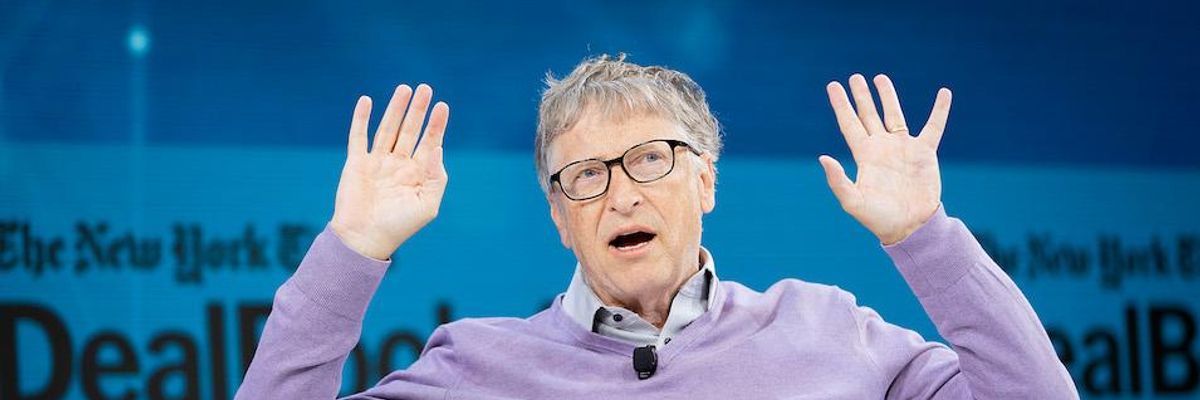
Bill Gates, billionaire, speaks onstage at 2019 New York Times Dealbook on November 06, 2019 in New York City. (Photo: Michael Cohen/Getty Images/The New York Times)
Billionaire Microsoft co-founder Bill Gates on Wednesday told a crowd at a New York Times sponsored conference that a proposed wealth tax from Sen. Elizabeth Warren, a frontrunner for the 2020 Democratic presidential nomination, could take so much money from his vast fortune that he wouldn't know how much was left.
"When you say I should pay $100 billion, then I'm starting to do a little math about what I have left over," said Gates, who prefaced his remarks by saying he was willing to pay $20 billion in taxes.
As Sen. Bernie Sanders (I-Vt.), who is also running for the Democratic nomination for president in 2020, pointed out on Twitter, Gates' fortune is valued at roughly $106.8 billion, leaving $6.8 billion after the hypothetical tax hit.
"Say Bill Gates was actually taxed $100 billion," said Sanders. "We could end homelessness and provide safe drinking water to everyone in this country. Bill would still be a multibillionaire."
Warren, by contrast, rushed to reassure Gates on Twitter that he wouldn't be on the hook for $100 billion and invited the Microsoft founder to meet for a chat where the Massachusetts Democrat could "explain exactly how much you'd pay under my wealth tax."
Gates replied to the senator, saying that the tax discussion was part of an "interesting conversation" on how to solve the myriad issues at play in the primary.
"I greatly respect your commitment to finding ways to address wealth inequality and poverty at home," said Gates. "While we may disagree about some of the ways to get there, we certainly agree we need a lot of smart people committed to finding the path forward."
Progressives found Warren's tone to be too friendly to Gates and politically problematic as it missed the power dynamics in play with Gates' wealth.
"You can't logic Gates out of his class interest," tweeted lawyer and activist Emma Caterine. "This is about power. We need a president who tells the billionaires to suck it up, not one who tries to win them over."
Jacobin writer Luke Savage opined that Warren's response was unlikely to wrest meaningful concessions out of Gates.
"Whatever the intention, this kind of conciliatory posture is not how you promote or pass a wealth tax," said Savage. "Billionaires aren't some innocuous constituency to whom you patiently explain the nuts and bolts of tax policy: they're an illegitimate power bloc to be confronted and beaten."
The wealth in question, according to former Splinter editor Jack Mirkinson, is part of the problem.
"It's a pretty major indictment of American society that Bill Gates even has $100 billion to complain about being taxed on
Even with a wealth tax like the one Gates fears, $6.8 billion for one person is still too much, said 34justice co-founder Ben Spielberg.
"It would be good to also explain to Bill Gates that $6.8 billion--the amount he'd have left if he had to pay $100 billion--is an insane amount of wealth that most people can't even imagine," tweeted Spielberg. "Neither he nor anyone else should be able to have anything close to that amount."
One person on Twitter with the username "San" put the amount of money into perspective by referring to her own financial situation, one more in line with the rest of the world than with Gates--among the wealthiest of the 2,153 billionaires on the planet.
"Saw someone tweet that taxing 100 billion dollars from Bill Gates' $106.8 billion would 'literally' bankrupt him and my bank balance would gently like to tell you to fuck off," San said.
Dear Common Dreams reader, It’s been nearly 30 years since I co-founded Common Dreams with my late wife, Lina Newhouser. We had the radical notion that journalism should serve the public good, not corporate profits. It was clear to us from the outset what it would take to build such a project. No paid advertisements. No corporate sponsors. No millionaire publisher telling us what to think or do. Many people said we wouldn't last a year, but we proved those doubters wrong. Together with a tremendous team of journalists and dedicated staff, we built an independent media outlet free from the constraints of profits and corporate control. Our mission has always been simple: To inform. To inspire. To ignite change for the common good. Building Common Dreams was not easy. Our survival was never guaranteed. When you take on the most powerful forces—Wall Street greed, fossil fuel industry destruction, Big Tech lobbyists, and uber-rich oligarchs who have spent billions upon billions rigging the economy and democracy in their favor—the only bulwark you have is supporters who believe in your work. But here’s the urgent message from me today. It's never been this bad out there. And it's never been this hard to keep us going. At the very moment Common Dreams is most needed, the threats we face are intensifying. We need your support now more than ever. We don't accept corporate advertising and never will. We don't have a paywall because we don't think people should be blocked from critical news based on their ability to pay. Everything we do is funded by the donations of readers like you. When everyone does the little they can afford, we are strong. But if that support retreats or dries up, so do we. Will you donate now to make sure Common Dreams not only survives but thrives? —Craig Brown, Co-founder |
Billionaire Microsoft co-founder Bill Gates on Wednesday told a crowd at a New York Times sponsored conference that a proposed wealth tax from Sen. Elizabeth Warren, a frontrunner for the 2020 Democratic presidential nomination, could take so much money from his vast fortune that he wouldn't know how much was left.
"When you say I should pay $100 billion, then I'm starting to do a little math about what I have left over," said Gates, who prefaced his remarks by saying he was willing to pay $20 billion in taxes.
As Sen. Bernie Sanders (I-Vt.), who is also running for the Democratic nomination for president in 2020, pointed out on Twitter, Gates' fortune is valued at roughly $106.8 billion, leaving $6.8 billion after the hypothetical tax hit.
"Say Bill Gates was actually taxed $100 billion," said Sanders. "We could end homelessness and provide safe drinking water to everyone in this country. Bill would still be a multibillionaire."
Warren, by contrast, rushed to reassure Gates on Twitter that he wouldn't be on the hook for $100 billion and invited the Microsoft founder to meet for a chat where the Massachusetts Democrat could "explain exactly how much you'd pay under my wealth tax."
Gates replied to the senator, saying that the tax discussion was part of an "interesting conversation" on how to solve the myriad issues at play in the primary.
"I greatly respect your commitment to finding ways to address wealth inequality and poverty at home," said Gates. "While we may disagree about some of the ways to get there, we certainly agree we need a lot of smart people committed to finding the path forward."
Progressives found Warren's tone to be too friendly to Gates and politically problematic as it missed the power dynamics in play with Gates' wealth.
"You can't logic Gates out of his class interest," tweeted lawyer and activist Emma Caterine. "This is about power. We need a president who tells the billionaires to suck it up, not one who tries to win them over."
Jacobin writer Luke Savage opined that Warren's response was unlikely to wrest meaningful concessions out of Gates.
"Whatever the intention, this kind of conciliatory posture is not how you promote or pass a wealth tax," said Savage. "Billionaires aren't some innocuous constituency to whom you patiently explain the nuts and bolts of tax policy: they're an illegitimate power bloc to be confronted and beaten."
The wealth in question, according to former Splinter editor Jack Mirkinson, is part of the problem.
"It's a pretty major indictment of American society that Bill Gates even has $100 billion to complain about being taxed on
Even with a wealth tax like the one Gates fears, $6.8 billion for one person is still too much, said 34justice co-founder Ben Spielberg.
"It would be good to also explain to Bill Gates that $6.8 billion--the amount he'd have left if he had to pay $100 billion--is an insane amount of wealth that most people can't even imagine," tweeted Spielberg. "Neither he nor anyone else should be able to have anything close to that amount."
One person on Twitter with the username "San" put the amount of money into perspective by referring to her own financial situation, one more in line with the rest of the world than with Gates--among the wealthiest of the 2,153 billionaires on the planet.
"Saw someone tweet that taxing 100 billion dollars from Bill Gates' $106.8 billion would 'literally' bankrupt him and my bank balance would gently like to tell you to fuck off," San said.
Billionaire Microsoft co-founder Bill Gates on Wednesday told a crowd at a New York Times sponsored conference that a proposed wealth tax from Sen. Elizabeth Warren, a frontrunner for the 2020 Democratic presidential nomination, could take so much money from his vast fortune that he wouldn't know how much was left.
"When you say I should pay $100 billion, then I'm starting to do a little math about what I have left over," said Gates, who prefaced his remarks by saying he was willing to pay $20 billion in taxes.
As Sen. Bernie Sanders (I-Vt.), who is also running for the Democratic nomination for president in 2020, pointed out on Twitter, Gates' fortune is valued at roughly $106.8 billion, leaving $6.8 billion after the hypothetical tax hit.
"Say Bill Gates was actually taxed $100 billion," said Sanders. "We could end homelessness and provide safe drinking water to everyone in this country. Bill would still be a multibillionaire."
Warren, by contrast, rushed to reassure Gates on Twitter that he wouldn't be on the hook for $100 billion and invited the Microsoft founder to meet for a chat where the Massachusetts Democrat could "explain exactly how much you'd pay under my wealth tax."
Gates replied to the senator, saying that the tax discussion was part of an "interesting conversation" on how to solve the myriad issues at play in the primary.
"I greatly respect your commitment to finding ways to address wealth inequality and poverty at home," said Gates. "While we may disagree about some of the ways to get there, we certainly agree we need a lot of smart people committed to finding the path forward."
Progressives found Warren's tone to be too friendly to Gates and politically problematic as it missed the power dynamics in play with Gates' wealth.
"You can't logic Gates out of his class interest," tweeted lawyer and activist Emma Caterine. "This is about power. We need a president who tells the billionaires to suck it up, not one who tries to win them over."
Jacobin writer Luke Savage opined that Warren's response was unlikely to wrest meaningful concessions out of Gates.
"Whatever the intention, this kind of conciliatory posture is not how you promote or pass a wealth tax," said Savage. "Billionaires aren't some innocuous constituency to whom you patiently explain the nuts and bolts of tax policy: they're an illegitimate power bloc to be confronted and beaten."
The wealth in question, according to former Splinter editor Jack Mirkinson, is part of the problem.
"It's a pretty major indictment of American society that Bill Gates even has $100 billion to complain about being taxed on
Even with a wealth tax like the one Gates fears, $6.8 billion for one person is still too much, said 34justice co-founder Ben Spielberg.
"It would be good to also explain to Bill Gates that $6.8 billion--the amount he'd have left if he had to pay $100 billion--is an insane amount of wealth that most people can't even imagine," tweeted Spielberg. "Neither he nor anyone else should be able to have anything close to that amount."
One person on Twitter with the username "San" put the amount of money into perspective by referring to her own financial situation, one more in line with the rest of the world than with Gates--among the wealthiest of the 2,153 billionaires on the planet.
"Saw someone tweet that taxing 100 billion dollars from Bill Gates' $106.8 billion would 'literally' bankrupt him and my bank balance would gently like to tell you to fuck off," San said.