SUBSCRIBE TO OUR FREE NEWSLETTER
Daily news & progressive opinion—funded by the people, not the corporations—delivered straight to your inbox.
5
#000000
#FFFFFF
To donate by check, phone, or other method, see our More Ways to Give page.
Daily news & progressive opinion—funded by the people, not the corporations—delivered straight to your inbox.
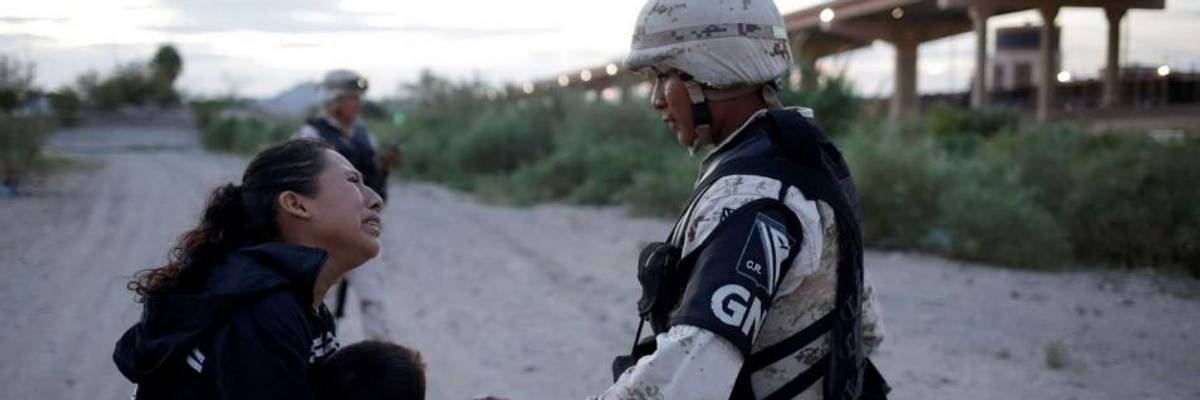
After traveling 1,500 miles from Guatemala to the U.S.-Mexico border, Lety Perez begged a Mexican National Guardsman to allow her to cross into the United States in July. For the first time in three decades, the U.S. resettled zero refugees during the month of October. (Photo: Jose Luis Gonzalez/Reuters)
This October marked the first month in 30 years that the U.S. resettled zero refugees, according to State Department records.
World Relief, which had planned to help more than 100 asylum-seekers reunite with family members already in the U.S. last month, reported that October was the first time since the group began keeping records of refugee resettlement that the U.S. has accepted none of the 26 million people who have fled violence and oppression in their home countries.
"It's a shame that at a time when we're facing the world's worst refugee crisis since World War II, and we're seeing the ongoing new displacement of Syrians, Rohingya, and others, that the U.S. has accepted zero refugees this month, for the first time in our records," said Jenny Yang, vice president of advocacy and policy at World Relief, in a statement released last week. "We should be doing more, not less, and keeping the door open to protect the persecuted who have no safe place to go."
Other critics, including Rep. Barbara Lee (D-Calif.) and the international organization Human Rights First, lamented the news as "shameful" and "outrageous."
The complete lack of asylum extended to refugees by the State Department in October is the result of President Donald Trump's delayed signing of an order, announced in September, capping refugees at 18,000 in 2020--the lowest number since 1980, when the U.S. resettlement program was established.
An ongoing State Department freeze on refugee admissions resulted in hundreds of canceled flights for asylum-seekers planning to come to the U.S. But Los Angeles Times columnist Scott Martelle on Wednesday wrote that the temporary freeze can hardly be written off as a simple bureaucratic oversight.
"This isn't just heartbreaking--it's unjust. Withdrawing our troops from Syria meant unleashing chaos in the region and forcing even more people to flee their homes. To refuse to open our doors is to abdicate responsibility for a scenario to which we as a nation have contributed."
--Scott Arbeiter, World Relief
"The fine details of bureaucratic delay are secondary to the bigger policy issue: the Trump administration has actively sought to throttle back immigration to the U.S., including desperate refugees (many of whom are seeking to reunite with families already here) and would-be lawful immigrants who can't prove they can afford to pay for healthcare when they arrive," Martelle wrote.
Trump's anti-immigration policies have resulted in at least 20,000 asylum seekers and migrants being sent to Mexico where they're forced to wait for their immigration proceedings to begin. Under the policy, thousands of people have been separated from loved ones and subjected to violence and other abuse.
World Relief noted that in addition to turning away asylum-seekers from Central American countries. The administration's rejection of refugees in October followed Trump's withdrawal of troops from Syria, which made way for a Turkish offensive against the Kurds.
"This isn't just heartbreaking--it's unjust," said Scott Arbeiter, president of World Relief. "Withdrawing our troops from Syria meant unleashing chaos in the region and forcing even more people to flee their homes. To refuse to open our doors is to abdicate responsibility for a scenario to which we as a nation have contributed."
Arbeiter called on Trump to set a refugee cap for 2020 far closer to those set in recent years. The U.S. accepted 45,000 asylum-seekers in 2018 and 30,000 in 2019.
"I urge the administration to reconsider its approach and set a cap that better represents the compassion and hospitality of the American people," Arbeiter said.
Dear Common Dreams reader, It’s been nearly 30 years since I co-founded Common Dreams with my late wife, Lina Newhouser. We had the radical notion that journalism should serve the public good, not corporate profits. It was clear to us from the outset what it would take to build such a project. No paid advertisements. No corporate sponsors. No millionaire publisher telling us what to think or do. Many people said we wouldn't last a year, but we proved those doubters wrong. Together with a tremendous team of journalists and dedicated staff, we built an independent media outlet free from the constraints of profits and corporate control. Our mission has always been simple: To inform. To inspire. To ignite change for the common good. Building Common Dreams was not easy. Our survival was never guaranteed. When you take on the most powerful forces—Wall Street greed, fossil fuel industry destruction, Big Tech lobbyists, and uber-rich oligarchs who have spent billions upon billions rigging the economy and democracy in their favor—the only bulwark you have is supporters who believe in your work. But here’s the urgent message from me today. It's never been this bad out there. And it's never been this hard to keep us going. At the very moment Common Dreams is most needed, the threats we face are intensifying. We need your support now more than ever. We don't accept corporate advertising and never will. We don't have a paywall because we don't think people should be blocked from critical news based on their ability to pay. Everything we do is funded by the donations of readers like you. When everyone does the little they can afford, we are strong. But if that support retreats or dries up, so do we. Will you donate now to make sure Common Dreams not only survives but thrives? —Craig Brown, Co-founder |
This October marked the first month in 30 years that the U.S. resettled zero refugees, according to State Department records.
World Relief, which had planned to help more than 100 asylum-seekers reunite with family members already in the U.S. last month, reported that October was the first time since the group began keeping records of refugee resettlement that the U.S. has accepted none of the 26 million people who have fled violence and oppression in their home countries.
"It's a shame that at a time when we're facing the world's worst refugee crisis since World War II, and we're seeing the ongoing new displacement of Syrians, Rohingya, and others, that the U.S. has accepted zero refugees this month, for the first time in our records," said Jenny Yang, vice president of advocacy and policy at World Relief, in a statement released last week. "We should be doing more, not less, and keeping the door open to protect the persecuted who have no safe place to go."
Other critics, including Rep. Barbara Lee (D-Calif.) and the international organization Human Rights First, lamented the news as "shameful" and "outrageous."
The complete lack of asylum extended to refugees by the State Department in October is the result of President Donald Trump's delayed signing of an order, announced in September, capping refugees at 18,000 in 2020--the lowest number since 1980, when the U.S. resettlement program was established.
An ongoing State Department freeze on refugee admissions resulted in hundreds of canceled flights for asylum-seekers planning to come to the U.S. But Los Angeles Times columnist Scott Martelle on Wednesday wrote that the temporary freeze can hardly be written off as a simple bureaucratic oversight.
"This isn't just heartbreaking--it's unjust. Withdrawing our troops from Syria meant unleashing chaos in the region and forcing even more people to flee their homes. To refuse to open our doors is to abdicate responsibility for a scenario to which we as a nation have contributed."
--Scott Arbeiter, World Relief
"The fine details of bureaucratic delay are secondary to the bigger policy issue: the Trump administration has actively sought to throttle back immigration to the U.S., including desperate refugees (many of whom are seeking to reunite with families already here) and would-be lawful immigrants who can't prove they can afford to pay for healthcare when they arrive," Martelle wrote.
Trump's anti-immigration policies have resulted in at least 20,000 asylum seekers and migrants being sent to Mexico where they're forced to wait for their immigration proceedings to begin. Under the policy, thousands of people have been separated from loved ones and subjected to violence and other abuse.
World Relief noted that in addition to turning away asylum-seekers from Central American countries. The administration's rejection of refugees in October followed Trump's withdrawal of troops from Syria, which made way for a Turkish offensive against the Kurds.
"This isn't just heartbreaking--it's unjust," said Scott Arbeiter, president of World Relief. "Withdrawing our troops from Syria meant unleashing chaos in the region and forcing even more people to flee their homes. To refuse to open our doors is to abdicate responsibility for a scenario to which we as a nation have contributed."
Arbeiter called on Trump to set a refugee cap for 2020 far closer to those set in recent years. The U.S. accepted 45,000 asylum-seekers in 2018 and 30,000 in 2019.
"I urge the administration to reconsider its approach and set a cap that better represents the compassion and hospitality of the American people," Arbeiter said.
This October marked the first month in 30 years that the U.S. resettled zero refugees, according to State Department records.
World Relief, which had planned to help more than 100 asylum-seekers reunite with family members already in the U.S. last month, reported that October was the first time since the group began keeping records of refugee resettlement that the U.S. has accepted none of the 26 million people who have fled violence and oppression in their home countries.
"It's a shame that at a time when we're facing the world's worst refugee crisis since World War II, and we're seeing the ongoing new displacement of Syrians, Rohingya, and others, that the U.S. has accepted zero refugees this month, for the first time in our records," said Jenny Yang, vice president of advocacy and policy at World Relief, in a statement released last week. "We should be doing more, not less, and keeping the door open to protect the persecuted who have no safe place to go."
Other critics, including Rep. Barbara Lee (D-Calif.) and the international organization Human Rights First, lamented the news as "shameful" and "outrageous."
The complete lack of asylum extended to refugees by the State Department in October is the result of President Donald Trump's delayed signing of an order, announced in September, capping refugees at 18,000 in 2020--the lowest number since 1980, when the U.S. resettlement program was established.
An ongoing State Department freeze on refugee admissions resulted in hundreds of canceled flights for asylum-seekers planning to come to the U.S. But Los Angeles Times columnist Scott Martelle on Wednesday wrote that the temporary freeze can hardly be written off as a simple bureaucratic oversight.
"This isn't just heartbreaking--it's unjust. Withdrawing our troops from Syria meant unleashing chaos in the region and forcing even more people to flee their homes. To refuse to open our doors is to abdicate responsibility for a scenario to which we as a nation have contributed."
--Scott Arbeiter, World Relief
"The fine details of bureaucratic delay are secondary to the bigger policy issue: the Trump administration has actively sought to throttle back immigration to the U.S., including desperate refugees (many of whom are seeking to reunite with families already here) and would-be lawful immigrants who can't prove they can afford to pay for healthcare when they arrive," Martelle wrote.
Trump's anti-immigration policies have resulted in at least 20,000 asylum seekers and migrants being sent to Mexico where they're forced to wait for their immigration proceedings to begin. Under the policy, thousands of people have been separated from loved ones and subjected to violence and other abuse.
World Relief noted that in addition to turning away asylum-seekers from Central American countries. The administration's rejection of refugees in October followed Trump's withdrawal of troops from Syria, which made way for a Turkish offensive against the Kurds.
"This isn't just heartbreaking--it's unjust," said Scott Arbeiter, president of World Relief. "Withdrawing our troops from Syria meant unleashing chaos in the region and forcing even more people to flee their homes. To refuse to open our doors is to abdicate responsibility for a scenario to which we as a nation have contributed."
Arbeiter called on Trump to set a refugee cap for 2020 far closer to those set in recent years. The U.S. accepted 45,000 asylum-seekers in 2018 and 30,000 in 2019.
"I urge the administration to reconsider its approach and set a cap that better represents the compassion and hospitality of the American people," Arbeiter said.