SUBSCRIBE TO OUR FREE NEWSLETTER
Daily news & progressive opinion—funded by the people, not the corporations—delivered straight to your inbox.
5
#000000
#FFFFFF
To donate by check, phone, or other method, see our More Ways to Give page.
Daily news & progressive opinion—funded by the people, not the corporations—delivered straight to your inbox.
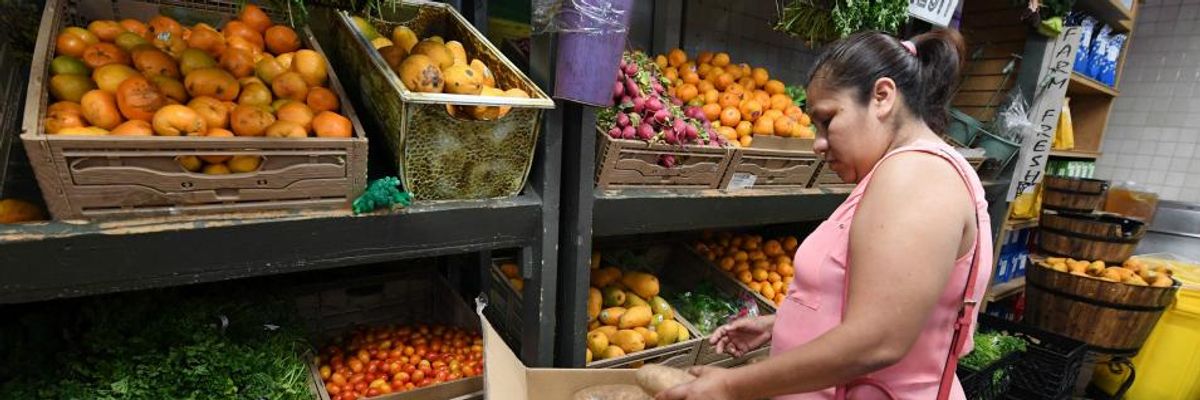
People on low-incomes and retirees choose food at the World Harvest Food Bank in Los Angeles, California on July 24, 2019. (Photo: Mark Ralston/AFP via Getty Images)
A new study published Monday in the journal Health Affairs found that people are less likely to die prematurely if they receive federal nutrition assistance, shedding light on the potentially deadly consequences of President Donald Trump's proposal to strip food stamps from millions of low-income Americans.
Participation in the Supplemental Nutrition Assistance Program (SNAP), the research found, "led to a population-wide reduction of 1-2 percentage points in mortality from all causes and a reduction in specific causes of death among people ages 40-64."
As HuffPost reported, when "looking specifically at deaths of despair--from drug overdoses, alcohol poisoning and suicide--the researchers found that SNAP benefits cut the mortality rate in half, from 1.64% to 0.81%, for people ages 40 to 64."
Rachel West, an economic policy adviser to the House Committee on Education and Labor, said the study confirms the effectiveness of federal food assistance and demonstrates that "cutting SNAP, like Trump is trying to do, will literally result in more people dying before age 65."
"SNAP saves lives," West tweeted.
The study came just days after the end of the public comment period for the Trump administration's proposal to end automatic food stamp eligibility for those receiving other forms of federal and state assistance. The U.S. Department of Agriculture said in July the move would eliminate food stamps benefits for more than three million people.
The proposed rule change could also cause 500,000 children to lose free school meals, the Washington Post reported in September.
"At a time when we're thinking about restricting access to SNAP and its generosity, our [study] speaks to the importance of SNAP to such basic outcomes as mortality," Colleen Heflin, a professor at Syracuse University and co-author of the new study, told HuffPost.
NPR reported last week that most of the 170,000 public comments on the Trump administration's food stamps proposal were negative.
"There is no excuse that in our first world country we have children who are malnourished," commented Eric Failing, executive director of the Pennsylvania Catholic Conference. "Yet this proposed rule, rather than helping to address these issues, will make them far worse."
Dear Common Dreams reader, It’s been nearly 30 years since I co-founded Common Dreams with my late wife, Lina Newhouser. We had the radical notion that journalism should serve the public good, not corporate profits. It was clear to us from the outset what it would take to build such a project. No paid advertisements. No corporate sponsors. No millionaire publisher telling us what to think or do. Many people said we wouldn't last a year, but we proved those doubters wrong. Together with a tremendous team of journalists and dedicated staff, we built an independent media outlet free from the constraints of profits and corporate control. Our mission has always been simple: To inform. To inspire. To ignite change for the common good. Building Common Dreams was not easy. Our survival was never guaranteed. When you take on the most powerful forces—Wall Street greed, fossil fuel industry destruction, Big Tech lobbyists, and uber-rich oligarchs who have spent billions upon billions rigging the economy and democracy in their favor—the only bulwark you have is supporters who believe in your work. But here’s the urgent message from me today. It's never been this bad out there. And it's never been this hard to keep us going. At the very moment Common Dreams is most needed, the threats we face are intensifying. We need your support now more than ever. We don't accept corporate advertising and never will. We don't have a paywall because we don't think people should be blocked from critical news based on their ability to pay. Everything we do is funded by the donations of readers like you. When everyone does the little they can afford, we are strong. But if that support retreats or dries up, so do we. Will you donate now to make sure Common Dreams not only survives but thrives? —Craig Brown, Co-founder |
A new study published Monday in the journal Health Affairs found that people are less likely to die prematurely if they receive federal nutrition assistance, shedding light on the potentially deadly consequences of President Donald Trump's proposal to strip food stamps from millions of low-income Americans.
Participation in the Supplemental Nutrition Assistance Program (SNAP), the research found, "led to a population-wide reduction of 1-2 percentage points in mortality from all causes and a reduction in specific causes of death among people ages 40-64."
As HuffPost reported, when "looking specifically at deaths of despair--from drug overdoses, alcohol poisoning and suicide--the researchers found that SNAP benefits cut the mortality rate in half, from 1.64% to 0.81%, for people ages 40 to 64."
Rachel West, an economic policy adviser to the House Committee on Education and Labor, said the study confirms the effectiveness of federal food assistance and demonstrates that "cutting SNAP, like Trump is trying to do, will literally result in more people dying before age 65."
"SNAP saves lives," West tweeted.
The study came just days after the end of the public comment period for the Trump administration's proposal to end automatic food stamp eligibility for those receiving other forms of federal and state assistance. The U.S. Department of Agriculture said in July the move would eliminate food stamps benefits for more than three million people.
The proposed rule change could also cause 500,000 children to lose free school meals, the Washington Post reported in September.
"At a time when we're thinking about restricting access to SNAP and its generosity, our [study] speaks to the importance of SNAP to such basic outcomes as mortality," Colleen Heflin, a professor at Syracuse University and co-author of the new study, told HuffPost.
NPR reported last week that most of the 170,000 public comments on the Trump administration's food stamps proposal were negative.
"There is no excuse that in our first world country we have children who are malnourished," commented Eric Failing, executive director of the Pennsylvania Catholic Conference. "Yet this proposed rule, rather than helping to address these issues, will make them far worse."
A new study published Monday in the journal Health Affairs found that people are less likely to die prematurely if they receive federal nutrition assistance, shedding light on the potentially deadly consequences of President Donald Trump's proposal to strip food stamps from millions of low-income Americans.
Participation in the Supplemental Nutrition Assistance Program (SNAP), the research found, "led to a population-wide reduction of 1-2 percentage points in mortality from all causes and a reduction in specific causes of death among people ages 40-64."
As HuffPost reported, when "looking specifically at deaths of despair--from drug overdoses, alcohol poisoning and suicide--the researchers found that SNAP benefits cut the mortality rate in half, from 1.64% to 0.81%, for people ages 40 to 64."
Rachel West, an economic policy adviser to the House Committee on Education and Labor, said the study confirms the effectiveness of federal food assistance and demonstrates that "cutting SNAP, like Trump is trying to do, will literally result in more people dying before age 65."
"SNAP saves lives," West tweeted.
The study came just days after the end of the public comment period for the Trump administration's proposal to end automatic food stamp eligibility for those receiving other forms of federal and state assistance. The U.S. Department of Agriculture said in July the move would eliminate food stamps benefits for more than three million people.
The proposed rule change could also cause 500,000 children to lose free school meals, the Washington Post reported in September.
"At a time when we're thinking about restricting access to SNAP and its generosity, our [study] speaks to the importance of SNAP to such basic outcomes as mortality," Colleen Heflin, a professor at Syracuse University and co-author of the new study, told HuffPost.
NPR reported last week that most of the 170,000 public comments on the Trump administration's food stamps proposal were negative.
"There is no excuse that in our first world country we have children who are malnourished," commented Eric Failing, executive director of the Pennsylvania Catholic Conference. "Yet this proposed rule, rather than helping to address these issues, will make them far worse."