SUBSCRIBE TO OUR FREE NEWSLETTER
Daily news & progressive opinion—funded by the people, not the corporations—delivered straight to your inbox.
5
#000000
#FFFFFF
To donate by check, phone, or other method, see our More Ways to Give page.
Daily news & progressive opinion—funded by the people, not the corporations—delivered straight to your inbox.
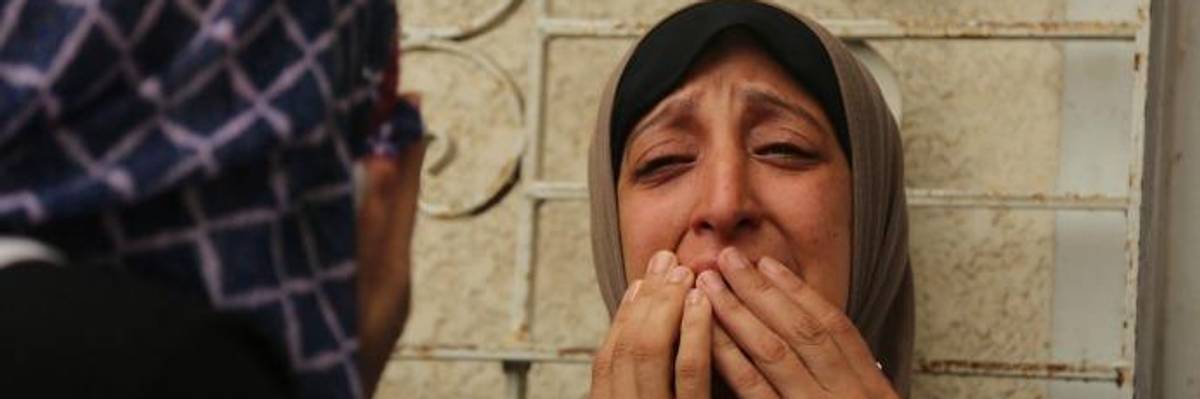
Palestinians and relatives mourn over the death of 15-year-old protester Othman Rami Halles during his funeral east of Gaza City on July 14, 2018. A Palestinian teenager was shot dead Friday by Israeli soldiers during clashes near the Gaza Strip's border with Israel, the territory's health ministry said. Fifteen-year-old Othman Rami Halles was killed east of Gaza City, while 25 other Palestinians were wounded as protests along the frontier spilt over into clashes, ministry spokesman Ashraf Al-Qodra said. (Photo: Majdi Fathi/NurPhoto via Getty Images)
An Israeli soldier who shot dead a Palestinian child during the Great March of Return protests last year was sentenced Monday to one month of community service.
Author and Electronic Intifada co-founder Ali Abunimah called the military court's action a "rare conviction and an obvious travesty attempting to fool the International Criminal Court that the criminal occupier can police itself."
The deadly incident--just one of hundreds in which Israeli forces used lethal violence against protesters in the series of protests along the fenced border of the Gaza Strip--took place July 13, 2018, when the Israeli solder shot 15-year-old "plainly unarmed" Osman Rami Halas.
As Haaretz reported:
Video uploaded to social media shows Halas standing by the separation fence with near several women and children waving Palestinian flags. At some stage, he is seen trying to climb the fence and then falling to the ground. He was shot in the torso and his death was declared shortly afterward in the field.
The soldier, whose name is blocked under a gag order, was convicted not for firing but for doing so "without receiving the required permission from his commanders," according to a statement from the military quoted by The Times of Israel.
"The soldier was not convicted of a more serious offense like manslaughter," the news outlet added, "as military prosecutors were unable to collect sufficient evidence connecting his gunshot to Halas' death."
The outcome, Haaretz noted, marks a plea bargain in which the soldier was sentenced to "a month of the military's equivalent of community service, and a downgrade to the rank of private, for endangering a life by deviating from orders."
"This makes a mockery of justice," tweeted Yousef Munayyer, the exeuctive director of the U.S. Campaign for Palestinian Rights. "This soldier got in trouble for not waiting his turn."
"This is what apartheid looks like," opined Portugal-based researcher Adam al-Alou.
What's more, warned the Geneva-based Euro-Mediterranean Human Rights Monitor, the light conviction could open the floodgates for similar shootings by Israeli soldiers. In a statement released Wednesday, the group said:
While holding Israeli soldiers accountable for crimes perpetrated against Palestinians is a step in the right direction, the Euro-Mediterranean Human Rights Monitor finds the sentencing to be entirely disproportionate with the criminal act of killing an unarmed child protester, and may encourage other IDF soldiers to follow the lead of the incriminated sniper, knowing that the consequences are negligible and lenient.
Therefore, calls for greater sanctions on Israeli soldiers who unlawfully kill Palestinians. A month of community service for the death of a person is not deterrent enough to stop the killings.
Israeli security forces operate with near impunity, facing few repercussions for abusive and illegal actions, such as beatings and killings. The Euro-Med Monitor is concerned that the court's decision will encourage further killings and questions the impartiality of the Israeli judiciary.
On the one-year anniversary of the protests in March, human rights group Amnesty International condemned what it called "Israel's ruthless tactics without accountability" towards the Palestinian protestors.
"The shocking scale and horrific nature of the debilitating injuries inflicted by Israeli forces on Palestinian protesters in Gaza last year suggests Israel pursued a deliberate strategy to maim civilians," Saleh Higazi, Middle East and North Africa Deputy director for Amnesty International, said at the time.
A United Nations inquiry into the Gaza protests released in February also found there were "reasonable grounds" to believe "Israeli soldiers committed violations of international human rights and humanitarian law. Some of those violations may constitute war crimes or crimes against humanity."
Dear Common Dreams reader, It’s been nearly 30 years since I co-founded Common Dreams with my late wife, Lina Newhouser. We had the radical notion that journalism should serve the public good, not corporate profits. It was clear to us from the outset what it would take to build such a project. No paid advertisements. No corporate sponsors. No millionaire publisher telling us what to think or do. Many people said we wouldn't last a year, but we proved those doubters wrong. Together with a tremendous team of journalists and dedicated staff, we built an independent media outlet free from the constraints of profits and corporate control. Our mission has always been simple: To inform. To inspire. To ignite change for the common good. Building Common Dreams was not easy. Our survival was never guaranteed. When you take on the most powerful forces—Wall Street greed, fossil fuel industry destruction, Big Tech lobbyists, and uber-rich oligarchs who have spent billions upon billions rigging the economy and democracy in their favor—the only bulwark you have is supporters who believe in your work. But here’s the urgent message from me today. It's never been this bad out there. And it's never been this hard to keep us going. At the very moment Common Dreams is most needed, the threats we face are intensifying. We need your support now more than ever. We don't accept corporate advertising and never will. We don't have a paywall because we don't think people should be blocked from critical news based on their ability to pay. Everything we do is funded by the donations of readers like you. When everyone does the little they can afford, we are strong. But if that support retreats or dries up, so do we. Will you donate now to make sure Common Dreams not only survives but thrives? —Craig Brown, Co-founder |
An Israeli soldier who shot dead a Palestinian child during the Great March of Return protests last year was sentenced Monday to one month of community service.
Author and Electronic Intifada co-founder Ali Abunimah called the military court's action a "rare conviction and an obvious travesty attempting to fool the International Criminal Court that the criminal occupier can police itself."
The deadly incident--just one of hundreds in which Israeli forces used lethal violence against protesters in the series of protests along the fenced border of the Gaza Strip--took place July 13, 2018, when the Israeli solder shot 15-year-old "plainly unarmed" Osman Rami Halas.
As Haaretz reported:
Video uploaded to social media shows Halas standing by the separation fence with near several women and children waving Palestinian flags. At some stage, he is seen trying to climb the fence and then falling to the ground. He was shot in the torso and his death was declared shortly afterward in the field.
The soldier, whose name is blocked under a gag order, was convicted not for firing but for doing so "without receiving the required permission from his commanders," according to a statement from the military quoted by The Times of Israel.
"The soldier was not convicted of a more serious offense like manslaughter," the news outlet added, "as military prosecutors were unable to collect sufficient evidence connecting his gunshot to Halas' death."
The outcome, Haaretz noted, marks a plea bargain in which the soldier was sentenced to "a month of the military's equivalent of community service, and a downgrade to the rank of private, for endangering a life by deviating from orders."
"This makes a mockery of justice," tweeted Yousef Munayyer, the exeuctive director of the U.S. Campaign for Palestinian Rights. "This soldier got in trouble for not waiting his turn."
"This is what apartheid looks like," opined Portugal-based researcher Adam al-Alou.
What's more, warned the Geneva-based Euro-Mediterranean Human Rights Monitor, the light conviction could open the floodgates for similar shootings by Israeli soldiers. In a statement released Wednesday, the group said:
While holding Israeli soldiers accountable for crimes perpetrated against Palestinians is a step in the right direction, the Euro-Mediterranean Human Rights Monitor finds the sentencing to be entirely disproportionate with the criminal act of killing an unarmed child protester, and may encourage other IDF soldiers to follow the lead of the incriminated sniper, knowing that the consequences are negligible and lenient.
Therefore, calls for greater sanctions on Israeli soldiers who unlawfully kill Palestinians. A month of community service for the death of a person is not deterrent enough to stop the killings.
Israeli security forces operate with near impunity, facing few repercussions for abusive and illegal actions, such as beatings and killings. The Euro-Med Monitor is concerned that the court's decision will encourage further killings and questions the impartiality of the Israeli judiciary.
On the one-year anniversary of the protests in March, human rights group Amnesty International condemned what it called "Israel's ruthless tactics without accountability" towards the Palestinian protestors.
"The shocking scale and horrific nature of the debilitating injuries inflicted by Israeli forces on Palestinian protesters in Gaza last year suggests Israel pursued a deliberate strategy to maim civilians," Saleh Higazi, Middle East and North Africa Deputy director for Amnesty International, said at the time.
A United Nations inquiry into the Gaza protests released in February also found there were "reasonable grounds" to believe "Israeli soldiers committed violations of international human rights and humanitarian law. Some of those violations may constitute war crimes or crimes against humanity."
An Israeli soldier who shot dead a Palestinian child during the Great March of Return protests last year was sentenced Monday to one month of community service.
Author and Electronic Intifada co-founder Ali Abunimah called the military court's action a "rare conviction and an obvious travesty attempting to fool the International Criminal Court that the criminal occupier can police itself."
The deadly incident--just one of hundreds in which Israeli forces used lethal violence against protesters in the series of protests along the fenced border of the Gaza Strip--took place July 13, 2018, when the Israeli solder shot 15-year-old "plainly unarmed" Osman Rami Halas.
As Haaretz reported:
Video uploaded to social media shows Halas standing by the separation fence with near several women and children waving Palestinian flags. At some stage, he is seen trying to climb the fence and then falling to the ground. He was shot in the torso and his death was declared shortly afterward in the field.
The soldier, whose name is blocked under a gag order, was convicted not for firing but for doing so "without receiving the required permission from his commanders," according to a statement from the military quoted by The Times of Israel.
"The soldier was not convicted of a more serious offense like manslaughter," the news outlet added, "as military prosecutors were unable to collect sufficient evidence connecting his gunshot to Halas' death."
The outcome, Haaretz noted, marks a plea bargain in which the soldier was sentenced to "a month of the military's equivalent of community service, and a downgrade to the rank of private, for endangering a life by deviating from orders."
"This makes a mockery of justice," tweeted Yousef Munayyer, the exeuctive director of the U.S. Campaign for Palestinian Rights. "This soldier got in trouble for not waiting his turn."
"This is what apartheid looks like," opined Portugal-based researcher Adam al-Alou.
What's more, warned the Geneva-based Euro-Mediterranean Human Rights Monitor, the light conviction could open the floodgates for similar shootings by Israeli soldiers. In a statement released Wednesday, the group said:
While holding Israeli soldiers accountable for crimes perpetrated against Palestinians is a step in the right direction, the Euro-Mediterranean Human Rights Monitor finds the sentencing to be entirely disproportionate with the criminal act of killing an unarmed child protester, and may encourage other IDF soldiers to follow the lead of the incriminated sniper, knowing that the consequences are negligible and lenient.
Therefore, calls for greater sanctions on Israeli soldiers who unlawfully kill Palestinians. A month of community service for the death of a person is not deterrent enough to stop the killings.
Israeli security forces operate with near impunity, facing few repercussions for abusive and illegal actions, such as beatings and killings. The Euro-Med Monitor is concerned that the court's decision will encourage further killings and questions the impartiality of the Israeli judiciary.
On the one-year anniversary of the protests in March, human rights group Amnesty International condemned what it called "Israel's ruthless tactics without accountability" towards the Palestinian protestors.
"The shocking scale and horrific nature of the debilitating injuries inflicted by Israeli forces on Palestinian protesters in Gaza last year suggests Israel pursued a deliberate strategy to maim civilians," Saleh Higazi, Middle East and North Africa Deputy director for Amnesty International, said at the time.
A United Nations inquiry into the Gaza protests released in February also found there were "reasonable grounds" to believe "Israeli soldiers committed violations of international human rights and humanitarian law. Some of those violations may constitute war crimes or crimes against humanity."