SUBSCRIBE TO OUR FREE NEWSLETTER
Daily news & progressive opinion—funded by the people, not the corporations—delivered straight to your inbox.
5
#000000
#FFFFFF
To donate by check, phone, or other method, see our More Ways to Give page.
Daily news & progressive opinion—funded by the people, not the corporations—delivered straight to your inbox.
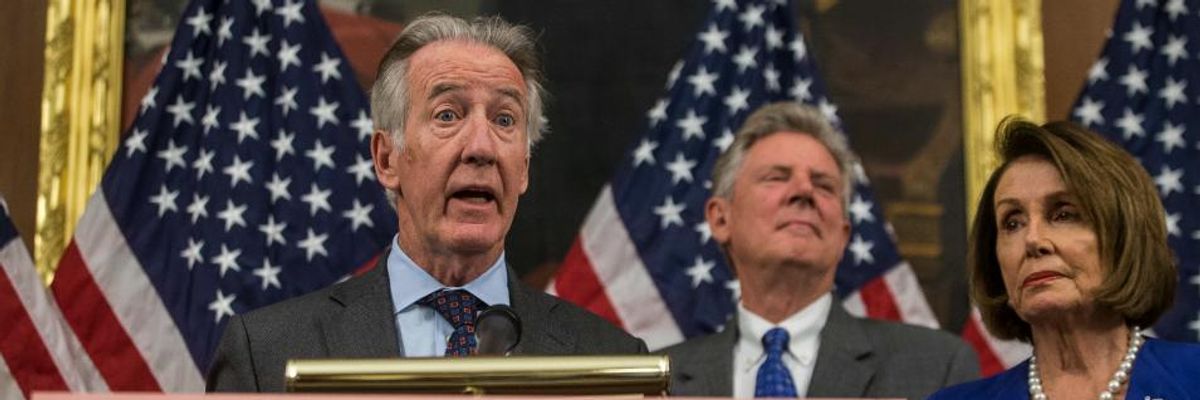
Rep. Richard Neal (D-Mass.) speaks as Rep. Frank Pallone (D-N.J.) and House Speaker Nancy Pelosi (D-Calif.) look on during a news conference discussing H.R. 3, the Lower Drug Costs Now Act, on Capitol Hill on October 16, 2019 in Washington, D.C. (Photo: Zach Gibson/Getty Images)
Following the lead of pharma-friendly Rep. Richard Neal, Democrats on the House Ways and Means Committee this week crushed several progressive amendments to a House drug pricing bill that would have expanded the number of medicines covered by the legislation and extended lower costs to the nation's tens of millions of uninsured.
The Intercept reported Wednesday that Neal, a Massachusetts Democrat and chairman of the Ways and Means Committee, warned his Democratic colleagues against offering any amendments to the Lower Drug Costs Now Act of 2019 (H.R. 3) during the committee's markup of the legislation on Tuesday.
"The chances that the typical patient will see their prices lowered are akin to winning the lottery. Is it so burdensome to ask that a few more drugs be done? No, it's not."
--Rep. Lloyd Doggett
"We intend to stick with the measure in front of us," Neal told The Hill.
But Rep. Lloyd Doggett (D-Texas), the author of a more ambitious drug pricing bill that House Speaker Nancy Pelosi in April brushed aside in favor of the more moderate H.R. 3, introduced amendments anyway during the marathon hearing.
If adopted, Doggett's amendments would have raised the minimum number of drugs the government would be required to negotiate under the legislation from 35 to 50 and guaranteed that the approximately 30 million people without health insurance in the U.S. would benefit from the lower negotiated rates.
"The chances that the typical patient will see their prices lowered are akin to winning the lottery," Doggett said. "Is it so burdensome to ask that a few more drugs be done? No, it's not."
Despite Doggett's plea, most House Democrats on the committee followed Neal's lead in rejecting the amendments. The legislation passed out of the Ways and Means Committee late Tuesday by a vote of 24-7-1, with Doggett the lone member voting present.
Under the current version of H.R. 3, it would take the government over 100 years to negotiate lower prices for all of the prescription drugs covered by Medicare, Doggett said in a document summarizing his issues with the bill.
"My objective is not to let the perfect get in the way of the good, but to ensure that the good we seek actually reaches those whom we serve," Doggett wrote in a Dear Colleague letter (pdf) in September. "In short, more work and amendments are needed to make H.R. 3 effective in achieving our shared objective of lowering drug prices for American families."
The Intercept's Aida Chavez reported that Neal "is one of the biggest beneficiaries" of campaign cash from the pharmaceutical and insurance industries.
"According to Kaiser Health News," Chavez noted, "he's received $670,100 in campaign contributions from pharmaceutical companies since 2007."
Chavez's colleague Ryan Grim was among those noting that Neal is currently facing a primary challenge from his left flank:
Donald Shaw, reporter with the investigative outlet Sludge, highlighted the slew of major pharmaceutical companies that have donated to Neal just this year:
As Common Dreams reported in June, progressives accused Pelosi of cutting them out of negotiations over the details of H.R. 3 and warned the bill would be far too soft on the pharmaceutical industry.
"If we don't address this in a big and bold way, a lot of us should go home and start knitting," Rep. Mark Pocan (D-Wis.), co-chair of the Congressional Progressive Caucus, told reporters at the time.
Progressives were ultimately able to win minor concessions from leadership, such as raising from 25 to 35 the minimum number of drugs the government must negotiate under the bill.
When Pelosi finally unveiled the H.R. 3 in September, advocacy groups cautiously applauded the measure but said improvements would be necessary to make a significant dent in soaring drug prices.
"Fundamentally, high medicine prices are rooted in the monopoly powers our government grants to prescription drug corporations," Peter Maybarduk, director of Public Citizen's Access to Medicines Program, said in a statement. "Making medicine affordable for everyone requires that we challenge this power."
Dear Common Dreams reader, It’s been nearly 30 years since I co-founded Common Dreams with my late wife, Lina Newhouser. We had the radical notion that journalism should serve the public good, not corporate profits. It was clear to us from the outset what it would take to build such a project. No paid advertisements. No corporate sponsors. No millionaire publisher telling us what to think or do. Many people said we wouldn't last a year, but we proved those doubters wrong. Together with a tremendous team of journalists and dedicated staff, we built an independent media outlet free from the constraints of profits and corporate control. Our mission has always been simple: To inform. To inspire. To ignite change for the common good. Building Common Dreams was not easy. Our survival was never guaranteed. When you take on the most powerful forces—Wall Street greed, fossil fuel industry destruction, Big Tech lobbyists, and uber-rich oligarchs who have spent billions upon billions rigging the economy and democracy in their favor—the only bulwark you have is supporters who believe in your work. But here’s the urgent message from me today. It's never been this bad out there. And it's never been this hard to keep us going. At the very moment Common Dreams is most needed, the threats we face are intensifying. We need your support now more than ever. We don't accept corporate advertising and never will. We don't have a paywall because we don't think people should be blocked from critical news based on their ability to pay. Everything we do is funded by the donations of readers like you. When everyone does the little they can afford, we are strong. But if that support retreats or dries up, so do we. Will you donate now to make sure Common Dreams not only survives but thrives? —Craig Brown, Co-founder |
Following the lead of pharma-friendly Rep. Richard Neal, Democrats on the House Ways and Means Committee this week crushed several progressive amendments to a House drug pricing bill that would have expanded the number of medicines covered by the legislation and extended lower costs to the nation's tens of millions of uninsured.
The Intercept reported Wednesday that Neal, a Massachusetts Democrat and chairman of the Ways and Means Committee, warned his Democratic colleagues against offering any amendments to the Lower Drug Costs Now Act of 2019 (H.R. 3) during the committee's markup of the legislation on Tuesday.
"The chances that the typical patient will see their prices lowered are akin to winning the lottery. Is it so burdensome to ask that a few more drugs be done? No, it's not."
--Rep. Lloyd Doggett
"We intend to stick with the measure in front of us," Neal told The Hill.
But Rep. Lloyd Doggett (D-Texas), the author of a more ambitious drug pricing bill that House Speaker Nancy Pelosi in April brushed aside in favor of the more moderate H.R. 3, introduced amendments anyway during the marathon hearing.
If adopted, Doggett's amendments would have raised the minimum number of drugs the government would be required to negotiate under the legislation from 35 to 50 and guaranteed that the approximately 30 million people without health insurance in the U.S. would benefit from the lower negotiated rates.
"The chances that the typical patient will see their prices lowered are akin to winning the lottery," Doggett said. "Is it so burdensome to ask that a few more drugs be done? No, it's not."
Despite Doggett's plea, most House Democrats on the committee followed Neal's lead in rejecting the amendments. The legislation passed out of the Ways and Means Committee late Tuesday by a vote of 24-7-1, with Doggett the lone member voting present.
Under the current version of H.R. 3, it would take the government over 100 years to negotiate lower prices for all of the prescription drugs covered by Medicare, Doggett said in a document summarizing his issues with the bill.
"My objective is not to let the perfect get in the way of the good, but to ensure that the good we seek actually reaches those whom we serve," Doggett wrote in a Dear Colleague letter (pdf) in September. "In short, more work and amendments are needed to make H.R. 3 effective in achieving our shared objective of lowering drug prices for American families."
The Intercept's Aida Chavez reported that Neal "is one of the biggest beneficiaries" of campaign cash from the pharmaceutical and insurance industries.
"According to Kaiser Health News," Chavez noted, "he's received $670,100 in campaign contributions from pharmaceutical companies since 2007."
Chavez's colleague Ryan Grim was among those noting that Neal is currently facing a primary challenge from his left flank:
Donald Shaw, reporter with the investigative outlet Sludge, highlighted the slew of major pharmaceutical companies that have donated to Neal just this year:
As Common Dreams reported in June, progressives accused Pelosi of cutting them out of negotiations over the details of H.R. 3 and warned the bill would be far too soft on the pharmaceutical industry.
"If we don't address this in a big and bold way, a lot of us should go home and start knitting," Rep. Mark Pocan (D-Wis.), co-chair of the Congressional Progressive Caucus, told reporters at the time.
Progressives were ultimately able to win minor concessions from leadership, such as raising from 25 to 35 the minimum number of drugs the government must negotiate under the bill.
When Pelosi finally unveiled the H.R. 3 in September, advocacy groups cautiously applauded the measure but said improvements would be necessary to make a significant dent in soaring drug prices.
"Fundamentally, high medicine prices are rooted in the monopoly powers our government grants to prescription drug corporations," Peter Maybarduk, director of Public Citizen's Access to Medicines Program, said in a statement. "Making medicine affordable for everyone requires that we challenge this power."
Following the lead of pharma-friendly Rep. Richard Neal, Democrats on the House Ways and Means Committee this week crushed several progressive amendments to a House drug pricing bill that would have expanded the number of medicines covered by the legislation and extended lower costs to the nation's tens of millions of uninsured.
The Intercept reported Wednesday that Neal, a Massachusetts Democrat and chairman of the Ways and Means Committee, warned his Democratic colleagues against offering any amendments to the Lower Drug Costs Now Act of 2019 (H.R. 3) during the committee's markup of the legislation on Tuesday.
"The chances that the typical patient will see their prices lowered are akin to winning the lottery. Is it so burdensome to ask that a few more drugs be done? No, it's not."
--Rep. Lloyd Doggett
"We intend to stick with the measure in front of us," Neal told The Hill.
But Rep. Lloyd Doggett (D-Texas), the author of a more ambitious drug pricing bill that House Speaker Nancy Pelosi in April brushed aside in favor of the more moderate H.R. 3, introduced amendments anyway during the marathon hearing.
If adopted, Doggett's amendments would have raised the minimum number of drugs the government would be required to negotiate under the legislation from 35 to 50 and guaranteed that the approximately 30 million people without health insurance in the U.S. would benefit from the lower negotiated rates.
"The chances that the typical patient will see their prices lowered are akin to winning the lottery," Doggett said. "Is it so burdensome to ask that a few more drugs be done? No, it's not."
Despite Doggett's plea, most House Democrats on the committee followed Neal's lead in rejecting the amendments. The legislation passed out of the Ways and Means Committee late Tuesday by a vote of 24-7-1, with Doggett the lone member voting present.
Under the current version of H.R. 3, it would take the government over 100 years to negotiate lower prices for all of the prescription drugs covered by Medicare, Doggett said in a document summarizing his issues with the bill.
"My objective is not to let the perfect get in the way of the good, but to ensure that the good we seek actually reaches those whom we serve," Doggett wrote in a Dear Colleague letter (pdf) in September. "In short, more work and amendments are needed to make H.R. 3 effective in achieving our shared objective of lowering drug prices for American families."
The Intercept's Aida Chavez reported that Neal "is one of the biggest beneficiaries" of campaign cash from the pharmaceutical and insurance industries.
"According to Kaiser Health News," Chavez noted, "he's received $670,100 in campaign contributions from pharmaceutical companies since 2007."
Chavez's colleague Ryan Grim was among those noting that Neal is currently facing a primary challenge from his left flank:
Donald Shaw, reporter with the investigative outlet Sludge, highlighted the slew of major pharmaceutical companies that have donated to Neal just this year:
As Common Dreams reported in June, progressives accused Pelosi of cutting them out of negotiations over the details of H.R. 3 and warned the bill would be far too soft on the pharmaceutical industry.
"If we don't address this in a big and bold way, a lot of us should go home and start knitting," Rep. Mark Pocan (D-Wis.), co-chair of the Congressional Progressive Caucus, told reporters at the time.
Progressives were ultimately able to win minor concessions from leadership, such as raising from 25 to 35 the minimum number of drugs the government must negotiate under the bill.
When Pelosi finally unveiled the H.R. 3 in September, advocacy groups cautiously applauded the measure but said improvements would be necessary to make a significant dent in soaring drug prices.
"Fundamentally, high medicine prices are rooted in the monopoly powers our government grants to prescription drug corporations," Peter Maybarduk, director of Public Citizen's Access to Medicines Program, said in a statement. "Making medicine affordable for everyone requires that we challenge this power."