SUBSCRIBE TO OUR FREE NEWSLETTER
Daily news & progressive opinion—funded by the people, not the corporations—delivered straight to your inbox.
5
#000000
#FFFFFF
To donate by check, phone, or other method, see our More Ways to Give page.
Daily news & progressive opinion—funded by the people, not the corporations—delivered straight to your inbox.
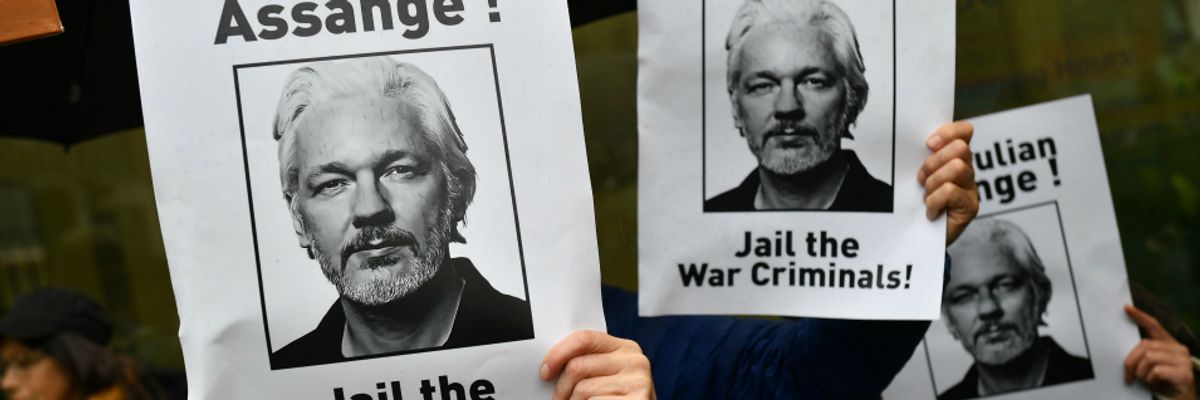
Demonstrators protest outside Westminster Magistrates Court in London on October 21, 2019, where WikiLeaks founder Julian Assange has been attending a case management hearing as he fights extradition to the United States. (Photo: Isabel Infantes/AFP via Getty Images)
Lawyers for WikiLeaks founder Julian Assange on Monday warned of potentially devastating consequences for journalism around the world after a British judge denied Assange's request to delay his U.S. extradition hearing in February.
Assange struggled to say his own name and date of birth during the hearing at Westminster Magistrates' Court in London.
"I can't think properly," Assange told Judge Vanessa Baraitser.
The WikiLeaks publisher has been behind bars since he was dragged out of the Ecuadorian Embassy by U.K. police. Supporters say Assange's waning physical and mental condition is a consequence of his prolonged isolation, which the United Nations condemned as torture.
"It's a political attempt to signal to journalists the consequences of publishing information. It's legally unprecedented."
--Mark Summers, lawyer for Julian Assange
Assange's legal team requested a three-month delay to submit new evidence in the U.S. extradition case, including reports that a Spanish security firm spied on Assange on behalf of U.S. intelligence agencies. The allegation is the subject of an ongoing investigation by the Spanish National Court.
If Assange is sent back to the U.S., he could face up to 175 years in prison on more than a dozen charges related to WikiLeaks' publication of classified documents that exposed American war crimes and other state secrets.
"I don't understand how this is equitable," Assange said Monday. "This superpower had 10 years to prepare for this case and I can't access my writings. It's very difficult where I am to do anything but these people have unlimited resources."
"They are saying journalists and whistleblowers are enemies of the people," Assange said of the Trump administration. "They have unfair advantages dealing with documents. They [know] the interior of my life with my psychologist. They steal my children's DNA. This is not equitable what is happening here."
Mark Summers, one of Assange's lawyers, called the U.S. extradition effort "a political attempt to signal to journalists the consequences of publishing information."
"It's legally unprecedented," said Summers. "This is part of an avowed war on whistleblowers to include investigative journalists and publishers."
This country and this world are at a monumental crossroads. US voters have an opportunity to beat back the forces of fascism and confront the billionaires who are rigging the economy, our media system, and our democracy, making it increasingly impossible for ordinary people to get by. We’re not just talking about the election. We’re talking about what must be done once these fascist elements are vanquished from power. We need a bolder set of solutions than what either major party has so far been willing to offer and a working-class movement ready to fight like hell for it. Trump didn't emerge from nowhere. The conditions that fueled MAGA authoritarianism were created by decades of radical neoliberal economic policies and a corrupt political system dominated by corporate interests. They slashed taxes on the super-rich, promising that the benefits would trickle down. They said giveaways to the corporate titans would make life more affordable for the rest of us. It was all bullshit. And when a bitter, betrayed populace searches for someone to blame, right-wing demagogues have little trouble finding scapegoats. People know when they're being lied to, but you won't hear any of this from the corporate media. Only independent journalism—powered and funded by people who believe in building a better world—can deliver truly trustworthy daily news. If you share our vision, please contribute whatever you can to sustain our work. |
Lawyers for WikiLeaks founder Julian Assange on Monday warned of potentially devastating consequences for journalism around the world after a British judge denied Assange's request to delay his U.S. extradition hearing in February.
Assange struggled to say his own name and date of birth during the hearing at Westminster Magistrates' Court in London.
"I can't think properly," Assange told Judge Vanessa Baraitser.
The WikiLeaks publisher has been behind bars since he was dragged out of the Ecuadorian Embassy by U.K. police. Supporters say Assange's waning physical and mental condition is a consequence of his prolonged isolation, which the United Nations condemned as torture.
"It's a political attempt to signal to journalists the consequences of publishing information. It's legally unprecedented."
--Mark Summers, lawyer for Julian Assange
Assange's legal team requested a three-month delay to submit new evidence in the U.S. extradition case, including reports that a Spanish security firm spied on Assange on behalf of U.S. intelligence agencies. The allegation is the subject of an ongoing investigation by the Spanish National Court.
If Assange is sent back to the U.S., he could face up to 175 years in prison on more than a dozen charges related to WikiLeaks' publication of classified documents that exposed American war crimes and other state secrets.
"I don't understand how this is equitable," Assange said Monday. "This superpower had 10 years to prepare for this case and I can't access my writings. It's very difficult where I am to do anything but these people have unlimited resources."
"They are saying journalists and whistleblowers are enemies of the people," Assange said of the Trump administration. "They have unfair advantages dealing with documents. They [know] the interior of my life with my psychologist. They steal my children's DNA. This is not equitable what is happening here."
Mark Summers, one of Assange's lawyers, called the U.S. extradition effort "a political attempt to signal to journalists the consequences of publishing information."
"It's legally unprecedented," said Summers. "This is part of an avowed war on whistleblowers to include investigative journalists and publishers."