SUBSCRIBE TO OUR FREE NEWSLETTER
Daily news & progressive opinion—funded by the people, not the corporations—delivered straight to your inbox.
5
#000000
#FFFFFF
To donate by check, phone, or other method, see our More Ways to Give page.
Daily news & progressive opinion—funded by the people, not the corporations—delivered straight to your inbox.
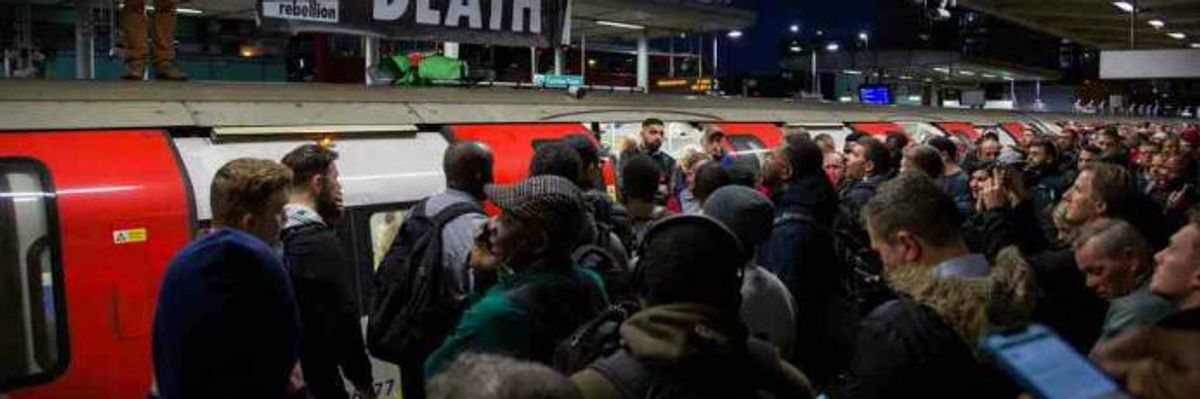
Two activists with the Extinction Rebellion movement stand on a train at Canning Town station in London on October 17, 2019. (Photo: Twitter/Screengrab)
Extinction Rebellion sparked backlash Thursday after a small group of affiliated activists shut down parts of the London Tube as morning commuters attempted to make their way to work.
"You know what emits more carbon than public transit and leads to congestion? Taxis, Lyfts, and Ubers. So the whole point of shutting down public transit as a climate protest is somewhat self-defeating."
--Brian Kahn, Earther
The decision to target public transit was opposed by many within the movement and those involved "did not take this action lightly," XR said in a statement following the demonstration.
Commuters' furious reaction to the protest appeared to validate concerns that the action would alienate potential and necessary working-class allies and fuel perception of the movement as out of touch with the material concerns of vulnerable people.
In the early hours of Thursday morning, several XR-aligned activists climbed atop an electric train at Canning Town station in London and glued themselves to one car. As commuters filled the platform, many shouted at the demonstrators and one man dragged an activist off the train.
"I need to get to work! I have to feed my kids!" one person yelled from the packed platform.
Extinction Rebellion has won sympathy from broad segments of civil society for disrupting the day-to-day activities of powerful institutions that are driving the climate crisis, from big banks to the U.S. Congress.
Supporters of XR tactics have argued that some measure of disruption and inconvenience will be necessary to fight the planetary crisis, but critics of Thursday's protest said it is crucial that demonstrations are as focused as possible on the powerful corporate and political enemies of climate action.
Earther's Brian Kahn wrote Thursday that while XR has "done a lot to raise the profile of climate activism" and "most of its arrows are aimed at the right targets," the London train action was a major misstep.
The protest "almost certainly forced some commuters to walk out of the station and snag a taxi, Lyft, or Uber to their office," said Kahn. "You know what emits more carbon than public transit and leads to congestion? Taxis, Lyfts, and Ubers. So the whole point of shutting down public transit as a climate protest is somewhat self-defeating."
"Everyone can relate to the annoyance of a delayed commute, but the people who suffer the worst consequences are society's most vulnerable," said Kahn. "In the case of people doing shift work paid by the hour, showing up late could be grounds for being fired at worst and a hit to their earnings at least."
Kahn expressed agreement with filmmaker Astra Taylor's suggestion that XR activists look to the Occupy Movement for a form of public transit protest that assists rather than disrupts the lives of ordinary commuters:
Some local XR groups acknowledged the protest was a mistake.
"A difficult day, one testing the principle of decentralization and autonomous action," tweeted XR London. "Nearly all rebels opposed the action on the tube. But there is well-founded fear in the hearts of some and, of desperation, it was expressed in drastic ways. Urgent, but a mistake."
XR Croydon said the protest and the reaction to it represent an opportunity to "listen to our supporters and critics alike, reflect on our mistakes, and improve ourselves as a movement and as individuals."
Gaby Hinsliff, a columnist for The Guardian, wrote Thursday that the "ugly standoff at Canning Town station is a wake-up call, illustrating the risks to a fledgling movement that has so far enjoyed huge reserves of goodwill from the millions broadly sympathetic to its cause."
"Any political movement refusing to engage with the bread-and-butter concerns of low-paid, marginalized, or justifiably anxious people... cannot call itself progressive," said Hinsliff. "That the poorest will suffer most from global heating is no excuse for trampling them in the rush to do something about it."
Dear Common Dreams reader, It’s been nearly 30 years since I co-founded Common Dreams with my late wife, Lina Newhouser. We had the radical notion that journalism should serve the public good, not corporate profits. It was clear to us from the outset what it would take to build such a project. No paid advertisements. No corporate sponsors. No millionaire publisher telling us what to think or do. Many people said we wouldn't last a year, but we proved those doubters wrong. Together with a tremendous team of journalists and dedicated staff, we built an independent media outlet free from the constraints of profits and corporate control. Our mission has always been simple: To inform. To inspire. To ignite change for the common good. Building Common Dreams was not easy. Our survival was never guaranteed. When you take on the most powerful forces—Wall Street greed, fossil fuel industry destruction, Big Tech lobbyists, and uber-rich oligarchs who have spent billions upon billions rigging the economy and democracy in their favor—the only bulwark you have is supporters who believe in your work. But here’s the urgent message from me today. It's never been this bad out there. And it's never been this hard to keep us going. At the very moment Common Dreams is most needed, the threats we face are intensifying. We need your support now more than ever. We don't accept corporate advertising and never will. We don't have a paywall because we don't think people should be blocked from critical news based on their ability to pay. Everything we do is funded by the donations of readers like you. When everyone does the little they can afford, we are strong. But if that support retreats or dries up, so do we. Will you donate now to make sure Common Dreams not only survives but thrives? —Craig Brown, Co-founder |
Extinction Rebellion sparked backlash Thursday after a small group of affiliated activists shut down parts of the London Tube as morning commuters attempted to make their way to work.
"You know what emits more carbon than public transit and leads to congestion? Taxis, Lyfts, and Ubers. So the whole point of shutting down public transit as a climate protest is somewhat self-defeating."
--Brian Kahn, Earther
The decision to target public transit was opposed by many within the movement and those involved "did not take this action lightly," XR said in a statement following the demonstration.
Commuters' furious reaction to the protest appeared to validate concerns that the action would alienate potential and necessary working-class allies and fuel perception of the movement as out of touch with the material concerns of vulnerable people.
In the early hours of Thursday morning, several XR-aligned activists climbed atop an electric train at Canning Town station in London and glued themselves to one car. As commuters filled the platform, many shouted at the demonstrators and one man dragged an activist off the train.
"I need to get to work! I have to feed my kids!" one person yelled from the packed platform.
Extinction Rebellion has won sympathy from broad segments of civil society for disrupting the day-to-day activities of powerful institutions that are driving the climate crisis, from big banks to the U.S. Congress.
Supporters of XR tactics have argued that some measure of disruption and inconvenience will be necessary to fight the planetary crisis, but critics of Thursday's protest said it is crucial that demonstrations are as focused as possible on the powerful corporate and political enemies of climate action.
Earther's Brian Kahn wrote Thursday that while XR has "done a lot to raise the profile of climate activism" and "most of its arrows are aimed at the right targets," the London train action was a major misstep.
The protest "almost certainly forced some commuters to walk out of the station and snag a taxi, Lyft, or Uber to their office," said Kahn. "You know what emits more carbon than public transit and leads to congestion? Taxis, Lyfts, and Ubers. So the whole point of shutting down public transit as a climate protest is somewhat self-defeating."
"Everyone can relate to the annoyance of a delayed commute, but the people who suffer the worst consequences are society's most vulnerable," said Kahn. "In the case of people doing shift work paid by the hour, showing up late could be grounds for being fired at worst and a hit to their earnings at least."
Kahn expressed agreement with filmmaker Astra Taylor's suggestion that XR activists look to the Occupy Movement for a form of public transit protest that assists rather than disrupts the lives of ordinary commuters:
Some local XR groups acknowledged the protest was a mistake.
"A difficult day, one testing the principle of decentralization and autonomous action," tweeted XR London. "Nearly all rebels opposed the action on the tube. But there is well-founded fear in the hearts of some and, of desperation, it was expressed in drastic ways. Urgent, but a mistake."
XR Croydon said the protest and the reaction to it represent an opportunity to "listen to our supporters and critics alike, reflect on our mistakes, and improve ourselves as a movement and as individuals."
Gaby Hinsliff, a columnist for The Guardian, wrote Thursday that the "ugly standoff at Canning Town station is a wake-up call, illustrating the risks to a fledgling movement that has so far enjoyed huge reserves of goodwill from the millions broadly sympathetic to its cause."
"Any political movement refusing to engage with the bread-and-butter concerns of low-paid, marginalized, or justifiably anxious people... cannot call itself progressive," said Hinsliff. "That the poorest will suffer most from global heating is no excuse for trampling them in the rush to do something about it."
Extinction Rebellion sparked backlash Thursday after a small group of affiliated activists shut down parts of the London Tube as morning commuters attempted to make their way to work.
"You know what emits more carbon than public transit and leads to congestion? Taxis, Lyfts, and Ubers. So the whole point of shutting down public transit as a climate protest is somewhat self-defeating."
--Brian Kahn, Earther
The decision to target public transit was opposed by many within the movement and those involved "did not take this action lightly," XR said in a statement following the demonstration.
Commuters' furious reaction to the protest appeared to validate concerns that the action would alienate potential and necessary working-class allies and fuel perception of the movement as out of touch with the material concerns of vulnerable people.
In the early hours of Thursday morning, several XR-aligned activists climbed atop an electric train at Canning Town station in London and glued themselves to one car. As commuters filled the platform, many shouted at the demonstrators and one man dragged an activist off the train.
"I need to get to work! I have to feed my kids!" one person yelled from the packed platform.
Extinction Rebellion has won sympathy from broad segments of civil society for disrupting the day-to-day activities of powerful institutions that are driving the climate crisis, from big banks to the U.S. Congress.
Supporters of XR tactics have argued that some measure of disruption and inconvenience will be necessary to fight the planetary crisis, but critics of Thursday's protest said it is crucial that demonstrations are as focused as possible on the powerful corporate and political enemies of climate action.
Earther's Brian Kahn wrote Thursday that while XR has "done a lot to raise the profile of climate activism" and "most of its arrows are aimed at the right targets," the London train action was a major misstep.
The protest "almost certainly forced some commuters to walk out of the station and snag a taxi, Lyft, or Uber to their office," said Kahn. "You know what emits more carbon than public transit and leads to congestion? Taxis, Lyfts, and Ubers. So the whole point of shutting down public transit as a climate protest is somewhat self-defeating."
"Everyone can relate to the annoyance of a delayed commute, but the people who suffer the worst consequences are society's most vulnerable," said Kahn. "In the case of people doing shift work paid by the hour, showing up late could be grounds for being fired at worst and a hit to their earnings at least."
Kahn expressed agreement with filmmaker Astra Taylor's suggestion that XR activists look to the Occupy Movement for a form of public transit protest that assists rather than disrupts the lives of ordinary commuters:
Some local XR groups acknowledged the protest was a mistake.
"A difficult day, one testing the principle of decentralization and autonomous action," tweeted XR London. "Nearly all rebels opposed the action on the tube. But there is well-founded fear in the hearts of some and, of desperation, it was expressed in drastic ways. Urgent, but a mistake."
XR Croydon said the protest and the reaction to it represent an opportunity to "listen to our supporters and critics alike, reflect on our mistakes, and improve ourselves as a movement and as individuals."
Gaby Hinsliff, a columnist for The Guardian, wrote Thursday that the "ugly standoff at Canning Town station is a wake-up call, illustrating the risks to a fledgling movement that has so far enjoyed huge reserves of goodwill from the millions broadly sympathetic to its cause."
"Any political movement refusing to engage with the bread-and-butter concerns of low-paid, marginalized, or justifiably anxious people... cannot call itself progressive," said Hinsliff. "That the poorest will suffer most from global heating is no excuse for trampling them in the rush to do something about it."