SUBSCRIBE TO OUR FREE NEWSLETTER
Daily news & progressive opinion—funded by the people, not the corporations—delivered straight to your inbox.
5
#000000
#FFFFFF
To donate by check, phone, or other method, see our More Ways to Give page.
Daily news & progressive opinion—funded by the people, not the corporations—delivered straight to your inbox.
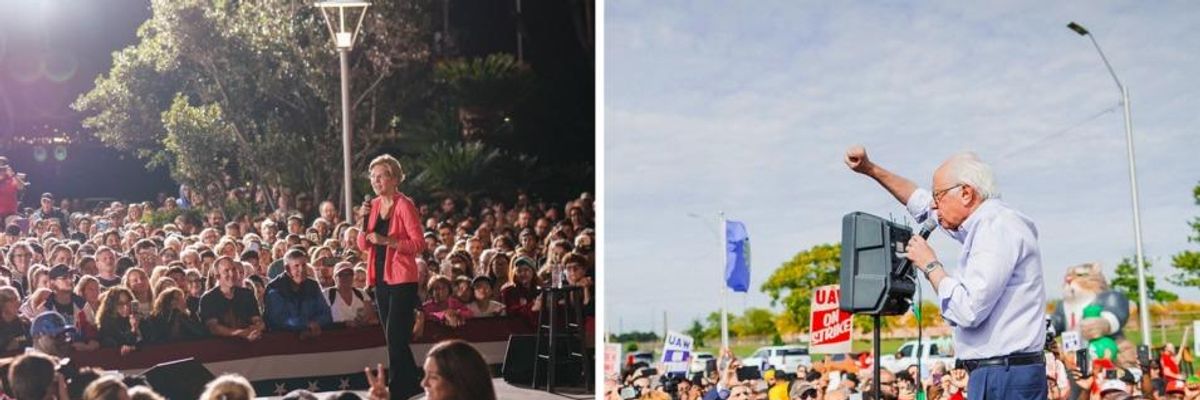
Rejecting corporate PAC money and big-dollar fundraisers, Sens. Elizabeth Warren (D-Mass.) and Bernie Sanders (I-Vt.) have raised $35 million and $46 million, respectively, during the 2020 election so far. Mayor Pete Buttigieg, who criticized the grassroots fundraising strategy Monday, has raised less than both candidates despite accepting corporate funds. (Photo: @ewarren/Twitter; @berniesanders/Twitter)
A day before 12 candidates in the 2020 Democratic presidential candidates take the stage for the fourth debate of the primary, South Bend, Indiana Mayor Pete Buttigieg criticized several of his opponents for their reliance on grassroots, small-dollar fundraising and bold policy proposals--despite the broad popularity and success of both.
On "Good Luck, America," a political news show airing on Snapchat, Buttigieg took aim at Sen. Elizabeth Warren (D-Mass.)--and indirectly at Sen. Bernie Sanders (I-Vt.)--for raising campaign funds mostly through small individual contributions.
"We're not going to beat Trump with pocket change," Buttigieg told host Peter Hamby.
Critics noted that Sanders and Warren are the top fundraisers of the Democratic primary, raising $46 million and $35 million mainly through small donations.
"Pocket change is beating Pete, though," journalist Krystal Ball tweeted.
Warren frequently posts videos of herself personally calling donors who have given her small amounts of money to thank them--a hallmark of the campaign which has won her praise and which Warren says she's able to do because she isn't spending time at high-dollar fundraisers.
The $32 million Buttigieg has raised is almost evenly split between small and large contributions, with 51 percent coming from large-dollar donations.
Both Sanders and Warren raised more than Buttigieg in the 3rd quarter of 2019, raising $25 million and $24 million, respectively, compared with Buttigieg's $19 million.
Some on social media said Buttigieg's disparaging comments about Warren's and Sanders's strategy could be seen negatively by his own potential small-dollar donors, forcing him to rely even more on large donations--the latter of which the majority of Americans believe should be limited, according to Pew Research.
Buttigieg also took aim at former Rep. Beto O'Rourke (D-Texas), who he recently disagreed with about the latter's proposed buy-back program from assault weapons.
"I get it, he needs to pick a fight in order to stay relevant but this is about a difference of opinion on policy," Buttigieg told Hamby.
Beto's statement about buy-backs at the third Democratic debate last month--"Hell, yes, we're going to take your AR-15, your AK-47,"--won loud applause from the audience, but garnered an accusation after the debate from Buttigieg that O'Rourke's proposal was "playing into the hands of Republicans." In response, O'Rourke suggested his opponent was among several who are "triangulating, poll-testing, focus-group driving their response" to questions about how they would govern.
A survey released by The Hill/HarrisX late last month showed broad support for O'Rourke's buy-back proposal. Eighty-seven percent of Democrats supported a voluntary program, while 76 percent of overall respondents backed the proposal. A mandatory program was supported by 59 percent of respondents, including 51 percent of independents and nearly 40 percent of Republicans.
Along with eight other candidates, including former Vice President Joe Biden and Sen. Kamala Harris (D-Calif.), Buttigieg, Warren, Sanders, and O'Rourke will take part in the fourth Democratic debate on Tuesday night.
Dear Common Dreams reader, It’s been nearly 30 years since I co-founded Common Dreams with my late wife, Lina Newhouser. We had the radical notion that journalism should serve the public good, not corporate profits. It was clear to us from the outset what it would take to build such a project. No paid advertisements. No corporate sponsors. No millionaire publisher telling us what to think or do. Many people said we wouldn't last a year, but we proved those doubters wrong. Together with a tremendous team of journalists and dedicated staff, we built an independent media outlet free from the constraints of profits and corporate control. Our mission has always been simple: To inform. To inspire. To ignite change for the common good. Building Common Dreams was not easy. Our survival was never guaranteed. When you take on the most powerful forces—Wall Street greed, fossil fuel industry destruction, Big Tech lobbyists, and uber-rich oligarchs who have spent billions upon billions rigging the economy and democracy in their favor—the only bulwark you have is supporters who believe in your work. But here’s the urgent message from me today. It's never been this bad out there. And it's never been this hard to keep us going. At the very moment Common Dreams is most needed, the threats we face are intensifying. We need your support now more than ever. We don't accept corporate advertising and never will. We don't have a paywall because we don't think people should be blocked from critical news based on their ability to pay. Everything we do is funded by the donations of readers like you. When everyone does the little they can afford, we are strong. But if that support retreats or dries up, so do we. Will you donate now to make sure Common Dreams not only survives but thrives? —Craig Brown, Co-founder |
A day before 12 candidates in the 2020 Democratic presidential candidates take the stage for the fourth debate of the primary, South Bend, Indiana Mayor Pete Buttigieg criticized several of his opponents for their reliance on grassroots, small-dollar fundraising and bold policy proposals--despite the broad popularity and success of both.
On "Good Luck, America," a political news show airing on Snapchat, Buttigieg took aim at Sen. Elizabeth Warren (D-Mass.)--and indirectly at Sen. Bernie Sanders (I-Vt.)--for raising campaign funds mostly through small individual contributions.
"We're not going to beat Trump with pocket change," Buttigieg told host Peter Hamby.
Critics noted that Sanders and Warren are the top fundraisers of the Democratic primary, raising $46 million and $35 million mainly through small donations.
"Pocket change is beating Pete, though," journalist Krystal Ball tweeted.
Warren frequently posts videos of herself personally calling donors who have given her small amounts of money to thank them--a hallmark of the campaign which has won her praise and which Warren says she's able to do because she isn't spending time at high-dollar fundraisers.
The $32 million Buttigieg has raised is almost evenly split between small and large contributions, with 51 percent coming from large-dollar donations.
Both Sanders and Warren raised more than Buttigieg in the 3rd quarter of 2019, raising $25 million and $24 million, respectively, compared with Buttigieg's $19 million.
Some on social media said Buttigieg's disparaging comments about Warren's and Sanders's strategy could be seen negatively by his own potential small-dollar donors, forcing him to rely even more on large donations--the latter of which the majority of Americans believe should be limited, according to Pew Research.
Buttigieg also took aim at former Rep. Beto O'Rourke (D-Texas), who he recently disagreed with about the latter's proposed buy-back program from assault weapons.
"I get it, he needs to pick a fight in order to stay relevant but this is about a difference of opinion on policy," Buttigieg told Hamby.
Beto's statement about buy-backs at the third Democratic debate last month--"Hell, yes, we're going to take your AR-15, your AK-47,"--won loud applause from the audience, but garnered an accusation after the debate from Buttigieg that O'Rourke's proposal was "playing into the hands of Republicans." In response, O'Rourke suggested his opponent was among several who are "triangulating, poll-testing, focus-group driving their response" to questions about how they would govern.
A survey released by The Hill/HarrisX late last month showed broad support for O'Rourke's buy-back proposal. Eighty-seven percent of Democrats supported a voluntary program, while 76 percent of overall respondents backed the proposal. A mandatory program was supported by 59 percent of respondents, including 51 percent of independents and nearly 40 percent of Republicans.
Along with eight other candidates, including former Vice President Joe Biden and Sen. Kamala Harris (D-Calif.), Buttigieg, Warren, Sanders, and O'Rourke will take part in the fourth Democratic debate on Tuesday night.
A day before 12 candidates in the 2020 Democratic presidential candidates take the stage for the fourth debate of the primary, South Bend, Indiana Mayor Pete Buttigieg criticized several of his opponents for their reliance on grassroots, small-dollar fundraising and bold policy proposals--despite the broad popularity and success of both.
On "Good Luck, America," a political news show airing on Snapchat, Buttigieg took aim at Sen. Elizabeth Warren (D-Mass.)--and indirectly at Sen. Bernie Sanders (I-Vt.)--for raising campaign funds mostly through small individual contributions.
"We're not going to beat Trump with pocket change," Buttigieg told host Peter Hamby.
Critics noted that Sanders and Warren are the top fundraisers of the Democratic primary, raising $46 million and $35 million mainly through small donations.
"Pocket change is beating Pete, though," journalist Krystal Ball tweeted.
Warren frequently posts videos of herself personally calling donors who have given her small amounts of money to thank them--a hallmark of the campaign which has won her praise and which Warren says she's able to do because she isn't spending time at high-dollar fundraisers.
The $32 million Buttigieg has raised is almost evenly split between small and large contributions, with 51 percent coming from large-dollar donations.
Both Sanders and Warren raised more than Buttigieg in the 3rd quarter of 2019, raising $25 million and $24 million, respectively, compared with Buttigieg's $19 million.
Some on social media said Buttigieg's disparaging comments about Warren's and Sanders's strategy could be seen negatively by his own potential small-dollar donors, forcing him to rely even more on large donations--the latter of which the majority of Americans believe should be limited, according to Pew Research.
Buttigieg also took aim at former Rep. Beto O'Rourke (D-Texas), who he recently disagreed with about the latter's proposed buy-back program from assault weapons.
"I get it, he needs to pick a fight in order to stay relevant but this is about a difference of opinion on policy," Buttigieg told Hamby.
Beto's statement about buy-backs at the third Democratic debate last month--"Hell, yes, we're going to take your AR-15, your AK-47,"--won loud applause from the audience, but garnered an accusation after the debate from Buttigieg that O'Rourke's proposal was "playing into the hands of Republicans." In response, O'Rourke suggested his opponent was among several who are "triangulating, poll-testing, focus-group driving their response" to questions about how they would govern.
A survey released by The Hill/HarrisX late last month showed broad support for O'Rourke's buy-back proposal. Eighty-seven percent of Democrats supported a voluntary program, while 76 percent of overall respondents backed the proposal. A mandatory program was supported by 59 percent of respondents, including 51 percent of independents and nearly 40 percent of Republicans.
Along with eight other candidates, including former Vice President Joe Biden and Sen. Kamala Harris (D-Calif.), Buttigieg, Warren, Sanders, and O'Rourke will take part in the fourth Democratic debate on Tuesday night.