SUBSCRIBE TO OUR FREE NEWSLETTER
Daily news & progressive opinion—funded by the people, not the corporations—delivered straight to your inbox.
5
#000000
#FFFFFF
To donate by check, phone, or other method, see our More Ways to Give page.
Daily news & progressive opinion—funded by the people, not the corporations—delivered straight to your inbox.
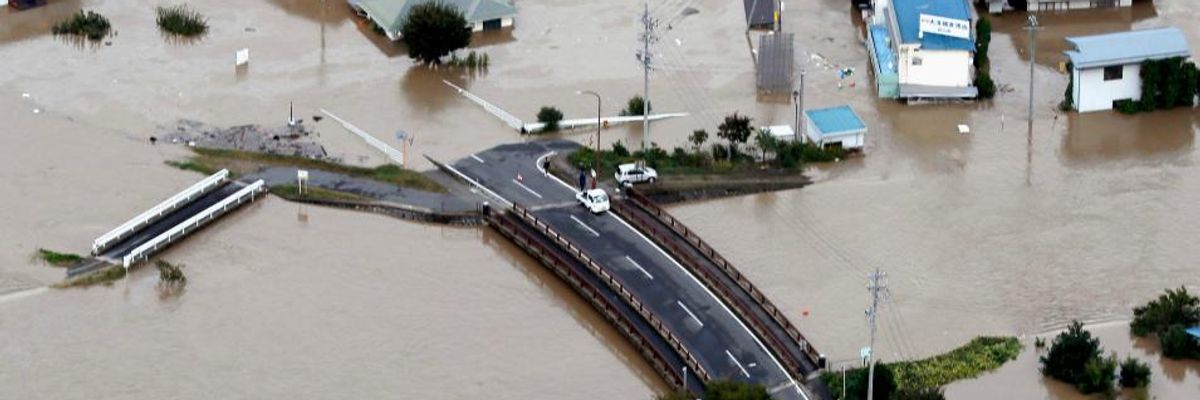
Typhoon Hagibis, which made landfall in Japan Saturday, killed dozens of people and caused "immense damage" to infrastructure across multiple prefectures. (Photo: Channel News Asia/Twitter)
Rescue operations were underway Sunday in Tokyo and several other prefectures in Japan that were battered by powerful winds and heavy rains from the deadly Typhoon Hagibis, which made landfall south of Tokyo Saturday.
"Hagibis, the 19th named storm of the season, tore through Japan's main island of Honshu on Saturday and early Sunday packing winds of up to 144 kph at landfall, killing 35 and leaving 17 unaccounted for as of Sunday afternoon," reported The Japan Times.
Deaths have been documented in Miyagi, Kanagawa, Tochigi, Gunma, Fukushima, Saitama, Iwate, Nagano, Ibaraki, Chiba, and Shizuoka prefectures, according to public broadcaster NHK, which reported that at least 177 people suffered injuries because of the strong storm.
The environmental group 350 East Asia shared NHK footage of the destruction on Twitter and asked, "How many more extreme weather events like this should happen til all governments & corporations act seriously on the #climatebreakdown?"
A spokesperson for the Japanese government, Chief Cabinet Secretary Yoshihideu Suga, told journalists Sunday that "the major typhoon has caused immense damage far and wide in eastern Japan."
"People's lives continue to be affected by disruptions to power, water, and transportation services," said Suga, who added that 376,000 homes lack electricity and 14,000 homes lack running water. "Relevant government organizations are doing their best to restore those services as soon as possible."
"The government dispatched personnel ahead of the disaster to local governments. They are now cooperating with Self-Defense Force personnel in collecting information on the damage," he said, noting that 27,000 military troops and other crews are involved in rescue efforts.
"The Tama River, which runs by Tokyo, overflowed its banks, flooding homes and other buildings in the area," according to The Associated Press. "Authorities warned of a risk of mudslides. Among the reported deaths were those whose homes were buried in landslides. Other fatalities included people who got swept away by raging rivers."
Citing Japan's land ministry officials, NHK reported that due to the heavy rains brought by the typhoon, levees collapsed in at least 10 spots on nine rivers.
Japanese Prime Minister Shinzo Abe, as The Guardian noted, "held an emergency meeting and offered his support to all those affected by the disaster--the second destructive storm to hit Japan in the space of a month."
"I extend my condolences to all those who lost their lives and offer my sympathies to all those impacted," Abe said. "With respect to blackouts, water outage, and suspension of transportation services, we will do our utmost to bring about a swift recovery. We ask the public to stay vigilant in case of landslides and other hazards."
According to The Guardian:
The operator of the Fukushima Daiichi nuclear power plant, which was wrecked by a deadly tsunami in March 2011, reported irregular readings from sensors monitoring water at the facility.
Emi Iwasa, a spokeswoman for Tokyo Electric Power, said the storm had triggered 11 leak alerts at the plant, eight of which were confirmed as having been caused by rainwater. The utility has not confirmed if any radioactive water leaked into sea.
Away from the plant, a stretch of Fukushima was flooded, with only the rooftops of residential homes visible. Parts of nearby Miyagi prefecture were also under water.
Japan's famous bullet trains also sustained damage from Hagibis. The Japan Times reported that 10 Hokuriku Shinkansen line trains worth Y=32.8 billion ($302.5 million USD) were affected.
Hagibis--which means "speed" in the Philippine language Tagalog--was downgraded to a tropical storm Sunday after meteorologists' warnings earlier this week that it could be the strongest typhoon to hit Japan in over six decades.
Amid rescue operations in affected areas, Agence France-Presse reported that "Japan gave their typhoon-hit nation reason to celebrate when they edged a thrilling game with Scotland 28-21 to reach their first Rugby World Cup quarter-final on Sunday."
"To everyone that's suffering from the typhoon, this game was for you guys," Japan team captain Michael Leitch said of the soccer match at Yokohama International Stadium, which was nearly canceled. "It was more than just a game for us--there was talk this game may not happen--so our heart goes out to everyone that's suffering tonight with the typhoon."
Dear Common Dreams reader, It’s been nearly 30 years since I co-founded Common Dreams with my late wife, Lina Newhouser. We had the radical notion that journalism should serve the public good, not corporate profits. It was clear to us from the outset what it would take to build such a project. No paid advertisements. No corporate sponsors. No millionaire publisher telling us what to think or do. Many people said we wouldn't last a year, but we proved those doubters wrong. Together with a tremendous team of journalists and dedicated staff, we built an independent media outlet free from the constraints of profits and corporate control. Our mission has always been simple: To inform. To inspire. To ignite change for the common good. Building Common Dreams was not easy. Our survival was never guaranteed. When you take on the most powerful forces—Wall Street greed, fossil fuel industry destruction, Big Tech lobbyists, and uber-rich oligarchs who have spent billions upon billions rigging the economy and democracy in their favor—the only bulwark you have is supporters who believe in your work. But here’s the urgent message from me today. It's never been this bad out there. And it's never been this hard to keep us going. At the very moment Common Dreams is most needed, the threats we face are intensifying. We need your support now more than ever. We don't accept corporate advertising and never will. We don't have a paywall because we don't think people should be blocked from critical news based on their ability to pay. Everything we do is funded by the donations of readers like you. When everyone does the little they can afford, we are strong. But if that support retreats or dries up, so do we. Will you donate now to make sure Common Dreams not only survives but thrives? —Craig Brown, Co-founder |
Rescue operations were underway Sunday in Tokyo and several other prefectures in Japan that were battered by powerful winds and heavy rains from the deadly Typhoon Hagibis, which made landfall south of Tokyo Saturday.
"Hagibis, the 19th named storm of the season, tore through Japan's main island of Honshu on Saturday and early Sunday packing winds of up to 144 kph at landfall, killing 35 and leaving 17 unaccounted for as of Sunday afternoon," reported The Japan Times.
Deaths have been documented in Miyagi, Kanagawa, Tochigi, Gunma, Fukushima, Saitama, Iwate, Nagano, Ibaraki, Chiba, and Shizuoka prefectures, according to public broadcaster NHK, which reported that at least 177 people suffered injuries because of the strong storm.
The environmental group 350 East Asia shared NHK footage of the destruction on Twitter and asked, "How many more extreme weather events like this should happen til all governments & corporations act seriously on the #climatebreakdown?"
A spokesperson for the Japanese government, Chief Cabinet Secretary Yoshihideu Suga, told journalists Sunday that "the major typhoon has caused immense damage far and wide in eastern Japan."
"People's lives continue to be affected by disruptions to power, water, and transportation services," said Suga, who added that 376,000 homes lack electricity and 14,000 homes lack running water. "Relevant government organizations are doing their best to restore those services as soon as possible."
"The government dispatched personnel ahead of the disaster to local governments. They are now cooperating with Self-Defense Force personnel in collecting information on the damage," he said, noting that 27,000 military troops and other crews are involved in rescue efforts.
"The Tama River, which runs by Tokyo, overflowed its banks, flooding homes and other buildings in the area," according to The Associated Press. "Authorities warned of a risk of mudslides. Among the reported deaths were those whose homes were buried in landslides. Other fatalities included people who got swept away by raging rivers."
Citing Japan's land ministry officials, NHK reported that due to the heavy rains brought by the typhoon, levees collapsed in at least 10 spots on nine rivers.
Japanese Prime Minister Shinzo Abe, as The Guardian noted, "held an emergency meeting and offered his support to all those affected by the disaster--the second destructive storm to hit Japan in the space of a month."
"I extend my condolences to all those who lost their lives and offer my sympathies to all those impacted," Abe said. "With respect to blackouts, water outage, and suspension of transportation services, we will do our utmost to bring about a swift recovery. We ask the public to stay vigilant in case of landslides and other hazards."
According to The Guardian:
The operator of the Fukushima Daiichi nuclear power plant, which was wrecked by a deadly tsunami in March 2011, reported irregular readings from sensors monitoring water at the facility.
Emi Iwasa, a spokeswoman for Tokyo Electric Power, said the storm had triggered 11 leak alerts at the plant, eight of which were confirmed as having been caused by rainwater. The utility has not confirmed if any radioactive water leaked into sea.
Away from the plant, a stretch of Fukushima was flooded, with only the rooftops of residential homes visible. Parts of nearby Miyagi prefecture were also under water.
Japan's famous bullet trains also sustained damage from Hagibis. The Japan Times reported that 10 Hokuriku Shinkansen line trains worth Y=32.8 billion ($302.5 million USD) were affected.
Hagibis--which means "speed" in the Philippine language Tagalog--was downgraded to a tropical storm Sunday after meteorologists' warnings earlier this week that it could be the strongest typhoon to hit Japan in over six decades.
Amid rescue operations in affected areas, Agence France-Presse reported that "Japan gave their typhoon-hit nation reason to celebrate when they edged a thrilling game with Scotland 28-21 to reach their first Rugby World Cup quarter-final on Sunday."
"To everyone that's suffering from the typhoon, this game was for you guys," Japan team captain Michael Leitch said of the soccer match at Yokohama International Stadium, which was nearly canceled. "It was more than just a game for us--there was talk this game may not happen--so our heart goes out to everyone that's suffering tonight with the typhoon."
Rescue operations were underway Sunday in Tokyo and several other prefectures in Japan that were battered by powerful winds and heavy rains from the deadly Typhoon Hagibis, which made landfall south of Tokyo Saturday.
"Hagibis, the 19th named storm of the season, tore through Japan's main island of Honshu on Saturday and early Sunday packing winds of up to 144 kph at landfall, killing 35 and leaving 17 unaccounted for as of Sunday afternoon," reported The Japan Times.
Deaths have been documented in Miyagi, Kanagawa, Tochigi, Gunma, Fukushima, Saitama, Iwate, Nagano, Ibaraki, Chiba, and Shizuoka prefectures, according to public broadcaster NHK, which reported that at least 177 people suffered injuries because of the strong storm.
The environmental group 350 East Asia shared NHK footage of the destruction on Twitter and asked, "How many more extreme weather events like this should happen til all governments & corporations act seriously on the #climatebreakdown?"
A spokesperson for the Japanese government, Chief Cabinet Secretary Yoshihideu Suga, told journalists Sunday that "the major typhoon has caused immense damage far and wide in eastern Japan."
"People's lives continue to be affected by disruptions to power, water, and transportation services," said Suga, who added that 376,000 homes lack electricity and 14,000 homes lack running water. "Relevant government organizations are doing their best to restore those services as soon as possible."
"The government dispatched personnel ahead of the disaster to local governments. They are now cooperating with Self-Defense Force personnel in collecting information on the damage," he said, noting that 27,000 military troops and other crews are involved in rescue efforts.
"The Tama River, which runs by Tokyo, overflowed its banks, flooding homes and other buildings in the area," according to The Associated Press. "Authorities warned of a risk of mudslides. Among the reported deaths were those whose homes were buried in landslides. Other fatalities included people who got swept away by raging rivers."
Citing Japan's land ministry officials, NHK reported that due to the heavy rains brought by the typhoon, levees collapsed in at least 10 spots on nine rivers.
Japanese Prime Minister Shinzo Abe, as The Guardian noted, "held an emergency meeting and offered his support to all those affected by the disaster--the second destructive storm to hit Japan in the space of a month."
"I extend my condolences to all those who lost their lives and offer my sympathies to all those impacted," Abe said. "With respect to blackouts, water outage, and suspension of transportation services, we will do our utmost to bring about a swift recovery. We ask the public to stay vigilant in case of landslides and other hazards."
According to The Guardian:
The operator of the Fukushima Daiichi nuclear power plant, which was wrecked by a deadly tsunami in March 2011, reported irregular readings from sensors monitoring water at the facility.
Emi Iwasa, a spokeswoman for Tokyo Electric Power, said the storm had triggered 11 leak alerts at the plant, eight of which were confirmed as having been caused by rainwater. The utility has not confirmed if any radioactive water leaked into sea.
Away from the plant, a stretch of Fukushima was flooded, with only the rooftops of residential homes visible. Parts of nearby Miyagi prefecture were also under water.
Japan's famous bullet trains also sustained damage from Hagibis. The Japan Times reported that 10 Hokuriku Shinkansen line trains worth Y=32.8 billion ($302.5 million USD) were affected.
Hagibis--which means "speed" in the Philippine language Tagalog--was downgraded to a tropical storm Sunday after meteorologists' warnings earlier this week that it could be the strongest typhoon to hit Japan in over six decades.
Amid rescue operations in affected areas, Agence France-Presse reported that "Japan gave their typhoon-hit nation reason to celebrate when they edged a thrilling game with Scotland 28-21 to reach their first Rugby World Cup quarter-final on Sunday."
"To everyone that's suffering from the typhoon, this game was for you guys," Japan team captain Michael Leitch said of the soccer match at Yokohama International Stadium, which was nearly canceled. "It was more than just a game for us--there was talk this game may not happen--so our heart goes out to everyone that's suffering tonight with the typhoon."