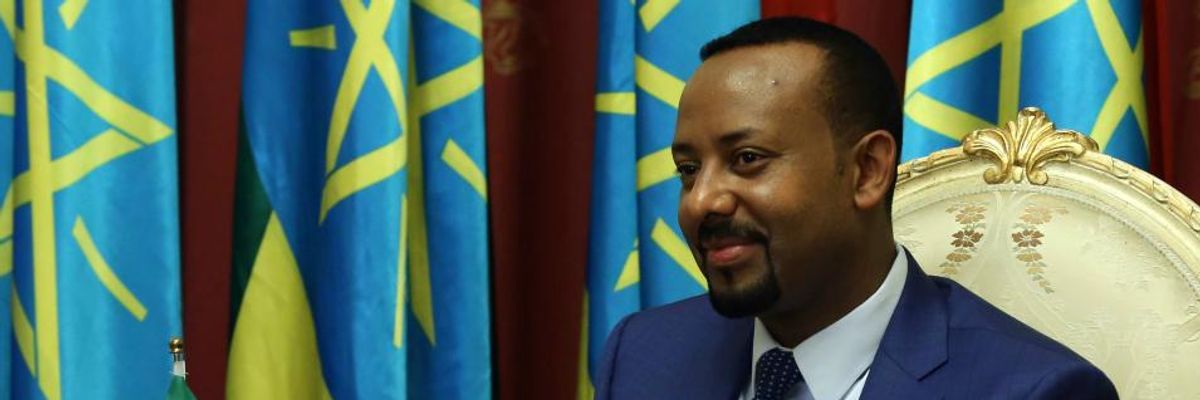
A file photo dated May 25, 2018 shows Ethiopia's Prime Minister Abiy Ahmed during his meeting with President of Rwanda, Paul Kagame (not seen) at the National Palace in Addis Ababa, Ethiopia. Ethiopian Prime Minister Abiy Ahmed Ali won a Nobel Peace Prize in 2019. (Photo by Minasse Wondimu Hailu/Anadolu Agency via Getty Images)
Ethiopian Prime Minister Abiy Ahmed Awarded 2019 Nobel Peace Prize
Though the necessary work is far from done, said Amnesty International's Kumi Naidoo, "Truly remarkable human rights reforms have happened under his leadership."
Ethiopian Prime Minister Abiy Ahmed was declared the recipient of the 2019 Nobel Peace Prize on Friday morning.
The Nobel committee said the prize was awarded to Ahmed for his "efforts to achieve peace and international cooperation, and in particular for his decisive initiative to resolve the border conflict with neighbouring Eritrea."
According to the official announcement, the prize is meant to
recognise all the stakeholders working for peace and reconciliation in Ethiopia and in the East and Northeast African regions.
When Abiy Ahmed became Prime Minister in April 2018, he made it clear that he wished to resume peace talks with Eritrea. In close cooperation with Isaias Afwerki, the President of Eritrea, Abiy Ahmed quickly worked out the principles of a peace agreement to end the long "no peace, no war" stalemate between the two countries. These principles are set out in the declarations that Prime Minister Abiy and President Afwerki signed in Asmara and Jeddah last July and September. An important premise for the breakthrough was Abiy Ahmed's unconditional willingness to accept the arbitration ruling of an international boundary commission in 2002.
Peace does not arise from the actions of one party alone. When Prime Minister Abiy reached out his hand, President Afwerki grasped it, and helped to formalise the peace process between the two countries. The Norwegian Nobel Committee hopes the peace agreement will help to bring about positive change for the entire populations of Ethiopia and Eritrea.
Ahmed is the first Ethiopian to be awarded a Nobel Prize. "I was so humbled and thrilled when I just heard the news," Ahmed said.
Listen to the call between Ethiopian Prime Minister Abiy Ahmed Ali and Olav Njolstad, Secretary of the Norwegian Nobel Committee:
In response to the news, Amnesty International's secretary general Kumi Naidoo congratulated Ahmed for the award and praised him for the reforms he has enacted.
"This award recognizes the critical work Prime Minister Abiy Ahmed's government has done to initiate human rights reforms in Ethiopia after decades of widespread repression," said Naidoo.
"Since assuming office in April 2018, it has reformed the security forces, replaced the severely restricting charities and society law, and agreed a peace deal with neighbouring Eritrea to end two decades of hostile relations. He also helped broker an agreement between Sudan's military leaders and the civilian opposition, bringing an end to months of protests."
Despite those gains, however, Naidoo said much work remains to be done and indicated his hopes that the Nobel would serve to bolster future progress.
"Ahmed's work is far from done," said Naidoo. "This award should push and motivate him to tackle the outstanding human rights challenges that threaten to reverse the gains made so far. He must urgently ensure that his government addresses the ongoing ethnic tensions that threaten instability and further human rights abuses. He should also ensure that his government revises the Anti-Terrorism Proclamation which continues to be used as a tool of repression, and holds suspected perpetrators of past human rights violations to account."
"Now more than ever Prime Minister Abiy," he concluded, "must fully espouse the principles and values of the Nobel Peace Prize to leave a lasting human rights legacy for his country, the wider region, and the world."
We are at a crossroads
This country and this world are at a monumental crossroads. In a few short weeks, US voters will have an opportunity to beat back the forces of fascism and confront the billionaires who are rigging the economy, our media system, and our democracy, making it increasingly impossible for ordinary people to get by. We’re not just talking about the election. We’re talking about what must be done once these fascist elements are vanquished from power. We need a bolder set of solutions than what either major party has so far been willing to offer and a working-class movement ready to fight like hell for it. Trump didn't emerge from nowhere. The conditions that fueled MAGA authoritarianism were created by decades of radical neoliberal economic policies and a corrupt political system dominated by corporate interests. They slashed taxes on the super-rich, promising that the benefits would trickle down. They said giveaways to the corporate titans would make life more affordable for the rest of us. It was all bullshit. And when a bitter, betrayed populace searches for someone to blame, right-wing demagogues have little trouble finding scapegoats. People know when they're being lied to, but you won't hear any of this from the corporate media. Only independent journalism—powered and funded by people who believe in building a better world—can deliver truly trustworthy daily news. Our Fall Campaign is underway, and we need your help. To power our newsroom through the rest of the year, we need to raise $125,000 by midnight on October 31. So if you share our vision, please contribute whatever you can to sustain our work. |
Ethiopian Prime Minister Abiy Ahmed was declared the recipient of the 2019 Nobel Peace Prize on Friday morning.
The Nobel committee said the prize was awarded to Ahmed for his "efforts to achieve peace and international cooperation, and in particular for his decisive initiative to resolve the border conflict with neighbouring Eritrea."
According to the official announcement, the prize is meant to
recognise all the stakeholders working for peace and reconciliation in Ethiopia and in the East and Northeast African regions.
When Abiy Ahmed became Prime Minister in April 2018, he made it clear that he wished to resume peace talks with Eritrea. In close cooperation with Isaias Afwerki, the President of Eritrea, Abiy Ahmed quickly worked out the principles of a peace agreement to end the long "no peace, no war" stalemate between the two countries. These principles are set out in the declarations that Prime Minister Abiy and President Afwerki signed in Asmara and Jeddah last July and September. An important premise for the breakthrough was Abiy Ahmed's unconditional willingness to accept the arbitration ruling of an international boundary commission in 2002.
Peace does not arise from the actions of one party alone. When Prime Minister Abiy reached out his hand, President Afwerki grasped it, and helped to formalise the peace process between the two countries. The Norwegian Nobel Committee hopes the peace agreement will help to bring about positive change for the entire populations of Ethiopia and Eritrea.
Ahmed is the first Ethiopian to be awarded a Nobel Prize. "I was so humbled and thrilled when I just heard the news," Ahmed said.
Listen to the call between Ethiopian Prime Minister Abiy Ahmed Ali and Olav Njolstad, Secretary of the Norwegian Nobel Committee:
In response to the news, Amnesty International's secretary general Kumi Naidoo congratulated Ahmed for the award and praised him for the reforms he has enacted.
"This award recognizes the critical work Prime Minister Abiy Ahmed's government has done to initiate human rights reforms in Ethiopia after decades of widespread repression," said Naidoo.
"Since assuming office in April 2018, it has reformed the security forces, replaced the severely restricting charities and society law, and agreed a peace deal with neighbouring Eritrea to end two decades of hostile relations. He also helped broker an agreement between Sudan's military leaders and the civilian opposition, bringing an end to months of protests."
Despite those gains, however, Naidoo said much work remains to be done and indicated his hopes that the Nobel would serve to bolster future progress.
"Ahmed's work is far from done," said Naidoo. "This award should push and motivate him to tackle the outstanding human rights challenges that threaten to reverse the gains made so far. He must urgently ensure that his government addresses the ongoing ethnic tensions that threaten instability and further human rights abuses. He should also ensure that his government revises the Anti-Terrorism Proclamation which continues to be used as a tool of repression, and holds suspected perpetrators of past human rights violations to account."
"Now more than ever Prime Minister Abiy," he concluded, "must fully espouse the principles and values of the Nobel Peace Prize to leave a lasting human rights legacy for his country, the wider region, and the world."
Ethiopian Prime Minister Abiy Ahmed was declared the recipient of the 2019 Nobel Peace Prize on Friday morning.
The Nobel committee said the prize was awarded to Ahmed for his "efforts to achieve peace and international cooperation, and in particular for his decisive initiative to resolve the border conflict with neighbouring Eritrea."
According to the official announcement, the prize is meant to
recognise all the stakeholders working for peace and reconciliation in Ethiopia and in the East and Northeast African regions.
When Abiy Ahmed became Prime Minister in April 2018, he made it clear that he wished to resume peace talks with Eritrea. In close cooperation with Isaias Afwerki, the President of Eritrea, Abiy Ahmed quickly worked out the principles of a peace agreement to end the long "no peace, no war" stalemate between the two countries. These principles are set out in the declarations that Prime Minister Abiy and President Afwerki signed in Asmara and Jeddah last July and September. An important premise for the breakthrough was Abiy Ahmed's unconditional willingness to accept the arbitration ruling of an international boundary commission in 2002.
Peace does not arise from the actions of one party alone. When Prime Minister Abiy reached out his hand, President Afwerki grasped it, and helped to formalise the peace process between the two countries. The Norwegian Nobel Committee hopes the peace agreement will help to bring about positive change for the entire populations of Ethiopia and Eritrea.
Ahmed is the first Ethiopian to be awarded a Nobel Prize. "I was so humbled and thrilled when I just heard the news," Ahmed said.
Listen to the call between Ethiopian Prime Minister Abiy Ahmed Ali and Olav Njolstad, Secretary of the Norwegian Nobel Committee:
In response to the news, Amnesty International's secretary general Kumi Naidoo congratulated Ahmed for the award and praised him for the reforms he has enacted.
"This award recognizes the critical work Prime Minister Abiy Ahmed's government has done to initiate human rights reforms in Ethiopia after decades of widespread repression," said Naidoo.
"Since assuming office in April 2018, it has reformed the security forces, replaced the severely restricting charities and society law, and agreed a peace deal with neighbouring Eritrea to end two decades of hostile relations. He also helped broker an agreement between Sudan's military leaders and the civilian opposition, bringing an end to months of protests."
Despite those gains, however, Naidoo said much work remains to be done and indicated his hopes that the Nobel would serve to bolster future progress.
"Ahmed's work is far from done," said Naidoo. "This award should push and motivate him to tackle the outstanding human rights challenges that threaten to reverse the gains made so far. He must urgently ensure that his government addresses the ongoing ethnic tensions that threaten instability and further human rights abuses. He should also ensure that his government revises the Anti-Terrorism Proclamation which continues to be used as a tool of repression, and holds suspected perpetrators of past human rights violations to account."
"Now more than ever Prime Minister Abiy," he concluded, "must fully espouse the principles and values of the Nobel Peace Prize to leave a lasting human rights legacy for his country, the wider region, and the world."