SUBSCRIBE TO OUR FREE NEWSLETTER
Daily news & progressive opinion—funded by the people, not the corporations—delivered straight to your inbox.
5
#000000
#FFFFFF
To donate by check, phone, or other method, see our More Ways to Give page.
Daily news & progressive opinion—funded by the people, not the corporations—delivered straight to your inbox.
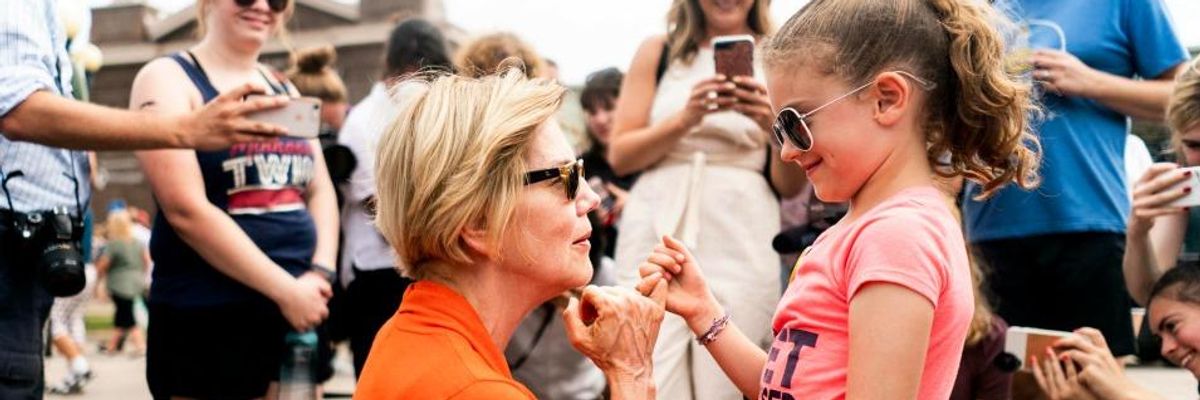
2020 Democratic candidate for President Senator Elizabeth Warren does a pinky swear with a little girl while walking through the Iowa voters at the Iowa State Fair in Des Moines, Iowa on Saturday August, 10, 2019. (Photo: Melina Mara/The Washington Post via Getty Images)
Sen. Elizabeth Warren on Tuesday evening used an attack from the right about her past experience with gender discrimination to lead a national conversation about a common occurrence in American workplaces--the firing, demotion, and unfair treatment of workers who become pregnant.
"Rendering subjects of discrimination untrustworthy narrators, because they can't prove it, or perhaps aren't even sure if it was definitely wrong--is part of how discrimination works."
--Rebecca Traister, journalist
On Tuesday evening, a day after the Washington Free Beacon claimed Warren had lied about experiencing gender discrimination, the Massachusetts Democrat and 2020 presidential candidate released a video detailing her experience of being fired from a teaching job after she became visibly pregnant in 1971.
The video also included stories from a number of women who had suffered similar treatment at work--some recounting incidents that took place decades ago, like Warren's, and others detailing their treatment at work in the very recent past.
"When I was 22 years old, I had an experience that a lot of women will recognize," Warren said, as she has at many campaign events. "I had been hired for the next year, all hired and set to go. And then when they realized I was pregnant, the job was given to someone else."
"This kind of stuff still happens now," she added.
Watch:
The senator shared the story of a woman named Summer, who said she was not offered a job based on gender discrimination.
"Women are still fired or not hired at all basically for looking like they might one day soon want to become pregnant," Summer wrote. "Someone at the U.N. once told me to my face this was why I didn't get a job."
Another woman wrote about mistreatment her mother faced in 1989:
"My mother had to threaten to sue to keep her job when she was pregnant with me. Her colleagues made a big stink about her asking for maternity leave a second time (I was her second kid)...Things haven't improved much for pregnancy discrimination since."
Warren posted the video on social media after the Free Beacon published a story on Monday claiming she lied about her experience. The publication reported that Riverdale, New Jersey school board records refuted her claim that she had not been asked back to teach for a second year due to her pregnancy:
Minutes of an April 21, 1971, Riverdale Board of Education meeting obtained by the Washington Free Beacon show that the board voted unanimously on a motion to extend Warren a "2nd year" contract for a two-days-per-week teaching job. That job is similar to the one she held the previous year, her first year of teaching. Minutes from a board meeting held two months later, on June 16, 1971, indicate that Warren's resignation was "accepted with regret."
The Free Beacon also pointed to tweets posted by Jacobin journalist Meagan Day on October 1 suggesting "that Warren's story appeared to have changed over the years." The Free Beacon noted that Warren's two retellings of her experience--that she wasn't asked back when her pregnancy began to show and that she decided, "I don't think this is going to work out for me" while pregnant--"aren't necessarily incompatible."
Many observers quickly defended Warren, with Vox.com journalist Emily Crockett writing, "It's actually trivially easy to reconcile what some believe are contradictions" in Warren's story.
In an interview with CBS News Tuesday, Warren said she was indeed offered a job for the next school year in April 1971, as the records showed, but that the offer was rescinded in June when she was 6 months along in her pregnancy.
The story led many women on social media on Tuesday to share their own stories of pregnancy discrimination--and their frustration at the suggestion that Warren's story wasn't believable.
"Insisting that a woman who has described (and perhaps understood) her own professional trajectory in different ways at different points in her life is 'obfuscating' contributes to the sense that those who've faced discrimination and felt confused or ashamed about it, can't be trusted to tell us that they've experienced it," wrote journalist Rebecca Traister. "Rendering subjects of discrimination untrustworthy narrators, because they can't prove it, or perhaps aren't even sure if it was definitely wrong--is part of how discrimination works."
Dear Common Dreams reader, It’s been nearly 30 years since I co-founded Common Dreams with my late wife, Lina Newhouser. We had the radical notion that journalism should serve the public good, not corporate profits. It was clear to us from the outset what it would take to build such a project. No paid advertisements. No corporate sponsors. No millionaire publisher telling us what to think or do. Many people said we wouldn't last a year, but we proved those doubters wrong. Together with a tremendous team of journalists and dedicated staff, we built an independent media outlet free from the constraints of profits and corporate control. Our mission has always been simple: To inform. To inspire. To ignite change for the common good. Building Common Dreams was not easy. Our survival was never guaranteed. When you take on the most powerful forces—Wall Street greed, fossil fuel industry destruction, Big Tech lobbyists, and uber-rich oligarchs who have spent billions upon billions rigging the economy and democracy in their favor—the only bulwark you have is supporters who believe in your work. But here’s the urgent message from me today. It's never been this bad out there. And it's never been this hard to keep us going. At the very moment Common Dreams is most needed, the threats we face are intensifying. We need your support now more than ever. We don't accept corporate advertising and never will. We don't have a paywall because we don't think people should be blocked from critical news based on their ability to pay. Everything we do is funded by the donations of readers like you. When everyone does the little they can afford, we are strong. But if that support retreats or dries up, so do we. Will you donate now to make sure Common Dreams not only survives but thrives? —Craig Brown, Co-founder |
Sen. Elizabeth Warren on Tuesday evening used an attack from the right about her past experience with gender discrimination to lead a national conversation about a common occurrence in American workplaces--the firing, demotion, and unfair treatment of workers who become pregnant.
"Rendering subjects of discrimination untrustworthy narrators, because they can't prove it, or perhaps aren't even sure if it was definitely wrong--is part of how discrimination works."
--Rebecca Traister, journalist
On Tuesday evening, a day after the Washington Free Beacon claimed Warren had lied about experiencing gender discrimination, the Massachusetts Democrat and 2020 presidential candidate released a video detailing her experience of being fired from a teaching job after she became visibly pregnant in 1971.
The video also included stories from a number of women who had suffered similar treatment at work--some recounting incidents that took place decades ago, like Warren's, and others detailing their treatment at work in the very recent past.
"When I was 22 years old, I had an experience that a lot of women will recognize," Warren said, as she has at many campaign events. "I had been hired for the next year, all hired and set to go. And then when they realized I was pregnant, the job was given to someone else."
"This kind of stuff still happens now," she added.
Watch:
The senator shared the story of a woman named Summer, who said she was not offered a job based on gender discrimination.
"Women are still fired or not hired at all basically for looking like they might one day soon want to become pregnant," Summer wrote. "Someone at the U.N. once told me to my face this was why I didn't get a job."
Another woman wrote about mistreatment her mother faced in 1989:
"My mother had to threaten to sue to keep her job when she was pregnant with me. Her colleagues made a big stink about her asking for maternity leave a second time (I was her second kid)...Things haven't improved much for pregnancy discrimination since."
Warren posted the video on social media after the Free Beacon published a story on Monday claiming she lied about her experience. The publication reported that Riverdale, New Jersey school board records refuted her claim that she had not been asked back to teach for a second year due to her pregnancy:
Minutes of an April 21, 1971, Riverdale Board of Education meeting obtained by the Washington Free Beacon show that the board voted unanimously on a motion to extend Warren a "2nd year" contract for a two-days-per-week teaching job. That job is similar to the one she held the previous year, her first year of teaching. Minutes from a board meeting held two months later, on June 16, 1971, indicate that Warren's resignation was "accepted with regret."
The Free Beacon also pointed to tweets posted by Jacobin journalist Meagan Day on October 1 suggesting "that Warren's story appeared to have changed over the years." The Free Beacon noted that Warren's two retellings of her experience--that she wasn't asked back when her pregnancy began to show and that she decided, "I don't think this is going to work out for me" while pregnant--"aren't necessarily incompatible."
Many observers quickly defended Warren, with Vox.com journalist Emily Crockett writing, "It's actually trivially easy to reconcile what some believe are contradictions" in Warren's story.
In an interview with CBS News Tuesday, Warren said she was indeed offered a job for the next school year in April 1971, as the records showed, but that the offer was rescinded in June when she was 6 months along in her pregnancy.
The story led many women on social media on Tuesday to share their own stories of pregnancy discrimination--and their frustration at the suggestion that Warren's story wasn't believable.
"Insisting that a woman who has described (and perhaps understood) her own professional trajectory in different ways at different points in her life is 'obfuscating' contributes to the sense that those who've faced discrimination and felt confused or ashamed about it, can't be trusted to tell us that they've experienced it," wrote journalist Rebecca Traister. "Rendering subjects of discrimination untrustworthy narrators, because they can't prove it, or perhaps aren't even sure if it was definitely wrong--is part of how discrimination works."
Sen. Elizabeth Warren on Tuesday evening used an attack from the right about her past experience with gender discrimination to lead a national conversation about a common occurrence in American workplaces--the firing, demotion, and unfair treatment of workers who become pregnant.
"Rendering subjects of discrimination untrustworthy narrators, because they can't prove it, or perhaps aren't even sure if it was definitely wrong--is part of how discrimination works."
--Rebecca Traister, journalist
On Tuesday evening, a day after the Washington Free Beacon claimed Warren had lied about experiencing gender discrimination, the Massachusetts Democrat and 2020 presidential candidate released a video detailing her experience of being fired from a teaching job after she became visibly pregnant in 1971.
The video also included stories from a number of women who had suffered similar treatment at work--some recounting incidents that took place decades ago, like Warren's, and others detailing their treatment at work in the very recent past.
"When I was 22 years old, I had an experience that a lot of women will recognize," Warren said, as she has at many campaign events. "I had been hired for the next year, all hired and set to go. And then when they realized I was pregnant, the job was given to someone else."
"This kind of stuff still happens now," she added.
Watch:
The senator shared the story of a woman named Summer, who said she was not offered a job based on gender discrimination.
"Women are still fired or not hired at all basically for looking like they might one day soon want to become pregnant," Summer wrote. "Someone at the U.N. once told me to my face this was why I didn't get a job."
Another woman wrote about mistreatment her mother faced in 1989:
"My mother had to threaten to sue to keep her job when she was pregnant with me. Her colleagues made a big stink about her asking for maternity leave a second time (I was her second kid)...Things haven't improved much for pregnancy discrimination since."
Warren posted the video on social media after the Free Beacon published a story on Monday claiming she lied about her experience. The publication reported that Riverdale, New Jersey school board records refuted her claim that she had not been asked back to teach for a second year due to her pregnancy:
Minutes of an April 21, 1971, Riverdale Board of Education meeting obtained by the Washington Free Beacon show that the board voted unanimously on a motion to extend Warren a "2nd year" contract for a two-days-per-week teaching job. That job is similar to the one she held the previous year, her first year of teaching. Minutes from a board meeting held two months later, on June 16, 1971, indicate that Warren's resignation was "accepted with regret."
The Free Beacon also pointed to tweets posted by Jacobin journalist Meagan Day on October 1 suggesting "that Warren's story appeared to have changed over the years." The Free Beacon noted that Warren's two retellings of her experience--that she wasn't asked back when her pregnancy began to show and that she decided, "I don't think this is going to work out for me" while pregnant--"aren't necessarily incompatible."
Many observers quickly defended Warren, with Vox.com journalist Emily Crockett writing, "It's actually trivially easy to reconcile what some believe are contradictions" in Warren's story.
In an interview with CBS News Tuesday, Warren said she was indeed offered a job for the next school year in April 1971, as the records showed, but that the offer was rescinded in June when she was 6 months along in her pregnancy.
The story led many women on social media on Tuesday to share their own stories of pregnancy discrimination--and their frustration at the suggestion that Warren's story wasn't believable.
"Insisting that a woman who has described (and perhaps understood) her own professional trajectory in different ways at different points in her life is 'obfuscating' contributes to the sense that those who've faced discrimination and felt confused or ashamed about it, can't be trusted to tell us that they've experienced it," wrote journalist Rebecca Traister. "Rendering subjects of discrimination untrustworthy narrators, because they can't prove it, or perhaps aren't even sure if it was definitely wrong--is part of how discrimination works."