

SUBSCRIBE TO OUR FREE NEWSLETTER
Daily news & progressive opinion—funded by the people, not the corporations—delivered straight to your inbox.
5
#000000
#FFFFFF
To donate by check, phone, or other method, see our More Ways to Give page.
Daily news & progressive opinion—funded by the people, not the corporations—delivered straight to your inbox.
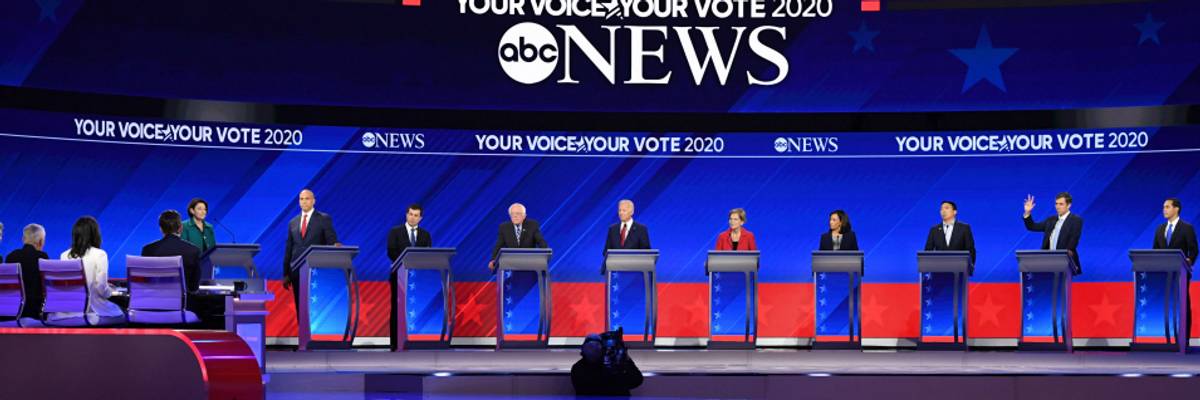
Democratic presidential hopefuls participate in the third Democratic primary debate of the 2020 presidential campaign season at Texas Southern University in Houston, Texas on September 12, 2019. (Photo: Robyn Beck/AFP/Getty Images)
A major climate refugee crisis is currently underway after one of the most catastrophic storms in recorded history ripped through the Bahamas, but the 2020 Democratic presidential debate Thursday night featured just one question and less than five minutes of discussion on the planetary emergency that is intensifying extreme weather, taking lives, and threatening to render large swathes of the planet uninhabitable.
"I don't know how Tom Perez and DNC leaders can look themselves in the mirror after tonight," said Varshini Prakash, co-founder of the youth-led Sunrise Movement. "When Tom Perez and Democratic Party leaders rejected a climate debate last month they promised us that they would ensure this issue got the attention it deserved. Tonight their check bounced."
Hosted by ABC News in partnership with Univision, the third Democratic presidential primary debate took place in Houston, Texas, a city that is often referred to as the oil capital of the world.
Yet the first and only question specifically about the global climate crisis, which came two hours into the three-hour debate, did not make the connection between the oil and gas industry and the ecological emergency.
Noting the destruction caused in Texas by Hurricane Harvey in 2017, Univision's Jorge Ramos asked former Rep. Beto O'Rourke what "meaningful action" he would take to "reverse the effect of climate change."
O'Rourke said he would "make sure that we free ourselves from a dependence on fossil fuels and embrace renewable wind and solar energy technology."
Angering climate campaigners, many of the 10 candidates on stage--including Sen. Bernie Sanders (I-Vt.), whose Green New Deal plan has been hailed as a benchmark for climate policy--were not given an opportunity to respond to the question.
Observers noted that Hurricane Dorian--which destroyed tens of thousands of homes in the Bahamas and left at least 50 dead and 1,300 missing--was not mentioned during the debate.
"None brought up the people or places already suffering the extreme weather and insufficient infrastructure that scientists have long warned makes climate change deadly," reported HuffPost's Alexander Kaufman. "Catastrophic weather has displaced on average 24 million people per year since 2008, according to the Swiss-based Internal Displacement Monitoring Centre. By 2050, that number could climb to anywhere from 140 million to 300 million to 1 billion."
And with the youth-led global climate strikes just a week away, no questions were asked about what organizers say could be the largest mass mobilization for climate action in history.
"That sound you hear," reported The Guardian, "is every climate activist banging their head against the wall."
"Climate change is the greatest existential threat we face as a nation," said Sunrise's Prakash. "Yet, even as poll after poll show that it's a top concern for voters in the 2020 election, tonight's debate almost entirely ignored it."
"This is an emergency," Prakash added. "We need the next president to act like it. They should show they're ready to fight for our generation by standing up to the DNC and commit to a climate debate."
This country and this world are at a monumental crossroads. US voters have an opportunity to beat back the forces of fascism and confront the billionaires who are rigging the economy, our media system, and our democracy, making it increasingly impossible for ordinary people to get by. We’re not just talking about the election. We’re talking about what must be done once these fascist elements are vanquished from power. We need a bolder set of solutions than what either major party has so far been willing to offer and a working-class movement ready to fight like hell for it. Trump didn't emerge from nowhere. The conditions that fueled MAGA authoritarianism were created by decades of radical neoliberal economic policies and a corrupt political system dominated by corporate interests. They slashed taxes on the super-rich, promising that the benefits would trickle down. They said giveaways to the corporate titans would make life more affordable for the rest of us. It was all bullshit. And when a bitter, betrayed populace searches for someone to blame, right-wing demagogues have little trouble finding scapegoats. People know when they're being lied to, but you won't hear any of this from the corporate media. Only independent journalism—powered and funded by people who believe in building a better world—can deliver truly trustworthy daily news. If you share our vision, please contribute whatever you can to sustain our work. |
A major climate refugee crisis is currently underway after one of the most catastrophic storms in recorded history ripped through the Bahamas, but the 2020 Democratic presidential debate Thursday night featured just one question and less than five minutes of discussion on the planetary emergency that is intensifying extreme weather, taking lives, and threatening to render large swathes of the planet uninhabitable.
"I don't know how Tom Perez and DNC leaders can look themselves in the mirror after tonight," said Varshini Prakash, co-founder of the youth-led Sunrise Movement. "When Tom Perez and Democratic Party leaders rejected a climate debate last month they promised us that they would ensure this issue got the attention it deserved. Tonight their check bounced."
Hosted by ABC News in partnership with Univision, the third Democratic presidential primary debate took place in Houston, Texas, a city that is often referred to as the oil capital of the world.
Yet the first and only question specifically about the global climate crisis, which came two hours into the three-hour debate, did not make the connection between the oil and gas industry and the ecological emergency.
Noting the destruction caused in Texas by Hurricane Harvey in 2017, Univision's Jorge Ramos asked former Rep. Beto O'Rourke what "meaningful action" he would take to "reverse the effect of climate change."
O'Rourke said he would "make sure that we free ourselves from a dependence on fossil fuels and embrace renewable wind and solar energy technology."
Angering climate campaigners, many of the 10 candidates on stage--including Sen. Bernie Sanders (I-Vt.), whose Green New Deal plan has been hailed as a benchmark for climate policy--were not given an opportunity to respond to the question.
Observers noted that Hurricane Dorian--which destroyed tens of thousands of homes in the Bahamas and left at least 50 dead and 1,300 missing--was not mentioned during the debate.
"None brought up the people or places already suffering the extreme weather and insufficient infrastructure that scientists have long warned makes climate change deadly," reported HuffPost's Alexander Kaufman. "Catastrophic weather has displaced on average 24 million people per year since 2008, according to the Swiss-based Internal Displacement Monitoring Centre. By 2050, that number could climb to anywhere from 140 million to 300 million to 1 billion."
And with the youth-led global climate strikes just a week away, no questions were asked about what organizers say could be the largest mass mobilization for climate action in history.
"That sound you hear," reported The Guardian, "is every climate activist banging their head against the wall."
"Climate change is the greatest existential threat we face as a nation," said Sunrise's Prakash. "Yet, even as poll after poll show that it's a top concern for voters in the 2020 election, tonight's debate almost entirely ignored it."
"This is an emergency," Prakash added. "We need the next president to act like it. They should show they're ready to fight for our generation by standing up to the DNC and commit to a climate debate."

