

SUBSCRIBE TO OUR FREE NEWSLETTER
Daily news & progressive opinion—funded by the people, not the corporations—delivered straight to your inbox.
5
#000000
#FFFFFF
To donate by check, phone, or other method, see our More Ways to Give page.
Daily news & progressive opinion—funded by the people, not the corporations—delivered straight to your inbox.
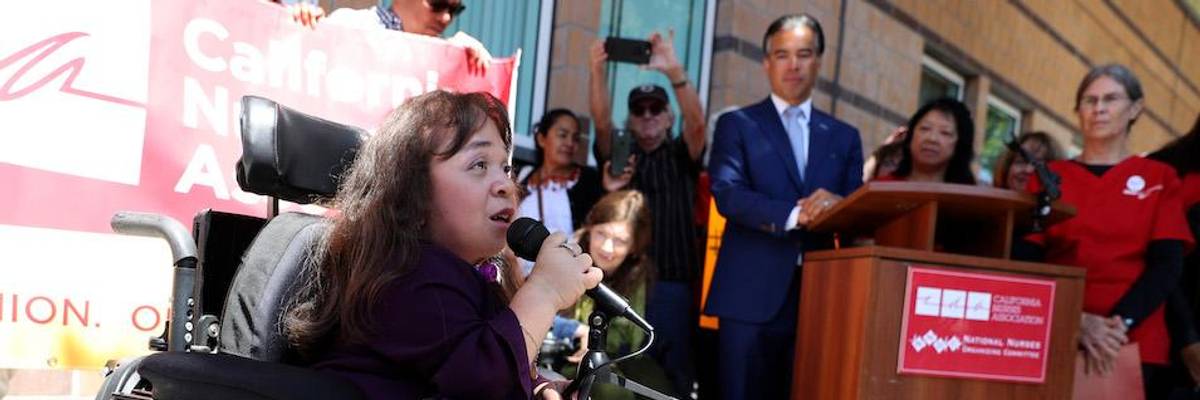
Maria Isabel Bueso, 24, speaks during a protest outside of UCSF Benioff Children's Hospital on September 06, 2019 in Oakland, California. (Photo: Justin Sullivan/Getty Images)
A group of healthcare providers rallied outside a California hospital on Friday to protest a patient's possible deportation--an action her advocates say would be an effective death sentence.
"Immigrants are human beings whose lives are not to be thrown away," said Aina Gagui, an RN at UCSF Benioff Children's Hospital Oakland, in a press statement.
The case involves 24-year-old Maria Isabel Bueso, who's been receiving life-saving treatment which is unavailable in her home country of Guatemala for the rare disease she suffers from, mucopolysaccharidosis type VI, at the Bay Area hospital since she was seven. Bueso and her parents came to the country at the invitation of Dr. Paul Harmatz, who wanted Isabel to take part in clinical trials.
While Bueso and her family have been in the country legally under the medical "deferred action" program that gives those receiving needed medical condition permission to stay. Rep. Mark DeSaulnier (D-Calif.) explained this week that the family "has followed every rule."
"They came here legally, paid their taxes, and Isabel's participation in groundbreaking clinical trials has given hope to Americans with rare diseases," said DeSaulnier.
But in mid-August, the family got news that Isabel's mom, Karla, said made her feel like "the whole world was collapsing." The Bueso family received a letter from the Department of Homeland Security saying the deferment was not being renewed, as it had been previously, and that the family must leave the country within 33 days or face deportation.
Uncertainty continued on Monday when the administration announced it was reopening cases of such deferments. But the administration did not say it was getting rid of the controversial policy change fully. Nor was it clear that another medical deferrment for Isabel, who is wheelchair-bound, was a sure thing.
For Isabel, it's a matter of life or death.
"You're really handing her a death sentence," Dr. Harmatz told MSNBC last week of a possible deportation. "It's as if we're pulling the plug on a respirator or stopping feedings for a patient that needs that type of support."
Healthcare workers at the hospital hope that scenario never happens.
"It's our duty as nurses to fight for what's best for our patients, regardless of their immigration status," said Bonnie Castillo, executive director of California Nurses Association/National Nurses United (CNA/NNU).
"There are no borders to caring for our patients' health," said Castillo, "and nurses are standing up to demand Maria Isabel Bueso and other patients maintain their right to receive lifesaving care. This is an issue of basic morality."
Dear Common Dreams reader, It’s been nearly 30 years since I co-founded Common Dreams with my late wife, Lina Newhouser. We had the radical notion that journalism should serve the public good, not corporate profits. It was clear to us from the outset what it would take to build such a project. No paid advertisements. No corporate sponsors. No millionaire publisher telling us what to think or do. Many people said we wouldn't last a year, but we proved those doubters wrong. Together with a tremendous team of journalists and dedicated staff, we built an independent media outlet free from the constraints of profits and corporate control. Our mission has always been simple: To inform. To inspire. To ignite change for the common good. Building Common Dreams was not easy. Our survival was never guaranteed. When you take on the most powerful forces—Wall Street greed, fossil fuel industry destruction, Big Tech lobbyists, and uber-rich oligarchs who have spent billions upon billions rigging the economy and democracy in their favor—the only bulwark you have is supporters who believe in your work. But here’s the urgent message from me today. It's never been this bad out there. And it's never been this hard to keep us going. At the very moment Common Dreams is most needed, the threats we face are intensifying. We need your support now more than ever. We don't accept corporate advertising and never will. We don't have a paywall because we don't think people should be blocked from critical news based on their ability to pay. Everything we do is funded by the donations of readers like you. When everyone does the little they can afford, we are strong. But if that support retreats or dries up, so do we. Will you donate now to make sure Common Dreams not only survives but thrives? —Craig Brown, Co-founder |
A group of healthcare providers rallied outside a California hospital on Friday to protest a patient's possible deportation--an action her advocates say would be an effective death sentence.
"Immigrants are human beings whose lives are not to be thrown away," said Aina Gagui, an RN at UCSF Benioff Children's Hospital Oakland, in a press statement.
The case involves 24-year-old Maria Isabel Bueso, who's been receiving life-saving treatment which is unavailable in her home country of Guatemala for the rare disease she suffers from, mucopolysaccharidosis type VI, at the Bay Area hospital since she was seven. Bueso and her parents came to the country at the invitation of Dr. Paul Harmatz, who wanted Isabel to take part in clinical trials.
While Bueso and her family have been in the country legally under the medical "deferred action" program that gives those receiving needed medical condition permission to stay. Rep. Mark DeSaulnier (D-Calif.) explained this week that the family "has followed every rule."
"They came here legally, paid their taxes, and Isabel's participation in groundbreaking clinical trials has given hope to Americans with rare diseases," said DeSaulnier.
But in mid-August, the family got news that Isabel's mom, Karla, said made her feel like "the whole world was collapsing." The Bueso family received a letter from the Department of Homeland Security saying the deferment was not being renewed, as it had been previously, and that the family must leave the country within 33 days or face deportation.
Uncertainty continued on Monday when the administration announced it was reopening cases of such deferments. But the administration did not say it was getting rid of the controversial policy change fully. Nor was it clear that another medical deferrment for Isabel, who is wheelchair-bound, was a sure thing.
For Isabel, it's a matter of life or death.
"You're really handing her a death sentence," Dr. Harmatz told MSNBC last week of a possible deportation. "It's as if we're pulling the plug on a respirator or stopping feedings for a patient that needs that type of support."
Healthcare workers at the hospital hope that scenario never happens.
"It's our duty as nurses to fight for what's best for our patients, regardless of their immigration status," said Bonnie Castillo, executive director of California Nurses Association/National Nurses United (CNA/NNU).
"There are no borders to caring for our patients' health," said Castillo, "and nurses are standing up to demand Maria Isabel Bueso and other patients maintain their right to receive lifesaving care. This is an issue of basic morality."
A group of healthcare providers rallied outside a California hospital on Friday to protest a patient's possible deportation--an action her advocates say would be an effective death sentence.
"Immigrants are human beings whose lives are not to be thrown away," said Aina Gagui, an RN at UCSF Benioff Children's Hospital Oakland, in a press statement.
The case involves 24-year-old Maria Isabel Bueso, who's been receiving life-saving treatment which is unavailable in her home country of Guatemala for the rare disease she suffers from, mucopolysaccharidosis type VI, at the Bay Area hospital since she was seven. Bueso and her parents came to the country at the invitation of Dr. Paul Harmatz, who wanted Isabel to take part in clinical trials.
While Bueso and her family have been in the country legally under the medical "deferred action" program that gives those receiving needed medical condition permission to stay. Rep. Mark DeSaulnier (D-Calif.) explained this week that the family "has followed every rule."
"They came here legally, paid their taxes, and Isabel's participation in groundbreaking clinical trials has given hope to Americans with rare diseases," said DeSaulnier.
But in mid-August, the family got news that Isabel's mom, Karla, said made her feel like "the whole world was collapsing." The Bueso family received a letter from the Department of Homeland Security saying the deferment was not being renewed, as it had been previously, and that the family must leave the country within 33 days or face deportation.
Uncertainty continued on Monday when the administration announced it was reopening cases of such deferments. But the administration did not say it was getting rid of the controversial policy change fully. Nor was it clear that another medical deferrment for Isabel, who is wheelchair-bound, was a sure thing.
For Isabel, it's a matter of life or death.
"You're really handing her a death sentence," Dr. Harmatz told MSNBC last week of a possible deportation. "It's as if we're pulling the plug on a respirator or stopping feedings for a patient that needs that type of support."
Healthcare workers at the hospital hope that scenario never happens.
"It's our duty as nurses to fight for what's best for our patients, regardless of their immigration status," said Bonnie Castillo, executive director of California Nurses Association/National Nurses United (CNA/NNU).
"There are no borders to caring for our patients' health," said Castillo, "and nurses are standing up to demand Maria Isabel Bueso and other patients maintain their right to receive lifesaving care. This is an issue of basic morality."

