SUBSCRIBE TO OUR FREE NEWSLETTER
Daily news & progressive opinion—funded by the people, not the corporations—delivered straight to your inbox.
5
#000000
#FFFFFF
To donate by check, phone, or other method, see our More Ways to Give page.
Daily news & progressive opinion—funded by the people, not the corporations—delivered straight to your inbox.
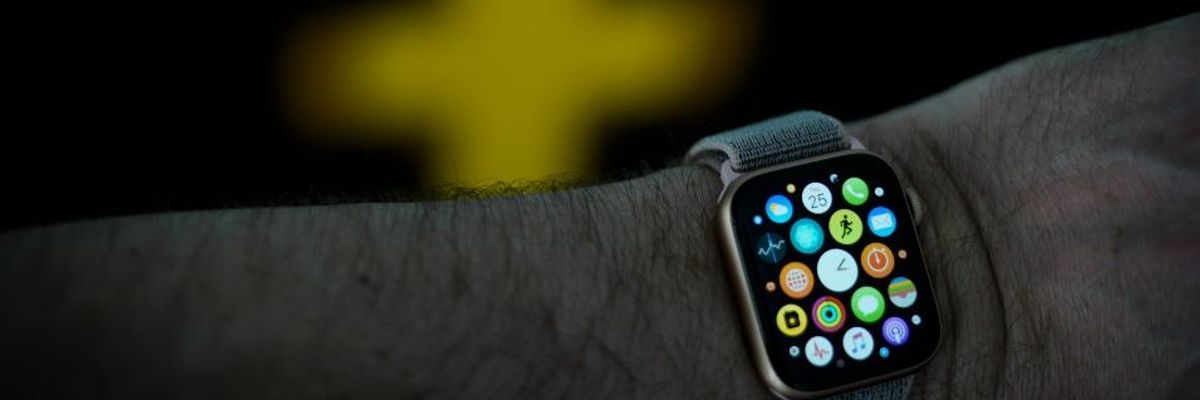
The Apple Watch is among the personal technology devices which could be used by a newly-proposed agency to draw information about people's health and behavior, with the stated goal of identifying risk factors for a mass shooting. (Photo: Jaap Arriens/NurPhoto via Getty Images)
In keeping with his insistence that people with mental illnesses, and not the wide availability of guns, are to blame for the epidemic of gun violence and mass shootings in the U.S., President Donald Trump is reportedly considering a new project aimed at detecting mental health issues to stop shootings before they happen.
As The Washington Post reported Thursday, the Trump administration has worked with Bob Wright, a close friend of Trump's and his collaborator on the reality show "The Apprentice," to develop a proposal for a new federal agency that would be called the Health Advanced Research Projects Agency (HARPA), within the Health and Human Services Department.
HARPA would be modeled after and led by a top official at the Pentagon's research office, the Defense Advanced Research Projects Agency (DARPA), which has developed drones, artificial intelligence meant to merge with deadly weapons, and technology to help U.S. soldiers detect safety threats during deployments.
Instead of developing military equipment, HARPA would draw information from people--gathered strictly from people who opt in to the program, the administration says--to identify "neurobehavioral signs" of "someone headed toward a violent explosive act."
As Sarah Orem, a postdoctoral student who researches disability rights, wrote on social media, HARPA's technology "deeply resembles" the Pentagon's, "which scans for 'possible threats' to soldiers at war."
"Except the 'threat' here is mentally ill Americans," Orem said.
Orem called the proposal "nothing less than chilling."
As many on Twitter are picking up on, Trump's interest in creating a DARPA-style agency called HARPA tasked with policing potential "neuropsychiatric violence" (a term which needs unpacking) is nothing less than chilling. (1/ https://t.co/Uo0uZdtw1S
-- Sarah Orem (@s_orem) August 22, 2019
The Post reported that Wright first proposed the program in June 2017. He approached the administration again last week in the wake of two mass shootings in El Paso, Texas and Dayton, Ohio, in which 31 people were killed this month.
Talks about HARPA were reopened as Trump was assuring the NRA that he would not pursue universal background check legislation to prevent mass shootings, and doubling down on previous claims that people with mental health challenges are the primary cause of shootings--suggesting to reporters last week that the U.S. should institutionalize mentally ill people en masse to prevent violence.
Contrary to the president's claims, studies have shown that mental health issues are not a major risk factor for perpetrating violence.
Trump has reportedly been receptive to the HARPA proposal and the administration is currently considering a potential project within the agency called "Safe Home" (Stopping Aberrant Fatal Events by Helping Overcome Mental Extremes), which would involve a "sensor suite" using AI to identify people who could be prone to violence.
Just as DARPA has partnered with private companies, HARPA would potentially use personal technology devices like Apple Watches, Google Home, and FitBit to identify behavioral or mental health changes.
Although officials insist the information would be gathered from people who volunteer it, some critics raised alarm about the use of products which have already come under scrutiny for violating users' privacy, to gather health information.
"While mental health research is, in and of itself, a worthy and important endeavor, the prospect of a computer culling people's smart home data in the pursuit of red-flagging potential mass shooters feels uniquely dystopian, particularly given America's long, dark history of domestic surveillance," wrote Rafi Schwartz at Splinter News.
Others noted that the details which have been released about HARPA thus far are vague--leading to questions about what the government plans to do after it determines that someone exhibits signs that they could be dangerous to the community.
"This agency isn't being proposed to stem gun violence. It never was," wrote Orem. "Tons of research suggests that gun violence does not correlate or stem from mental illness. This is about policing disability and cognitive difference."
"And remember: because diagnoses of mental illness have been used to police people of color...women, and queer people, policing disability results in policing broader networks of minority groups," she added.
Dear Common Dreams reader, It’s been nearly 30 years since I co-founded Common Dreams with my late wife, Lina Newhouser. We had the radical notion that journalism should serve the public good, not corporate profits. It was clear to us from the outset what it would take to build such a project. No paid advertisements. No corporate sponsors. No millionaire publisher telling us what to think or do. Many people said we wouldn't last a year, but we proved those doubters wrong. Together with a tremendous team of journalists and dedicated staff, we built an independent media outlet free from the constraints of profits and corporate control. Our mission has always been simple: To inform. To inspire. To ignite change for the common good. Building Common Dreams was not easy. Our survival was never guaranteed. When you take on the most powerful forces—Wall Street greed, fossil fuel industry destruction, Big Tech lobbyists, and uber-rich oligarchs who have spent billions upon billions rigging the economy and democracy in their favor—the only bulwark you have is supporters who believe in your work. But here’s the urgent message from me today. It's never been this bad out there. And it's never been this hard to keep us going. At the very moment Common Dreams is most needed, the threats we face are intensifying. We need your support now more than ever. We don't accept corporate advertising and never will. We don't have a paywall because we don't think people should be blocked from critical news based on their ability to pay. Everything we do is funded by the donations of readers like you. When everyone does the little they can afford, we are strong. But if that support retreats or dries up, so do we. Will you donate now to make sure Common Dreams not only survives but thrives? —Craig Brown, Co-founder |
In keeping with his insistence that people with mental illnesses, and not the wide availability of guns, are to blame for the epidemic of gun violence and mass shootings in the U.S., President Donald Trump is reportedly considering a new project aimed at detecting mental health issues to stop shootings before they happen.
As The Washington Post reported Thursday, the Trump administration has worked with Bob Wright, a close friend of Trump's and his collaborator on the reality show "The Apprentice," to develop a proposal for a new federal agency that would be called the Health Advanced Research Projects Agency (HARPA), within the Health and Human Services Department.
HARPA would be modeled after and led by a top official at the Pentagon's research office, the Defense Advanced Research Projects Agency (DARPA), which has developed drones, artificial intelligence meant to merge with deadly weapons, and technology to help U.S. soldiers detect safety threats during deployments.
Instead of developing military equipment, HARPA would draw information from people--gathered strictly from people who opt in to the program, the administration says--to identify "neurobehavioral signs" of "someone headed toward a violent explosive act."
As Sarah Orem, a postdoctoral student who researches disability rights, wrote on social media, HARPA's technology "deeply resembles" the Pentagon's, "which scans for 'possible threats' to soldiers at war."
"Except the 'threat' here is mentally ill Americans," Orem said.
Orem called the proposal "nothing less than chilling."
As many on Twitter are picking up on, Trump's interest in creating a DARPA-style agency called HARPA tasked with policing potential "neuropsychiatric violence" (a term which needs unpacking) is nothing less than chilling. (1/ https://t.co/Uo0uZdtw1S
-- Sarah Orem (@s_orem) August 22, 2019
The Post reported that Wright first proposed the program in June 2017. He approached the administration again last week in the wake of two mass shootings in El Paso, Texas and Dayton, Ohio, in which 31 people were killed this month.
Talks about HARPA were reopened as Trump was assuring the NRA that he would not pursue universal background check legislation to prevent mass shootings, and doubling down on previous claims that people with mental health challenges are the primary cause of shootings--suggesting to reporters last week that the U.S. should institutionalize mentally ill people en masse to prevent violence.
Contrary to the president's claims, studies have shown that mental health issues are not a major risk factor for perpetrating violence.
Trump has reportedly been receptive to the HARPA proposal and the administration is currently considering a potential project within the agency called "Safe Home" (Stopping Aberrant Fatal Events by Helping Overcome Mental Extremes), which would involve a "sensor suite" using AI to identify people who could be prone to violence.
Just as DARPA has partnered with private companies, HARPA would potentially use personal technology devices like Apple Watches, Google Home, and FitBit to identify behavioral or mental health changes.
Although officials insist the information would be gathered from people who volunteer it, some critics raised alarm about the use of products which have already come under scrutiny for violating users' privacy, to gather health information.
"While mental health research is, in and of itself, a worthy and important endeavor, the prospect of a computer culling people's smart home data in the pursuit of red-flagging potential mass shooters feels uniquely dystopian, particularly given America's long, dark history of domestic surveillance," wrote Rafi Schwartz at Splinter News.
Others noted that the details which have been released about HARPA thus far are vague--leading to questions about what the government plans to do after it determines that someone exhibits signs that they could be dangerous to the community.
"This agency isn't being proposed to stem gun violence. It never was," wrote Orem. "Tons of research suggests that gun violence does not correlate or stem from mental illness. This is about policing disability and cognitive difference."
"And remember: because diagnoses of mental illness have been used to police people of color...women, and queer people, policing disability results in policing broader networks of minority groups," she added.
In keeping with his insistence that people with mental illnesses, and not the wide availability of guns, are to blame for the epidemic of gun violence and mass shootings in the U.S., President Donald Trump is reportedly considering a new project aimed at detecting mental health issues to stop shootings before they happen.
As The Washington Post reported Thursday, the Trump administration has worked with Bob Wright, a close friend of Trump's and his collaborator on the reality show "The Apprentice," to develop a proposal for a new federal agency that would be called the Health Advanced Research Projects Agency (HARPA), within the Health and Human Services Department.
HARPA would be modeled after and led by a top official at the Pentagon's research office, the Defense Advanced Research Projects Agency (DARPA), which has developed drones, artificial intelligence meant to merge with deadly weapons, and technology to help U.S. soldiers detect safety threats during deployments.
Instead of developing military equipment, HARPA would draw information from people--gathered strictly from people who opt in to the program, the administration says--to identify "neurobehavioral signs" of "someone headed toward a violent explosive act."
As Sarah Orem, a postdoctoral student who researches disability rights, wrote on social media, HARPA's technology "deeply resembles" the Pentagon's, "which scans for 'possible threats' to soldiers at war."
"Except the 'threat' here is mentally ill Americans," Orem said.
Orem called the proposal "nothing less than chilling."
As many on Twitter are picking up on, Trump's interest in creating a DARPA-style agency called HARPA tasked with policing potential "neuropsychiatric violence" (a term which needs unpacking) is nothing less than chilling. (1/ https://t.co/Uo0uZdtw1S
-- Sarah Orem (@s_orem) August 22, 2019
The Post reported that Wright first proposed the program in June 2017. He approached the administration again last week in the wake of two mass shootings in El Paso, Texas and Dayton, Ohio, in which 31 people were killed this month.
Talks about HARPA were reopened as Trump was assuring the NRA that he would not pursue universal background check legislation to prevent mass shootings, and doubling down on previous claims that people with mental health challenges are the primary cause of shootings--suggesting to reporters last week that the U.S. should institutionalize mentally ill people en masse to prevent violence.
Contrary to the president's claims, studies have shown that mental health issues are not a major risk factor for perpetrating violence.
Trump has reportedly been receptive to the HARPA proposal and the administration is currently considering a potential project within the agency called "Safe Home" (Stopping Aberrant Fatal Events by Helping Overcome Mental Extremes), which would involve a "sensor suite" using AI to identify people who could be prone to violence.
Just as DARPA has partnered with private companies, HARPA would potentially use personal technology devices like Apple Watches, Google Home, and FitBit to identify behavioral or mental health changes.
Although officials insist the information would be gathered from people who volunteer it, some critics raised alarm about the use of products which have already come under scrutiny for violating users' privacy, to gather health information.
"While mental health research is, in and of itself, a worthy and important endeavor, the prospect of a computer culling people's smart home data in the pursuit of red-flagging potential mass shooters feels uniquely dystopian, particularly given America's long, dark history of domestic surveillance," wrote Rafi Schwartz at Splinter News.
Others noted that the details which have been released about HARPA thus far are vague--leading to questions about what the government plans to do after it determines that someone exhibits signs that they could be dangerous to the community.
"This agency isn't being proposed to stem gun violence. It never was," wrote Orem. "Tons of research suggests that gun violence does not correlate or stem from mental illness. This is about policing disability and cognitive difference."
"And remember: because diagnoses of mental illness have been used to police people of color...women, and queer people, policing disability results in policing broader networks of minority groups," she added.