SUBSCRIBE TO OUR FREE NEWSLETTER
Daily news & progressive opinion—funded by the people, not the corporations—delivered straight to your inbox.
5
#000000
#FFFFFF
To donate by check, phone, or other method, see our More Ways to Give page.
Daily news & progressive opinion—funded by the people, not the corporations—delivered straight to your inbox.
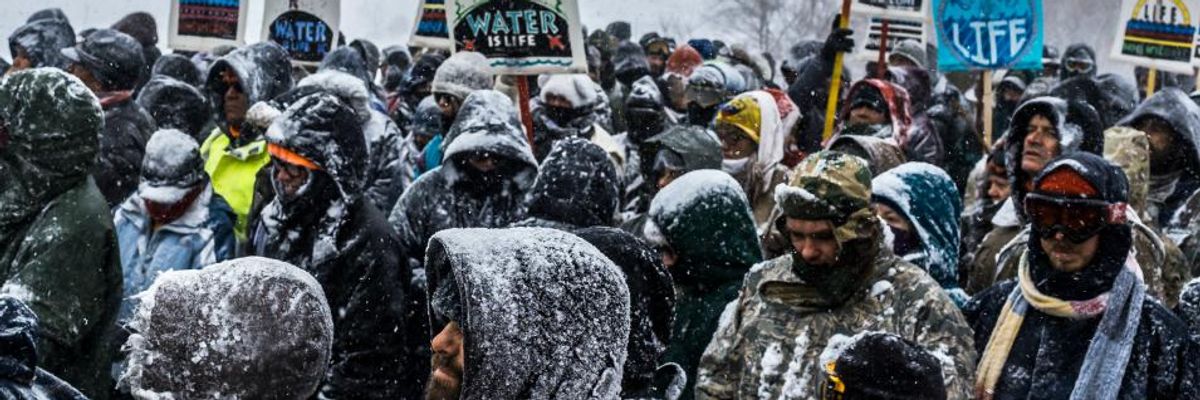
Winter arrives in Standing Rock at the Oceti Sakowin Camp in North Dakota on December 5, 2017. (Photo: Michael Nigro/Pacific Press/LightRocket via Getty Images)
As a growing number of states move to pass laws that would criminalize pipeline protests and hit demonstrators with years in prison, an audio recording obtained by The Intercept showed a representative of a powerful oil and gas lobbying group bragging about the industry's success in crafting anti-protest legislation behind closed doors.
Speaking during a conference in Washington, D.C. in June, Derrick Morgan, senior vice president for federal and regulatory affairs at the American Fuel & Petrochemical Manufacturers (AFPM), touted "model legislation" that states across the nation have passed in recent months.
AFPM represents a number of major fossil fuel giants, including Chevron, Koch Industries, and ExxonMobil.
"We've seen a lot of success at the state level, particularly starting with Oklahoma in 2017," said Morgan, citing Dakota Access Pipeline protests as the motivation behind the aggressive lobbying effort. "We're up to nine states that have passed laws that are substantially close to the model policy that you have in your packet."
The audio recording comes just months after Texas Gov. Greg Abbott signed into law legislation that would punish anti-pipeline demonstrators with up to 10 years in prison, a move environmentalists condemned as a flagrant attack on free expression.
" Big Oil is hijacking our legislative system," Dallas Goldtooth of the Indigenous Environmental Network said after the Texas Senate passed the bill in May.
As The Intercept's Lee Fang reported Monday, the model legislation Morgan cited in his remarks "has been introduced in various forms in 22 states and passed in... Texas, Louisiana, Oklahoma, Tennessee, Missouri, Indiana, Iowa, South Dakota, and North Dakota."
"The AFPM lobbyist also boasted that the template legislation has enjoyed bipartisan support," according to Fang. "In Louisiana, Democratic Gov. John Bel Edwards signed the version of the bill there, which is being challenged by the Center for Constitutional Rights. Even in Illinois, Morgan noted, 'We almost got that across the finish line in a very Democratic-dominated legislature.' The bill did not pass as it got pushed aside over time constraints at the end of the legislative session."
Dear Common Dreams reader, It’s been nearly 30 years since I co-founded Common Dreams with my late wife, Lina Newhouser. We had the radical notion that journalism should serve the public good, not corporate profits. It was clear to us from the outset what it would take to build such a project. No paid advertisements. No corporate sponsors. No millionaire publisher telling us what to think or do. Many people said we wouldn't last a year, but we proved those doubters wrong. Together with a tremendous team of journalists and dedicated staff, we built an independent media outlet free from the constraints of profits and corporate control. Our mission has always been simple: To inform. To inspire. To ignite change for the common good. Building Common Dreams was not easy. Our survival was never guaranteed. When you take on the most powerful forces—Wall Street greed, fossil fuel industry destruction, Big Tech lobbyists, and uber-rich oligarchs who have spent billions upon billions rigging the economy and democracy in their favor—the only bulwark you have is supporters who believe in your work. But here’s the urgent message from me today. It's never been this bad out there. And it's never been this hard to keep us going. At the very moment Common Dreams is most needed, the threats we face are intensifying. We need your support now more than ever. We don't accept corporate advertising and never will. We don't have a paywall because we don't think people should be blocked from critical news based on their ability to pay. Everything we do is funded by the donations of readers like you. When everyone does the little they can afford, we are strong. But if that support retreats or dries up, so do we. Will you donate now to make sure Common Dreams not only survives but thrives? —Craig Brown, Co-founder |
As a growing number of states move to pass laws that would criminalize pipeline protests and hit demonstrators with years in prison, an audio recording obtained by The Intercept showed a representative of a powerful oil and gas lobbying group bragging about the industry's success in crafting anti-protest legislation behind closed doors.
Speaking during a conference in Washington, D.C. in June, Derrick Morgan, senior vice president for federal and regulatory affairs at the American Fuel & Petrochemical Manufacturers (AFPM), touted "model legislation" that states across the nation have passed in recent months.
AFPM represents a number of major fossil fuel giants, including Chevron, Koch Industries, and ExxonMobil.
"We've seen a lot of success at the state level, particularly starting with Oklahoma in 2017," said Morgan, citing Dakota Access Pipeline protests as the motivation behind the aggressive lobbying effort. "We're up to nine states that have passed laws that are substantially close to the model policy that you have in your packet."
The audio recording comes just months after Texas Gov. Greg Abbott signed into law legislation that would punish anti-pipeline demonstrators with up to 10 years in prison, a move environmentalists condemned as a flagrant attack on free expression.
" Big Oil is hijacking our legislative system," Dallas Goldtooth of the Indigenous Environmental Network said after the Texas Senate passed the bill in May.
As The Intercept's Lee Fang reported Monday, the model legislation Morgan cited in his remarks "has been introduced in various forms in 22 states and passed in... Texas, Louisiana, Oklahoma, Tennessee, Missouri, Indiana, Iowa, South Dakota, and North Dakota."
"The AFPM lobbyist also boasted that the template legislation has enjoyed bipartisan support," according to Fang. "In Louisiana, Democratic Gov. John Bel Edwards signed the version of the bill there, which is being challenged by the Center for Constitutional Rights. Even in Illinois, Morgan noted, 'We almost got that across the finish line in a very Democratic-dominated legislature.' The bill did not pass as it got pushed aside over time constraints at the end of the legislative session."
As a growing number of states move to pass laws that would criminalize pipeline protests and hit demonstrators with years in prison, an audio recording obtained by The Intercept showed a representative of a powerful oil and gas lobbying group bragging about the industry's success in crafting anti-protest legislation behind closed doors.
Speaking during a conference in Washington, D.C. in June, Derrick Morgan, senior vice president for federal and regulatory affairs at the American Fuel & Petrochemical Manufacturers (AFPM), touted "model legislation" that states across the nation have passed in recent months.
AFPM represents a number of major fossil fuel giants, including Chevron, Koch Industries, and ExxonMobil.
"We've seen a lot of success at the state level, particularly starting with Oklahoma in 2017," said Morgan, citing Dakota Access Pipeline protests as the motivation behind the aggressive lobbying effort. "We're up to nine states that have passed laws that are substantially close to the model policy that you have in your packet."
The audio recording comes just months after Texas Gov. Greg Abbott signed into law legislation that would punish anti-pipeline demonstrators with up to 10 years in prison, a move environmentalists condemned as a flagrant attack on free expression.
" Big Oil is hijacking our legislative system," Dallas Goldtooth of the Indigenous Environmental Network said after the Texas Senate passed the bill in May.
As The Intercept's Lee Fang reported Monday, the model legislation Morgan cited in his remarks "has been introduced in various forms in 22 states and passed in... Texas, Louisiana, Oklahoma, Tennessee, Missouri, Indiana, Iowa, South Dakota, and North Dakota."
"The AFPM lobbyist also boasted that the template legislation has enjoyed bipartisan support," according to Fang. "In Louisiana, Democratic Gov. John Bel Edwards signed the version of the bill there, which is being challenged by the Center for Constitutional Rights. Even in Illinois, Morgan noted, 'We almost got that across the finish line in a very Democratic-dominated legislature.' The bill did not pass as it got pushed aside over time constraints at the end of the legislative session."