SUBSCRIBE TO OUR FREE NEWSLETTER
Daily news & progressive opinion—funded by the people, not the corporations—delivered straight to your inbox.
5
#000000
#FFFFFF
To donate by check, phone, or other method, see our More Ways to Give page.
Daily news & progressive opinion—funded by the people, not the corporations—delivered straight to your inbox.
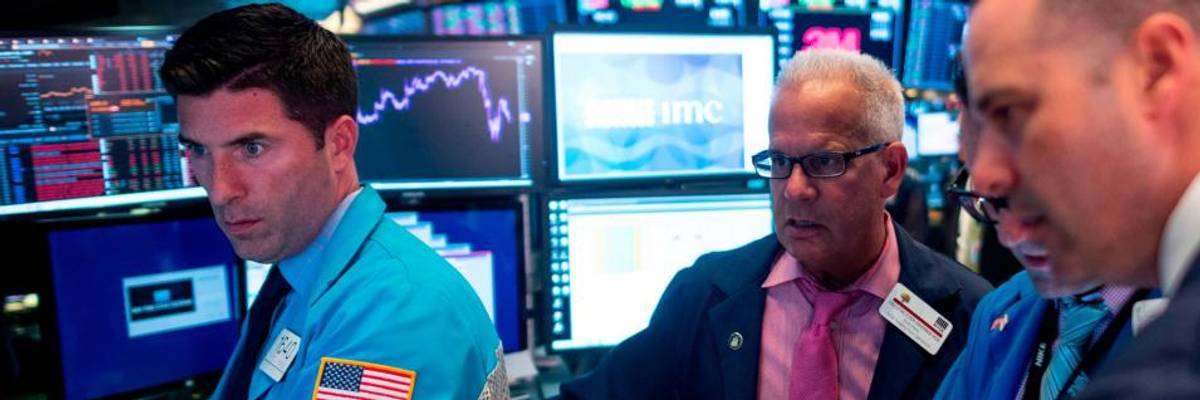
Traders work after the closing bell at the New York Stock Exchange (NYSE) on August 12, 2019 at Wall Street in New York City. (Photo: Johannes Eisele/AFP/Getty Images)
Warning signs that the U.S. economy could be barreling toward a recession quickly became alarm bells Wednesday after the Treasury bond yield curve--a key indicator that has preceded every major downturn over the past five decades--inverted for the first time since the Wall Street crash of 2007.
As the Washington Post reported, "the yields on short-term U.S. bonds eclipsed those of long-term bonds" on Wednesday, a phenomenon that "suggests investors' faith in the economy is faltering."
Chris Rupkey, chief financial economist at MUFG Union Bank, told the Post that "yield curves are all crying timber that a recession is almost a reality, and investors are tripping over themselves to get out of the way."
CNBC described the inverted yield curve as the "strongest recession signal yet."
Economists and other commentators were quick to place at least some of the blame for worsening market volatility on President Donald Trump's trade war with China, the world's second-largest economy behind the U.S.
Though Trump sparked a brief rally on Tuesday with his decision to delay his planned 10 percent tariffs on Chinese goods until Dec. 15, markets tanked again Wednesday in response to the inverted yield curve, wiping out the previous day's gains and triggering fears that a major recession could be imminent.
"Amazing how many people have spent time trying to project some rationality onto Trump trade policy," tweeted economist and New York Times columnist Paul Krugman. "What looks like raw ignorance and prejudice is, in fact, raw ignorance and prejudice."
Talking Points Memo editor Josh Marshall pointed out that while presidents are often incorrectly blamed or credited with the state of the economy, "it'll be impossible not to point to a ruinous, needless trade war as a key cause" if a recession hits.
As markets slid on Wednesday, others noted the historic pattern of recessionary cycles that have corresponded with massive tax cuts for the wealthiest:
Further intensifying fears of a recession, said economists, is the fact that the Trump administration does not appear willing to take the steps necessary to combat a serious downturn, such as spending money on meaningful government initiatives like an infrastructure program.
"If Trump proposed a serious infrastructure plan, Dems would have a hard time saying no even though it would help him politically. But no such plan has been or will be offered, for a couple of reasons," tweeted Krugman. "One is that [Senate Majority Leader] Mitch McConnell and his wing of the party oppose any kind of government program, no matter how much good it might do."
"Another," added Krugman, "is that Trump and co. just can't bring themselves to advocate anything that doesn't include scams on behalf of their cronies."
Dear Common Dreams reader, It’s been nearly 30 years since I co-founded Common Dreams with my late wife, Lina Newhouser. We had the radical notion that journalism should serve the public good, not corporate profits. It was clear to us from the outset what it would take to build such a project. No paid advertisements. No corporate sponsors. No millionaire publisher telling us what to think or do. Many people said we wouldn't last a year, but we proved those doubters wrong. Together with a tremendous team of journalists and dedicated staff, we built an independent media outlet free from the constraints of profits and corporate control. Our mission has always been simple: To inform. To inspire. To ignite change for the common good. Building Common Dreams was not easy. Our survival was never guaranteed. When you take on the most powerful forces—Wall Street greed, fossil fuel industry destruction, Big Tech lobbyists, and uber-rich oligarchs who have spent billions upon billions rigging the economy and democracy in their favor—the only bulwark you have is supporters who believe in your work. But here’s the urgent message from me today. It's never been this bad out there. And it's never been this hard to keep us going. At the very moment Common Dreams is most needed, the threats we face are intensifying. We need your support now more than ever. We don't accept corporate advertising and never will. We don't have a paywall because we don't think people should be blocked from critical news based on their ability to pay. Everything we do is funded by the donations of readers like you. When everyone does the little they can afford, we are strong. But if that support retreats or dries up, so do we. Will you donate now to make sure Common Dreams not only survives but thrives? —Craig Brown, Co-founder |
Warning signs that the U.S. economy could be barreling toward a recession quickly became alarm bells Wednesday after the Treasury bond yield curve--a key indicator that has preceded every major downturn over the past five decades--inverted for the first time since the Wall Street crash of 2007.
As the Washington Post reported, "the yields on short-term U.S. bonds eclipsed those of long-term bonds" on Wednesday, a phenomenon that "suggests investors' faith in the economy is faltering."
Chris Rupkey, chief financial economist at MUFG Union Bank, told the Post that "yield curves are all crying timber that a recession is almost a reality, and investors are tripping over themselves to get out of the way."
CNBC described the inverted yield curve as the "strongest recession signal yet."
Economists and other commentators were quick to place at least some of the blame for worsening market volatility on President Donald Trump's trade war with China, the world's second-largest economy behind the U.S.
Though Trump sparked a brief rally on Tuesday with his decision to delay his planned 10 percent tariffs on Chinese goods until Dec. 15, markets tanked again Wednesday in response to the inverted yield curve, wiping out the previous day's gains and triggering fears that a major recession could be imminent.
"Amazing how many people have spent time trying to project some rationality onto Trump trade policy," tweeted economist and New York Times columnist Paul Krugman. "What looks like raw ignorance and prejudice is, in fact, raw ignorance and prejudice."
Talking Points Memo editor Josh Marshall pointed out that while presidents are often incorrectly blamed or credited with the state of the economy, "it'll be impossible not to point to a ruinous, needless trade war as a key cause" if a recession hits.
As markets slid on Wednesday, others noted the historic pattern of recessionary cycles that have corresponded with massive tax cuts for the wealthiest:
Further intensifying fears of a recession, said economists, is the fact that the Trump administration does not appear willing to take the steps necessary to combat a serious downturn, such as spending money on meaningful government initiatives like an infrastructure program.
"If Trump proposed a serious infrastructure plan, Dems would have a hard time saying no even though it would help him politically. But no such plan has been or will be offered, for a couple of reasons," tweeted Krugman. "One is that [Senate Majority Leader] Mitch McConnell and his wing of the party oppose any kind of government program, no matter how much good it might do."
"Another," added Krugman, "is that Trump and co. just can't bring themselves to advocate anything that doesn't include scams on behalf of their cronies."
Warning signs that the U.S. economy could be barreling toward a recession quickly became alarm bells Wednesday after the Treasury bond yield curve--a key indicator that has preceded every major downturn over the past five decades--inverted for the first time since the Wall Street crash of 2007.
As the Washington Post reported, "the yields on short-term U.S. bonds eclipsed those of long-term bonds" on Wednesday, a phenomenon that "suggests investors' faith in the economy is faltering."
Chris Rupkey, chief financial economist at MUFG Union Bank, told the Post that "yield curves are all crying timber that a recession is almost a reality, and investors are tripping over themselves to get out of the way."
CNBC described the inverted yield curve as the "strongest recession signal yet."
Economists and other commentators were quick to place at least some of the blame for worsening market volatility on President Donald Trump's trade war with China, the world's second-largest economy behind the U.S.
Though Trump sparked a brief rally on Tuesday with his decision to delay his planned 10 percent tariffs on Chinese goods until Dec. 15, markets tanked again Wednesday in response to the inverted yield curve, wiping out the previous day's gains and triggering fears that a major recession could be imminent.
"Amazing how many people have spent time trying to project some rationality onto Trump trade policy," tweeted economist and New York Times columnist Paul Krugman. "What looks like raw ignorance and prejudice is, in fact, raw ignorance and prejudice."
Talking Points Memo editor Josh Marshall pointed out that while presidents are often incorrectly blamed or credited with the state of the economy, "it'll be impossible not to point to a ruinous, needless trade war as a key cause" if a recession hits.
As markets slid on Wednesday, others noted the historic pattern of recessionary cycles that have corresponded with massive tax cuts for the wealthiest:
Further intensifying fears of a recession, said economists, is the fact that the Trump administration does not appear willing to take the steps necessary to combat a serious downturn, such as spending money on meaningful government initiatives like an infrastructure program.
"If Trump proposed a serious infrastructure plan, Dems would have a hard time saying no even though it would help him politically. But no such plan has been or will be offered, for a couple of reasons," tweeted Krugman. "One is that [Senate Majority Leader] Mitch McConnell and his wing of the party oppose any kind of government program, no matter how much good it might do."
"Another," added Krugman, "is that Trump and co. just can't bring themselves to advocate anything that doesn't include scams on behalf of their cronies."