SUBSCRIBE TO OUR FREE NEWSLETTER
Daily news & progressive opinion—funded by the people, not the corporations—delivered straight to your inbox.
5
#000000
#FFFFFF
To donate by check, phone, or other method, see our More Ways to Give page.
Daily news & progressive opinion—funded by the people, not the corporations—delivered straight to your inbox.
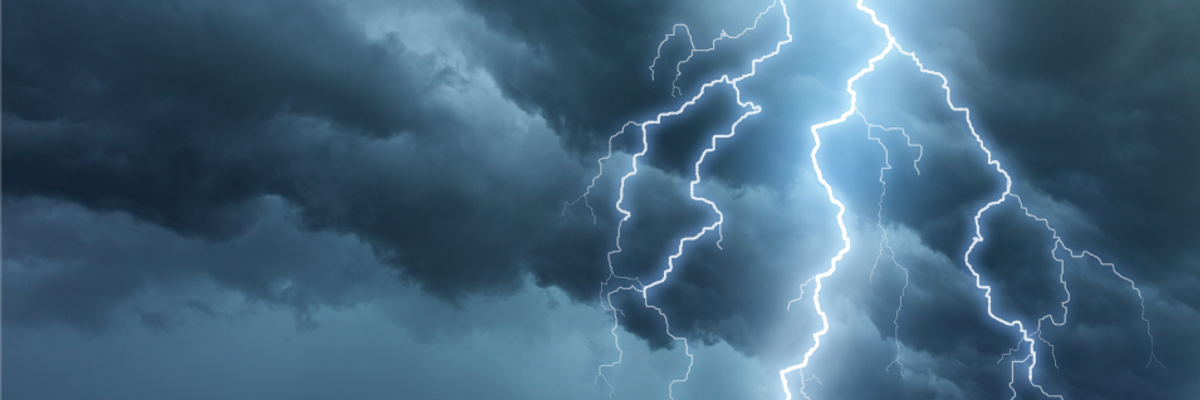
The National Weather Service in Fairbanks, Alaska recorded lightning within 300 miles of the North Pole over the weekend. (Photo: iStock/Getty Images Plus)
Meteorologists and climate scientists were startled Monday after the U.S. National Weather Service confirmed that an extremely rare occurrence of lightning had been observed at the North Pole.
Multiple lightning strikes were recorded by the NWS office in Fairbanks, Alaska between 4:00 and 6:00pm on Saturday, within 300 miles of the pole.
The NWS saw it necessary to release a public statement on the lightning event, which usually doesn't take place at the North Pole due to icy temperatures.
"This is one of the furthest north lightning strikes in Alaska forecaster memory," the NWS said.
Experts observed storm clouds in the region which, at lower latitudes, would have preceded thunderstorms. Lightning generally happens much further south because relatively higher temperatures and humidity levels are needed to cause the phenomenon.
The lightning at the North Pole was observed after climate experts have spent weeks recording higher-than-average temperatures in the Arctic. The warming globe is causing sea ice in the region to disappear at a higher rate than ever recorded, as Common Dreams reported last month. The melting ice in turn is contributing to a warmer Arctic.
As the Washington Post reported, the lighting denotes "that the atmosphere near the pole was unstable enough, with sufficient warm and moist air in the lower atmosphere, to give rise to thunderstorms."
"The probability of this kind of event occurring would increase as the sea ice extent retreats farther and farther north in the summertime," Alex Young, a meteorologist with the NWS in Fairbanks, told Wired.
Before the lightning was recorded, climate scientists were concerned about wildfires that have been burning in Greenland for more than a month.
"The lightning strikes near the North Pole come during one of the most extreme Arctic ice melt years on record," the Washington Post's Capital Weather Gang tweeted, summarizing meteorologists' alarm over recent weather in the planet's far northern region. "There's currently no sea ice in Alaskan waters, and Arctic-wide sea ice is plummeting to one of the five lowest levels on record."
Other climatologists and weather experts were stunned to learn of the lightning event.
UCLA climate scientist Daniel Swain warned that lightning strikes in the Arctic could be part of a new pattern of climate changes as the planet's sea ice continue to melt.
"Scientists already knew the Arctic was going to change much more rapidly than the rest of the world, and yet we've still been surprised at the rate of change we've been observing," Swain told Wired. "I think there's potential for nasty surprises coming out of the Arctic."
Dear Common Dreams reader, It’s been nearly 30 years since I co-founded Common Dreams with my late wife, Lina Newhouser. We had the radical notion that journalism should serve the public good, not corporate profits. It was clear to us from the outset what it would take to build such a project. No paid advertisements. No corporate sponsors. No millionaire publisher telling us what to think or do. Many people said we wouldn't last a year, but we proved those doubters wrong. Together with a tremendous team of journalists and dedicated staff, we built an independent media outlet free from the constraints of profits and corporate control. Our mission has always been simple: To inform. To inspire. To ignite change for the common good. Building Common Dreams was not easy. Our survival was never guaranteed. When you take on the most powerful forces—Wall Street greed, fossil fuel industry destruction, Big Tech lobbyists, and uber-rich oligarchs who have spent billions upon billions rigging the economy and democracy in their favor—the only bulwark you have is supporters who believe in your work. But here’s the urgent message from me today. It's never been this bad out there. And it's never been this hard to keep us going. At the very moment Common Dreams is most needed, the threats we face are intensifying. We need your support now more than ever. We don't accept corporate advertising and never will. We don't have a paywall because we don't think people should be blocked from critical news based on their ability to pay. Everything we do is funded by the donations of readers like you. When everyone does the little they can afford, we are strong. But if that support retreats or dries up, so do we. Will you donate now to make sure Common Dreams not only survives but thrives? —Craig Brown, Co-founder |
Meteorologists and climate scientists were startled Monday after the U.S. National Weather Service confirmed that an extremely rare occurrence of lightning had been observed at the North Pole.
Multiple lightning strikes were recorded by the NWS office in Fairbanks, Alaska between 4:00 and 6:00pm on Saturday, within 300 miles of the pole.
The NWS saw it necessary to release a public statement on the lightning event, which usually doesn't take place at the North Pole due to icy temperatures.
"This is one of the furthest north lightning strikes in Alaska forecaster memory," the NWS said.
Experts observed storm clouds in the region which, at lower latitudes, would have preceded thunderstorms. Lightning generally happens much further south because relatively higher temperatures and humidity levels are needed to cause the phenomenon.
The lightning at the North Pole was observed after climate experts have spent weeks recording higher-than-average temperatures in the Arctic. The warming globe is causing sea ice in the region to disappear at a higher rate than ever recorded, as Common Dreams reported last month. The melting ice in turn is contributing to a warmer Arctic.
As the Washington Post reported, the lighting denotes "that the atmosphere near the pole was unstable enough, with sufficient warm and moist air in the lower atmosphere, to give rise to thunderstorms."
"The probability of this kind of event occurring would increase as the sea ice extent retreats farther and farther north in the summertime," Alex Young, a meteorologist with the NWS in Fairbanks, told Wired.
Before the lightning was recorded, climate scientists were concerned about wildfires that have been burning in Greenland for more than a month.
"The lightning strikes near the North Pole come during one of the most extreme Arctic ice melt years on record," the Washington Post's Capital Weather Gang tweeted, summarizing meteorologists' alarm over recent weather in the planet's far northern region. "There's currently no sea ice in Alaskan waters, and Arctic-wide sea ice is plummeting to one of the five lowest levels on record."
Other climatologists and weather experts were stunned to learn of the lightning event.
UCLA climate scientist Daniel Swain warned that lightning strikes in the Arctic could be part of a new pattern of climate changes as the planet's sea ice continue to melt.
"Scientists already knew the Arctic was going to change much more rapidly than the rest of the world, and yet we've still been surprised at the rate of change we've been observing," Swain told Wired. "I think there's potential for nasty surprises coming out of the Arctic."
Meteorologists and climate scientists were startled Monday after the U.S. National Weather Service confirmed that an extremely rare occurrence of lightning had been observed at the North Pole.
Multiple lightning strikes were recorded by the NWS office in Fairbanks, Alaska between 4:00 and 6:00pm on Saturday, within 300 miles of the pole.
The NWS saw it necessary to release a public statement on the lightning event, which usually doesn't take place at the North Pole due to icy temperatures.
"This is one of the furthest north lightning strikes in Alaska forecaster memory," the NWS said.
Experts observed storm clouds in the region which, at lower latitudes, would have preceded thunderstorms. Lightning generally happens much further south because relatively higher temperatures and humidity levels are needed to cause the phenomenon.
The lightning at the North Pole was observed after climate experts have spent weeks recording higher-than-average temperatures in the Arctic. The warming globe is causing sea ice in the region to disappear at a higher rate than ever recorded, as Common Dreams reported last month. The melting ice in turn is contributing to a warmer Arctic.
As the Washington Post reported, the lighting denotes "that the atmosphere near the pole was unstable enough, with sufficient warm and moist air in the lower atmosphere, to give rise to thunderstorms."
"The probability of this kind of event occurring would increase as the sea ice extent retreats farther and farther north in the summertime," Alex Young, a meteorologist with the NWS in Fairbanks, told Wired.
Before the lightning was recorded, climate scientists were concerned about wildfires that have been burning in Greenland for more than a month.
"The lightning strikes near the North Pole come during one of the most extreme Arctic ice melt years on record," the Washington Post's Capital Weather Gang tweeted, summarizing meteorologists' alarm over recent weather in the planet's far northern region. "There's currently no sea ice in Alaskan waters, and Arctic-wide sea ice is plummeting to one of the five lowest levels on record."
Other climatologists and weather experts were stunned to learn of the lightning event.
UCLA climate scientist Daniel Swain warned that lightning strikes in the Arctic could be part of a new pattern of climate changes as the planet's sea ice continue to melt.
"Scientists already knew the Arctic was going to change much more rapidly than the rest of the world, and yet we've still been surprised at the rate of change we've been observing," Swain told Wired. "I think there's potential for nasty surprises coming out of the Arctic."