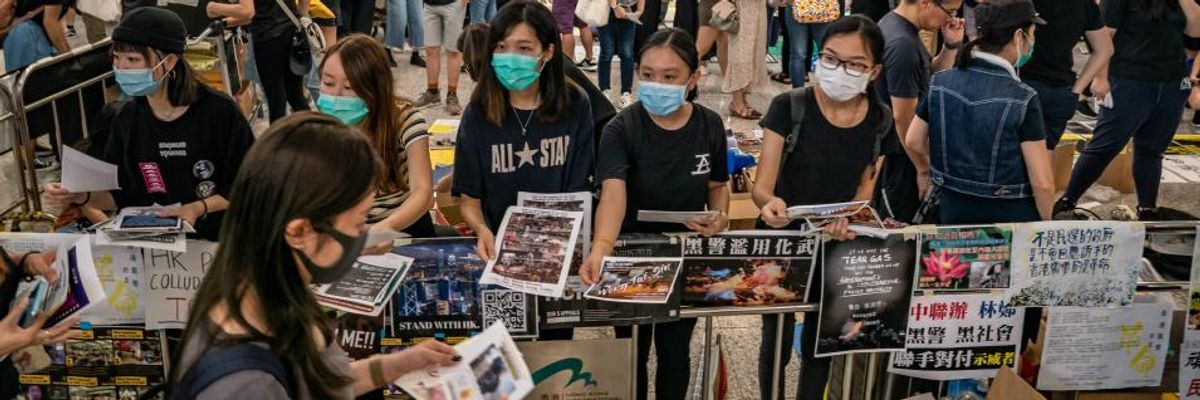
Pro-democracy protesters hand out leaflets at the arrival hall of the Hong Kong International Airport during a demonstration on Aug. 11, 2019. Rallies on the streets of Hong Kong against a controversial extradition bill began on June 9. (Photo: Anthony Kwan/Getty Images)
Concerns Over Police Brutality Persist as Hong Kong Protesters Shut Down One of World's Busiest Airports
Now in their 10th week, the protests were sparked in June by a controversial extradition bill
Thousands of pro-democracy protesters effectively shut down Hong Kong International Airport on Monday, the fourth day they have occupied one of the world's busiest airports as part of the mass demonstrations--against police brutality and a controversial extradition bill--that have rattled Hong Kong since June.
The protests were initially spurred by a bill that, NPR explained, "would have allowed people in Hong Kong to be sent to mainland China to face trials in courts controlled by the Communist Party, sparking fears of politically motivated prosecutions targeting outspoken critics of China." Although Hong Kong Chief Executive Carrie Lam quickly suspended the measure and later declared it "dead," demonstrators continue to demand its full withdrawal and Lam's resignation.
Monday, in what the South China Morning Post called an "unprecedented disruption," outgoing flights at the airport were cancelled from 4pm local time onward. Since Friday, protesters at the airport have carried signs that read "Hong Kong is not safe," "HK police are killing us," and "Sorry for the inconvenience. We are fighting for the future of our home." Some have donned eye patches to draw attention to a female who could lose her eye after reportedly being shot with a beanbag round fired by police during demonstrations in Tsim Sha Tsui Sunday.
A 38-year-old businessman who joined the airport protest, wearing a makeshift eye patch, told the Hong Kong-based newspaper that local police have "buried their humanity." Holding back tears, he said: "A girl who came out for Hongkongers lost her eye... My heart aches."
Addressing reports about the protester with a ruptured eye and police response to the demonstrations more broadly, Amnesty International Hong Kong director Man-Kei Tam said in a statement Monday that "the Hong Kong police have once again demonstrated how not to police a protest."
"Hong Kong police have once again used tear gas and rubber bullets in a way that have fallen short of international standards. Firing at retreating protesters in confined areas where they had little time to leave goes against the purported objective of dispersing a crowd," said Tam. "Law enforcement officials must be able to carry out their duty to protect the public. However, violence directed at police does not give officers a green light to operate outside of international policing standards."
Echoing a series of warnings from Amnesty and other rights groups in recent weeks, Tam added that "any heavy-handed policing approach will only increase tension and provoke hostility, leading to the overall escalation of the situation."
Hilary Lo, who took a half day's sick leave from her accountancy firm to attend the airport demonstration, told The Guardian in an interview Monday, "I just don't understand how people can tolerate that kind of police brutality."
"I feel like if I don't come out now, I can't come out ever," she said. "People are starting to realize the police are out of control, especially with what has happened in the past two weeks."
As The Guardian reported:
Civil Rights Observer, a local rights group that sends observers to protests, said it had "very serious concerns" about police violence and had seen "very clear evidence to show the police are violating their guidelines," according to its spokesman Icarus Wong.
He said the group was particularly concerned by the use of undercover officers for the first time, who later turned on protesters on Sunday night. He said it was unclear if they may have acted as agitators before making mass arrests.
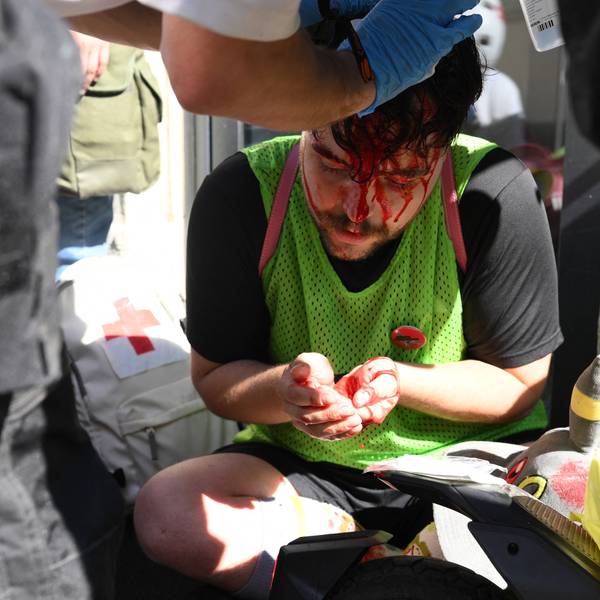
During the weekend protests, the website Hong Kong Free Press showed footage of one arrest that appeared to include officers dressing as protesters who injured a demonstrator pressed to the ground. The young man, who said his name was Chow Ka-lok and asked for a lawyer, was left with bleeding head wounds and a broken tooth.
Photos and videos of the airport occupation and weekend demonstrations have circulated on social media:
Hong Kong transitioned in 1997 from a British colony to a special administrative region of China, from which it maintains separate government and economic systems. Bloomberg reported Monday that "China in recent weeks has toughened its stance toward the movement and doubled down on its support for the police."
China stepped up its rhetoric on Monday, saying protesters have committed serious crimes and showed signs of "terrorism." Hong Kong has come to a "critical juncture" and all people who care about its future should say no to violence, Yang Guang, a spokesman for its Hong Kong and Macau Affairs Office, told reporters on Monday as protesters gathered at the airport.
"All those who care about Hong Kong's future should come out and stand against all criminal acts and perpetrators of violence," Yang told reporters.
"The protests have evolved into the biggest challenge to Chinese control since the U.K. relinquished its former colony in 1997," Bloomberg noted. "The social unrest has hurt the economy and impacted daily life in one of the world's most densely crowded cities, raising concern that Beijing will use force to restore order."
We are at a crossroads
This country and this world are at a monumental crossroads. In a few short weeks, US voters will have an opportunity to beat back the forces of fascism and confront the billionaires who are rigging the economy, our media system, and our democracy, making it increasingly impossible for ordinary people to get by. We’re not just talking about the election. We’re talking about what must be done once these fascist elements are vanquished from power. We need a bolder set of solutions than what either major party has so far been willing to offer and a working-class movement ready to fight like hell for it. Trump didn't emerge from nowhere. The conditions that fueled MAGA authoritarianism were created by decades of radical neoliberal economic policies and a corrupt political system dominated by corporate interests. They slashed taxes on the super-rich, promising that the benefits would trickle down. They said giveaways to the corporate titans would make life more affordable for the rest of us. It was all bullshit. And when a bitter, betrayed populace searches for someone to blame, right-wing demagogues have little trouble finding scapegoats. People know when they're being lied to, but you won't hear any of this from the corporate media. Only independent journalism—powered and funded by people who believe in building a better world—can deliver truly trustworthy daily news. Our Fall Campaign is underway, and we need your help. To power our newsroom through the rest of the year, we need to raise $125,000 by midnight on October 31. So if you share our vision, please contribute whatever you can to sustain our work. |
Thousands of pro-democracy protesters effectively shut down Hong Kong International Airport on Monday, the fourth day they have occupied one of the world's busiest airports as part of the mass demonstrations--against police brutality and a controversial extradition bill--that have rattled Hong Kong since June.
The protests were initially spurred by a bill that, NPR explained, "would have allowed people in Hong Kong to be sent to mainland China to face trials in courts controlled by the Communist Party, sparking fears of politically motivated prosecutions targeting outspoken critics of China." Although Hong Kong Chief Executive Carrie Lam quickly suspended the measure and later declared it "dead," demonstrators continue to demand its full withdrawal and Lam's resignation.
Monday, in what the South China Morning Post called an "unprecedented disruption," outgoing flights at the airport were cancelled from 4pm local time onward. Since Friday, protesters at the airport have carried signs that read "Hong Kong is not safe," "HK police are killing us," and "Sorry for the inconvenience. We are fighting for the future of our home." Some have donned eye patches to draw attention to a female who could lose her eye after reportedly being shot with a beanbag round fired by police during demonstrations in Tsim Sha Tsui Sunday.
A 38-year-old businessman who joined the airport protest, wearing a makeshift eye patch, told the Hong Kong-based newspaper that local police have "buried their humanity." Holding back tears, he said: "A girl who came out for Hongkongers lost her eye... My heart aches."
Addressing reports about the protester with a ruptured eye and police response to the demonstrations more broadly, Amnesty International Hong Kong director Man-Kei Tam said in a statement Monday that "the Hong Kong police have once again demonstrated how not to police a protest."
"Hong Kong police have once again used tear gas and rubber bullets in a way that have fallen short of international standards. Firing at retreating protesters in confined areas where they had little time to leave goes against the purported objective of dispersing a crowd," said Tam. "Law enforcement officials must be able to carry out their duty to protect the public. However, violence directed at police does not give officers a green light to operate outside of international policing standards."
Echoing a series of warnings from Amnesty and other rights groups in recent weeks, Tam added that "any heavy-handed policing approach will only increase tension and provoke hostility, leading to the overall escalation of the situation."
Hilary Lo, who took a half day's sick leave from her accountancy firm to attend the airport demonstration, told The Guardian in an interview Monday, "I just don't understand how people can tolerate that kind of police brutality."
"I feel like if I don't come out now, I can't come out ever," she said. "People are starting to realize the police are out of control, especially with what has happened in the past two weeks."
As The Guardian reported:
Civil Rights Observer, a local rights group that sends observers to protests, said it had "very serious concerns" about police violence and had seen "very clear evidence to show the police are violating their guidelines," according to its spokesman Icarus Wong.
He said the group was particularly concerned by the use of undercover officers for the first time, who later turned on protesters on Sunday night. He said it was unclear if they may have acted as agitators before making mass arrests.
During the weekend protests, the website Hong Kong Free Press showed footage of one arrest that appeared to include officers dressing as protesters who injured a demonstrator pressed to the ground. The young man, who said his name was Chow Ka-lok and asked for a lawyer, was left with bleeding head wounds and a broken tooth.
Photos and videos of the airport occupation and weekend demonstrations have circulated on social media:
Hong Kong transitioned in 1997 from a British colony to a special administrative region of China, from which it maintains separate government and economic systems. Bloomberg reported Monday that "China in recent weeks has toughened its stance toward the movement and doubled down on its support for the police."
China stepped up its rhetoric on Monday, saying protesters have committed serious crimes and showed signs of "terrorism." Hong Kong has come to a "critical juncture" and all people who care about its future should say no to violence, Yang Guang, a spokesman for its Hong Kong and Macau Affairs Office, told reporters on Monday as protesters gathered at the airport.
"All those who care about Hong Kong's future should come out and stand against all criminal acts and perpetrators of violence," Yang told reporters.
"The protests have evolved into the biggest challenge to Chinese control since the U.K. relinquished its former colony in 1997," Bloomberg noted. "The social unrest has hurt the economy and impacted daily life in one of the world's most densely crowded cities, raising concern that Beijing will use force to restore order."
Thousands of pro-democracy protesters effectively shut down Hong Kong International Airport on Monday, the fourth day they have occupied one of the world's busiest airports as part of the mass demonstrations--against police brutality and a controversial extradition bill--that have rattled Hong Kong since June.
The protests were initially spurred by a bill that, NPR explained, "would have allowed people in Hong Kong to be sent to mainland China to face trials in courts controlled by the Communist Party, sparking fears of politically motivated prosecutions targeting outspoken critics of China." Although Hong Kong Chief Executive Carrie Lam quickly suspended the measure and later declared it "dead," demonstrators continue to demand its full withdrawal and Lam's resignation.
Monday, in what the South China Morning Post called an "unprecedented disruption," outgoing flights at the airport were cancelled from 4pm local time onward. Since Friday, protesters at the airport have carried signs that read "Hong Kong is not safe," "HK police are killing us," and "Sorry for the inconvenience. We are fighting for the future of our home." Some have donned eye patches to draw attention to a female who could lose her eye after reportedly being shot with a beanbag round fired by police during demonstrations in Tsim Sha Tsui Sunday.
A 38-year-old businessman who joined the airport protest, wearing a makeshift eye patch, told the Hong Kong-based newspaper that local police have "buried their humanity." Holding back tears, he said: "A girl who came out for Hongkongers lost her eye... My heart aches."
Addressing reports about the protester with a ruptured eye and police response to the demonstrations more broadly, Amnesty International Hong Kong director Man-Kei Tam said in a statement Monday that "the Hong Kong police have once again demonstrated how not to police a protest."
"Hong Kong police have once again used tear gas and rubber bullets in a way that have fallen short of international standards. Firing at retreating protesters in confined areas where they had little time to leave goes against the purported objective of dispersing a crowd," said Tam. "Law enforcement officials must be able to carry out their duty to protect the public. However, violence directed at police does not give officers a green light to operate outside of international policing standards."
Echoing a series of warnings from Amnesty and other rights groups in recent weeks, Tam added that "any heavy-handed policing approach will only increase tension and provoke hostility, leading to the overall escalation of the situation."
Hilary Lo, who took a half day's sick leave from her accountancy firm to attend the airport demonstration, told The Guardian in an interview Monday, "I just don't understand how people can tolerate that kind of police brutality."
"I feel like if I don't come out now, I can't come out ever," she said. "People are starting to realize the police are out of control, especially with what has happened in the past two weeks."
As The Guardian reported:
Civil Rights Observer, a local rights group that sends observers to protests, said it had "very serious concerns" about police violence and had seen "very clear evidence to show the police are violating their guidelines," according to its spokesman Icarus Wong.
He said the group was particularly concerned by the use of undercover officers for the first time, who later turned on protesters on Sunday night. He said it was unclear if they may have acted as agitators before making mass arrests.
During the weekend protests, the website Hong Kong Free Press showed footage of one arrest that appeared to include officers dressing as protesters who injured a demonstrator pressed to the ground. The young man, who said his name was Chow Ka-lok and asked for a lawyer, was left with bleeding head wounds and a broken tooth.
Photos and videos of the airport occupation and weekend demonstrations have circulated on social media:
Hong Kong transitioned in 1997 from a British colony to a special administrative region of China, from which it maintains separate government and economic systems. Bloomberg reported Monday that "China in recent weeks has toughened its stance toward the movement and doubled down on its support for the police."
China stepped up its rhetoric on Monday, saying protesters have committed serious crimes and showed signs of "terrorism." Hong Kong has come to a "critical juncture" and all people who care about its future should say no to violence, Yang Guang, a spokesman for its Hong Kong and Macau Affairs Office, told reporters on Monday as protesters gathered at the airport.
"All those who care about Hong Kong's future should come out and stand against all criminal acts and perpetrators of violence," Yang told reporters.
"The protests have evolved into the biggest challenge to Chinese control since the U.K. relinquished its former colony in 1997," Bloomberg noted. "The social unrest has hurt the economy and impacted daily life in one of the world's most densely crowded cities, raising concern that Beijing will use force to restore order."