SUBSCRIBE TO OUR FREE NEWSLETTER
Daily news & progressive opinion—funded by the people, not the corporations—delivered straight to your inbox.
5
#000000
#FFFFFF
To donate by check, phone, or other method, see our More Ways to Give page.
Daily news & progressive opinion—funded by the people, not the corporations—delivered straight to your inbox.
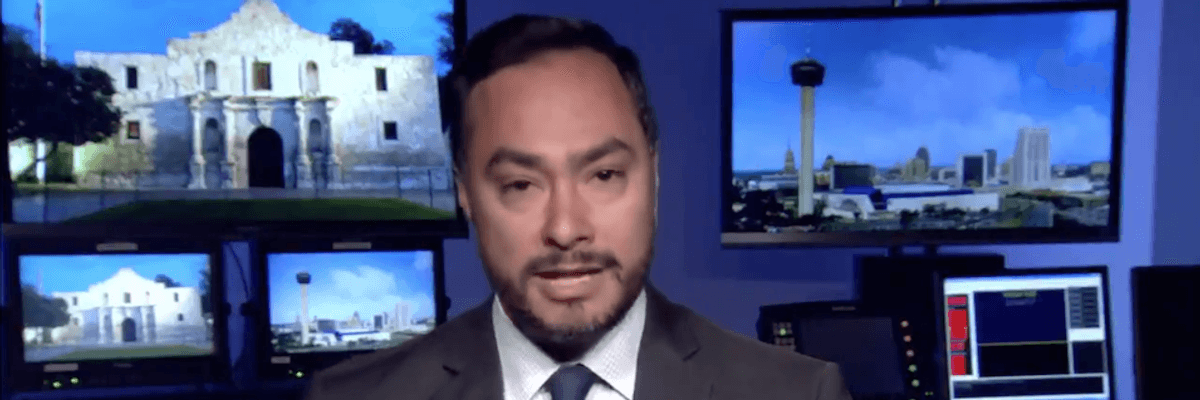
Rep. Joaquin Castro (D-Texas) on MSNBC's "Morning Joe" explaining his motivation for publishing the names of maxed-out San Antonio donors to Trump. (image: screenshot, MSNBC)
A Democratic congressman's tweeting of public information has conservatives apoplectically shrieking about "doxxing"--a claim that progressives are skewering.
Rep. Joaquin Castro (D-Texas) on Tuesday listed donors in the city of San Antonio, Texas to President Donald Trump who have "maxed out" their contributions for 2019, calling them out for supporting the president's racist and hateful rhetoric.
A screed allegedly written by a shooter in El Paso over the weekend who killed 22 people in an attack targeting Hispanics was similar in tone to Trump's anti-immigrant speeches.
"Their contributions are fueling a campaign of hate that labels Hispanic immigrants as 'invaders,'" said Castro.
The names and donations shared by Castro, the chairman of the Congressional Hispanic Caucus, are public information and easily searchable on the Federal Elections Commission (FEC) website.
"Chairman Castro, they don't like it when you name their donors," Rep. Rashida Tlaib (D-Mich.) said in a tweet. "The public needs to know who funds racism."
But that didn't stop the president's allies from having a full blown meltdown over the exposure, claiming that publishing the names amounted to "doxxing," or publishing the full private information of the donors. Castro only released the names of the donors.
"It's not as though Castro published anyone's phone number, e-mail address, or home address," said Media Matters for America editor Parker Molloy. "Had he done that, that would be unethical, absolutely."
FEC information is not private, as Axios explained Tuesday evening.
"Anyone who donates over $200 to campaigns must report to the Federal Election Commission," said Axios.
The right-wing reaction to Castro's tweet nevertheless ran the gamut from general disappointed scolding to analogizing posting the names with gun violence.
Publishing publicly available information was "a terrible and dangerous precedent to set," said HuffPost contributor Yashar Ali.
Rep. Steve Scalise (R-La.), who once referred to himself as "David Duke without the baggage," attempted to tie Castro's dissemination of the, again, publicly available names of the president's donors to a 2017 shooting that put Scalise in the hospital.
"It's dangerous, and lives are at stake," said Scalise. "I know this firsthand."
Progressives found the outrage over Castro's sharing of the public information to be at best suspect.
"Apparently the right wing is flipping out because Castro tweeted public information," tweeted privacy activist Kade Crockford. "I thought y'all loved free speech???"
The outrage was hypocritical, said journalist Benjamin Dixon.
"Conservatives are literally more offended by Castro 'targeting' voters than gunmen targeting children," Dixon said.
The right-wing attack on Castro was not in keeping with the "wait and see" approach to the president's racist attacks on four congresswomen of color in July, said activist Bree Newsome.
"Notice how quickly folks jumped on Joaquin Castro's tweet to feign concern about violence when two weeks ago they weren't even sure if chanting for Omar, Presley, AOC and Tlaib to 'go back' was racist," tweeted Newsome.
Splinter's Naomi LaChance was confused as to why sharing the information was generating such a reaction.
"It's totally bizarre," wrote LaChance. "It's certainly in the public interest to know who is willingly sending Trump money."
"I don't have any sympathy for someone who chooses to part with their money in such a freakish manner," added LaChance.
Dear Common Dreams reader, It’s been nearly 30 years since I co-founded Common Dreams with my late wife, Lina Newhouser. We had the radical notion that journalism should serve the public good, not corporate profits. It was clear to us from the outset what it would take to build such a project. No paid advertisements. No corporate sponsors. No millionaire publisher telling us what to think or do. Many people said we wouldn't last a year, but we proved those doubters wrong. Together with a tremendous team of journalists and dedicated staff, we built an independent media outlet free from the constraints of profits and corporate control. Our mission has always been simple: To inform. To inspire. To ignite change for the common good. Building Common Dreams was not easy. Our survival was never guaranteed. When you take on the most powerful forces—Wall Street greed, fossil fuel industry destruction, Big Tech lobbyists, and uber-rich oligarchs who have spent billions upon billions rigging the economy and democracy in their favor—the only bulwark you have is supporters who believe in your work. But here’s the urgent message from me today. It's never been this bad out there. And it's never been this hard to keep us going. At the very moment Common Dreams is most needed, the threats we face are intensifying. We need your support now more than ever. We don't accept corporate advertising and never will. We don't have a paywall because we don't think people should be blocked from critical news based on their ability to pay. Everything we do is funded by the donations of readers like you. When everyone does the little they can afford, we are strong. But if that support retreats or dries up, so do we. Will you donate now to make sure Common Dreams not only survives but thrives? —Craig Brown, Co-founder |
A Democratic congressman's tweeting of public information has conservatives apoplectically shrieking about "doxxing"--a claim that progressives are skewering.
Rep. Joaquin Castro (D-Texas) on Tuesday listed donors in the city of San Antonio, Texas to President Donald Trump who have "maxed out" their contributions for 2019, calling them out for supporting the president's racist and hateful rhetoric.
A screed allegedly written by a shooter in El Paso over the weekend who killed 22 people in an attack targeting Hispanics was similar in tone to Trump's anti-immigrant speeches.
"Their contributions are fueling a campaign of hate that labels Hispanic immigrants as 'invaders,'" said Castro.
The names and donations shared by Castro, the chairman of the Congressional Hispanic Caucus, are public information and easily searchable on the Federal Elections Commission (FEC) website.
"Chairman Castro, they don't like it when you name their donors," Rep. Rashida Tlaib (D-Mich.) said in a tweet. "The public needs to know who funds racism."
But that didn't stop the president's allies from having a full blown meltdown over the exposure, claiming that publishing the names amounted to "doxxing," or publishing the full private information of the donors. Castro only released the names of the donors.
"It's not as though Castro published anyone's phone number, e-mail address, or home address," said Media Matters for America editor Parker Molloy. "Had he done that, that would be unethical, absolutely."
FEC information is not private, as Axios explained Tuesday evening.
"Anyone who donates over $200 to campaigns must report to the Federal Election Commission," said Axios.
The right-wing reaction to Castro's tweet nevertheless ran the gamut from general disappointed scolding to analogizing posting the names with gun violence.
Publishing publicly available information was "a terrible and dangerous precedent to set," said HuffPost contributor Yashar Ali.
Rep. Steve Scalise (R-La.), who once referred to himself as "David Duke without the baggage," attempted to tie Castro's dissemination of the, again, publicly available names of the president's donors to a 2017 shooting that put Scalise in the hospital.
"It's dangerous, and lives are at stake," said Scalise. "I know this firsthand."
Progressives found the outrage over Castro's sharing of the public information to be at best suspect.
"Apparently the right wing is flipping out because Castro tweeted public information," tweeted privacy activist Kade Crockford. "I thought y'all loved free speech???"
The outrage was hypocritical, said journalist Benjamin Dixon.
"Conservatives are literally more offended by Castro 'targeting' voters than gunmen targeting children," Dixon said.
The right-wing attack on Castro was not in keeping with the "wait and see" approach to the president's racist attacks on four congresswomen of color in July, said activist Bree Newsome.
"Notice how quickly folks jumped on Joaquin Castro's tweet to feign concern about violence when two weeks ago they weren't even sure if chanting for Omar, Presley, AOC and Tlaib to 'go back' was racist," tweeted Newsome.
Splinter's Naomi LaChance was confused as to why sharing the information was generating such a reaction.
"It's totally bizarre," wrote LaChance. "It's certainly in the public interest to know who is willingly sending Trump money."
"I don't have any sympathy for someone who chooses to part with their money in such a freakish manner," added LaChance.
A Democratic congressman's tweeting of public information has conservatives apoplectically shrieking about "doxxing"--a claim that progressives are skewering.
Rep. Joaquin Castro (D-Texas) on Tuesday listed donors in the city of San Antonio, Texas to President Donald Trump who have "maxed out" their contributions for 2019, calling them out for supporting the president's racist and hateful rhetoric.
A screed allegedly written by a shooter in El Paso over the weekend who killed 22 people in an attack targeting Hispanics was similar in tone to Trump's anti-immigrant speeches.
"Their contributions are fueling a campaign of hate that labels Hispanic immigrants as 'invaders,'" said Castro.
The names and donations shared by Castro, the chairman of the Congressional Hispanic Caucus, are public information and easily searchable on the Federal Elections Commission (FEC) website.
"Chairman Castro, they don't like it when you name their donors," Rep. Rashida Tlaib (D-Mich.) said in a tweet. "The public needs to know who funds racism."
But that didn't stop the president's allies from having a full blown meltdown over the exposure, claiming that publishing the names amounted to "doxxing," or publishing the full private information of the donors. Castro only released the names of the donors.
"It's not as though Castro published anyone's phone number, e-mail address, or home address," said Media Matters for America editor Parker Molloy. "Had he done that, that would be unethical, absolutely."
FEC information is not private, as Axios explained Tuesday evening.
"Anyone who donates over $200 to campaigns must report to the Federal Election Commission," said Axios.
The right-wing reaction to Castro's tweet nevertheless ran the gamut from general disappointed scolding to analogizing posting the names with gun violence.
Publishing publicly available information was "a terrible and dangerous precedent to set," said HuffPost contributor Yashar Ali.
Rep. Steve Scalise (R-La.), who once referred to himself as "David Duke without the baggage," attempted to tie Castro's dissemination of the, again, publicly available names of the president's donors to a 2017 shooting that put Scalise in the hospital.
"It's dangerous, and lives are at stake," said Scalise. "I know this firsthand."
Progressives found the outrage over Castro's sharing of the public information to be at best suspect.
"Apparently the right wing is flipping out because Castro tweeted public information," tweeted privacy activist Kade Crockford. "I thought y'all loved free speech???"
The outrage was hypocritical, said journalist Benjamin Dixon.
"Conservatives are literally more offended by Castro 'targeting' voters than gunmen targeting children," Dixon said.
The right-wing attack on Castro was not in keeping with the "wait and see" approach to the president's racist attacks on four congresswomen of color in July, said activist Bree Newsome.
"Notice how quickly folks jumped on Joaquin Castro's tweet to feign concern about violence when two weeks ago they weren't even sure if chanting for Omar, Presley, AOC and Tlaib to 'go back' was racist," tweeted Newsome.
Splinter's Naomi LaChance was confused as to why sharing the information was generating such a reaction.
"It's totally bizarre," wrote LaChance. "It's certainly in the public interest to know who is willingly sending Trump money."
"I don't have any sympathy for someone who chooses to part with their money in such a freakish manner," added LaChance.