SUBSCRIBE TO OUR FREE NEWSLETTER
Daily news & progressive opinion—funded by the people, not the corporations—delivered straight to your inbox.
5
#000000
#FFFFFF
To donate by check, phone, or other method, see our More Ways to Give page.
Daily news & progressive opinion—funded by the people, not the corporations—delivered straight to your inbox.
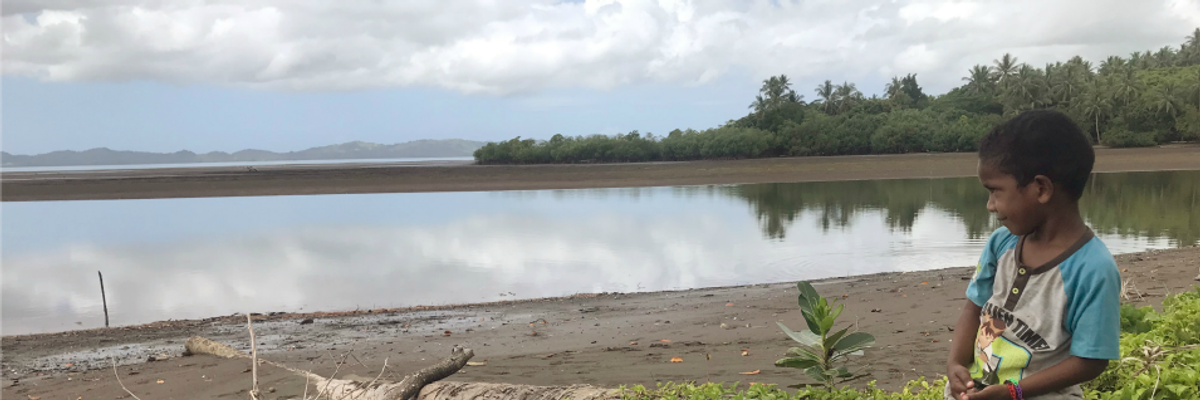
A boy sits on a log in the village of Vunisavisavi in Fiji, on October 16, 2017. The village is the first in the country to be forced to relocate due to rising water levels. (Photo: Christoph Sator/Picture Alliance via Getty Images)
The island nation of Fiji on Wednesday slammed world powers for their "grossly irresponsible and selfish" failure to act on the planetary emergency and unveiled a bold plan to bring the country's carbon emissions to net zero by 2050.
Aiyaz Sayed-Khaiyum, Fiji's economy and climate change minister, said in a speech to parliament Wednesday morning that the fight against the climate crisis is "a fight for our lives and our livelihoods."
"As the impacts of climate change accelerate and attempts are made to weaken global ambitions," said Sayed-Khaiyum, "we must listen more than ever to the scientists, not the climate deniers or those motivated by self-interest or political interests."
Sayed-Khaiyum continued:
Here in the vast Pacific sits our beloved Fiji. Small and increasingly vulnerable as we scan the horizon anxiously year by year for the kind of extreme weather event that three years ago, took the lives of 44 of our loved ones and inflicted damage equal to one-third of our GDP.
That is the grave situation in which we find ourselves through no fault of our own and why this government puts such a strong emphasis on the climate issue.
The Guardian described Fiji's plan as "one of the world's most ambitious legislative programs to tackle the climate crisis."
"The act will include tighter restrictions on the use of plastics, a framework for Fiji to reduce its emissions to net-zero by 2050, the introduction of a carbon credits scheme, and the establishment of procedures for the relocation of communities at risk from the adverse effects of the climate crisis," The Guardian reported.
Sayed-Khaiyum said he hopes the climate legislation will pass parliament with "unanimous support."
"There is no room for cynicism, no room for complacency," Sayed-Khaiyum added. "We cannot afford climate change fatigue to set in Fiji because if anything the outlook is worsening."
The climate plan, which was unveiled ahead of the Pacific Islands Forum (PIF) in Tuvalu next week, comes after Fiji joined a group of Pacific island nations in declaring a climate emergency and urging "governments of high emitting countries that are hindering progress in climate change efforts to heed the climate science and urgently change direction for the benefit of all, including the people in their own countries."
Fenton Lutunatabua, regional managing director of 350.org in the Pacific, celebrated the declaration as "visionary."
"The collective futures of Pacific peoples depends on us being able to push back against the fossil fuel industry fueling this climate crisis, and towards equitable and just solutions centered on people," Lutunatabua said. "This is what is at the heart of this important international statement."
Dear Common Dreams reader, It’s been nearly 30 years since I co-founded Common Dreams with my late wife, Lina Newhouser. We had the radical notion that journalism should serve the public good, not corporate profits. It was clear to us from the outset what it would take to build such a project. No paid advertisements. No corporate sponsors. No millionaire publisher telling us what to think or do. Many people said we wouldn't last a year, but we proved those doubters wrong. Together with a tremendous team of journalists and dedicated staff, we built an independent media outlet free from the constraints of profits and corporate control. Our mission has always been simple: To inform. To inspire. To ignite change for the common good. Building Common Dreams was not easy. Our survival was never guaranteed. When you take on the most powerful forces—Wall Street greed, fossil fuel industry destruction, Big Tech lobbyists, and uber-rich oligarchs who have spent billions upon billions rigging the economy and democracy in their favor—the only bulwark you have is supporters who believe in your work. But here’s the urgent message from me today. It's never been this bad out there. And it's never been this hard to keep us going. At the very moment Common Dreams is most needed, the threats we face are intensifying. We need your support now more than ever. We don't accept corporate advertising and never will. We don't have a paywall because we don't think people should be blocked from critical news based on their ability to pay. Everything we do is funded by the donations of readers like you. When everyone does the little they can afford, we are strong. But if that support retreats or dries up, so do we. Will you donate now to make sure Common Dreams not only survives but thrives? —Craig Brown, Co-founder |
The island nation of Fiji on Wednesday slammed world powers for their "grossly irresponsible and selfish" failure to act on the planetary emergency and unveiled a bold plan to bring the country's carbon emissions to net zero by 2050.
Aiyaz Sayed-Khaiyum, Fiji's economy and climate change minister, said in a speech to parliament Wednesday morning that the fight against the climate crisis is "a fight for our lives and our livelihoods."
"As the impacts of climate change accelerate and attempts are made to weaken global ambitions," said Sayed-Khaiyum, "we must listen more than ever to the scientists, not the climate deniers or those motivated by self-interest or political interests."
Sayed-Khaiyum continued:
Here in the vast Pacific sits our beloved Fiji. Small and increasingly vulnerable as we scan the horizon anxiously year by year for the kind of extreme weather event that three years ago, took the lives of 44 of our loved ones and inflicted damage equal to one-third of our GDP.
That is the grave situation in which we find ourselves through no fault of our own and why this government puts such a strong emphasis on the climate issue.
The Guardian described Fiji's plan as "one of the world's most ambitious legislative programs to tackle the climate crisis."
"The act will include tighter restrictions on the use of plastics, a framework for Fiji to reduce its emissions to net-zero by 2050, the introduction of a carbon credits scheme, and the establishment of procedures for the relocation of communities at risk from the adverse effects of the climate crisis," The Guardian reported.
Sayed-Khaiyum said he hopes the climate legislation will pass parliament with "unanimous support."
"There is no room for cynicism, no room for complacency," Sayed-Khaiyum added. "We cannot afford climate change fatigue to set in Fiji because if anything the outlook is worsening."
The climate plan, which was unveiled ahead of the Pacific Islands Forum (PIF) in Tuvalu next week, comes after Fiji joined a group of Pacific island nations in declaring a climate emergency and urging "governments of high emitting countries that are hindering progress in climate change efforts to heed the climate science and urgently change direction for the benefit of all, including the people in their own countries."
Fenton Lutunatabua, regional managing director of 350.org in the Pacific, celebrated the declaration as "visionary."
"The collective futures of Pacific peoples depends on us being able to push back against the fossil fuel industry fueling this climate crisis, and towards equitable and just solutions centered on people," Lutunatabua said. "This is what is at the heart of this important international statement."
The island nation of Fiji on Wednesday slammed world powers for their "grossly irresponsible and selfish" failure to act on the planetary emergency and unveiled a bold plan to bring the country's carbon emissions to net zero by 2050.
Aiyaz Sayed-Khaiyum, Fiji's economy and climate change minister, said in a speech to parliament Wednesday morning that the fight against the climate crisis is "a fight for our lives and our livelihoods."
"As the impacts of climate change accelerate and attempts are made to weaken global ambitions," said Sayed-Khaiyum, "we must listen more than ever to the scientists, not the climate deniers or those motivated by self-interest or political interests."
Sayed-Khaiyum continued:
Here in the vast Pacific sits our beloved Fiji. Small and increasingly vulnerable as we scan the horizon anxiously year by year for the kind of extreme weather event that three years ago, took the lives of 44 of our loved ones and inflicted damage equal to one-third of our GDP.
That is the grave situation in which we find ourselves through no fault of our own and why this government puts such a strong emphasis on the climate issue.
The Guardian described Fiji's plan as "one of the world's most ambitious legislative programs to tackle the climate crisis."
"The act will include tighter restrictions on the use of plastics, a framework for Fiji to reduce its emissions to net-zero by 2050, the introduction of a carbon credits scheme, and the establishment of procedures for the relocation of communities at risk from the adverse effects of the climate crisis," The Guardian reported.
Sayed-Khaiyum said he hopes the climate legislation will pass parliament with "unanimous support."
"There is no room for cynicism, no room for complacency," Sayed-Khaiyum added. "We cannot afford climate change fatigue to set in Fiji because if anything the outlook is worsening."
The climate plan, which was unveiled ahead of the Pacific Islands Forum (PIF) in Tuvalu next week, comes after Fiji joined a group of Pacific island nations in declaring a climate emergency and urging "governments of high emitting countries that are hindering progress in climate change efforts to heed the climate science and urgently change direction for the benefit of all, including the people in their own countries."
Fenton Lutunatabua, regional managing director of 350.org in the Pacific, celebrated the declaration as "visionary."
"The collective futures of Pacific peoples depends on us being able to push back against the fossil fuel industry fueling this climate crisis, and towards equitable and just solutions centered on people," Lutunatabua said. "This is what is at the heart of this important international statement."