SUBSCRIBE TO OUR FREE NEWSLETTER
Daily news & progressive opinion—funded by the people, not the corporations—delivered straight to your inbox.
5
#000000
#FFFFFF
To donate by check, phone, or other method, see our More Ways to Give page.
Daily news & progressive opinion—funded by the people, not the corporations—delivered straight to your inbox.
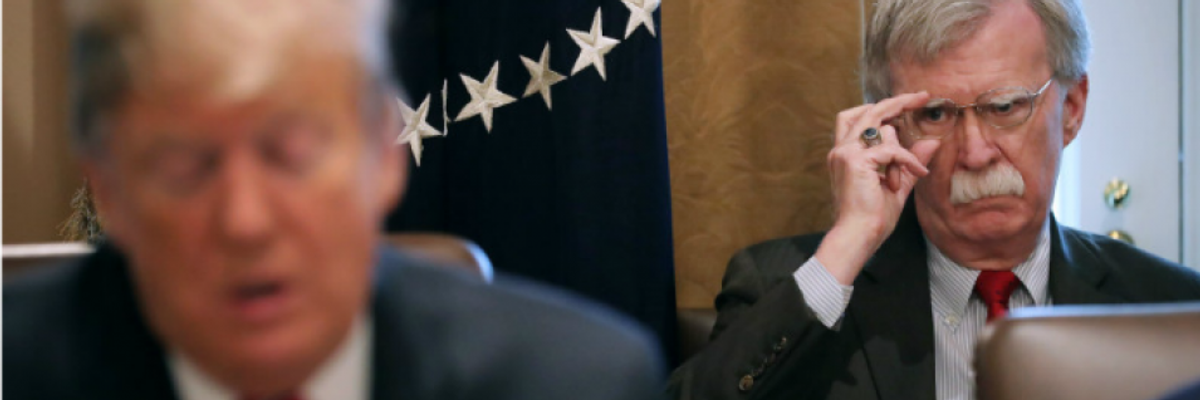
National security adviser John Bolton listens to President Donald Trump talk to reporters during a cabinet meeting at the White House in Washington on Feb. 12. (Photo: Chip Somodevilla/Getty Images)
After the U.S.-backed attempt to overthrow elected Venezuelan President Nicolas Maduro by force fizzled out, the Trump administration on Monday moved to further strangle the Latin American nation's economy by imposing a full economic embargo.
President Donald Trump's executive order targeting Venezuela, according to the Washington Post, "blocks all property and assets of the government and its officials, and prohibits any transactions with them, including the Venezuelan Central Bank and the state oil company."
"The action puts Venezuela on par with Cuba, Iran, North Korea, and Syria, the only other countries under a similar full embargo," the Post reported.
Journalist and filmmaker Dan Cohen described the embargo as "economic terrorism":
The Venezuelan economy has already been crippled by sweeping U.S. sanctions, which the Trump administration has expanded over the past several months in an attempt to overthrow Maduro and install opposition leader Juan Guaido.
As Common Dreams reported in April, a study published by the Center for Economic and Policy Research (CEPR) found that Trump's sanctions against Venezuela killed more than 40,000 people between 2017 and 2018.
"The sanctions are depriving Venezuelans of lifesaving medicines, medical equipment, food, and other essential imports," wrote CEPR's Mark Weisbrot, a co-author of the study. "This is illegal under U.S. and international law, and treaties that the U.S. has signed. Congress should move to stop it."
The Trump administration's decision to impose a full embargo on Venezuela was viewed as yet another attempt to oust Maduro--an effort that could do severe harm to the civilian population.
"Trump's action, the toughest yet against Maduro, not only bans U.S. companies from dealings with the Venezuela government but also appears to open the door to possible sanctions against foreign firms or individuals that assist it," HuffPost reported.
Responding to recent U.S. sanctions against Venezuela, journalist Ben Norton wrote, "The U.S. gov is telling the Venezuelan people that if they want to eat, they have to change their politics."
The embargo comes as Trump national security adviser John Bolton is in Peru to deliver an address Tuesday to the so-called International Conference on Democracy in Venezuela.
According to the Wall Street Journal, which obtained a copy of Bolton's prepared remarks, the national security adviser plans to claim that previous embargoes imposed by the U.S. were successful.
"It worked in Panama, it worked in Nicaragua once, and it will work there again, and it will work in Venezuela and Cuba!" Bolton will say, the Journal reported.
Though the Trump administration insisted the embargo will allow exceptions for humanitarian assistance such as food and medicine, experts said such exceptions will likely not have an effect in practice.
"The administration hasn't been very good at dedicating financial lines that would allow the purchase of food and medicine in sanctioned countries," sanctions expert Jeffrey Schott told the Journal. "In practice, we still block food and medicine because the parties in the targeted regime that want to import it can't get financing."
Dear Common Dreams reader, It’s been nearly 30 years since I co-founded Common Dreams with my late wife, Lina Newhouser. We had the radical notion that journalism should serve the public good, not corporate profits. It was clear to us from the outset what it would take to build such a project. No paid advertisements. No corporate sponsors. No millionaire publisher telling us what to think or do. Many people said we wouldn't last a year, but we proved those doubters wrong. Together with a tremendous team of journalists and dedicated staff, we built an independent media outlet free from the constraints of profits and corporate control. Our mission has always been simple: To inform. To inspire. To ignite change for the common good. Building Common Dreams was not easy. Our survival was never guaranteed. When you take on the most powerful forces—Wall Street greed, fossil fuel industry destruction, Big Tech lobbyists, and uber-rich oligarchs who have spent billions upon billions rigging the economy and democracy in their favor—the only bulwark you have is supporters who believe in your work. But here’s the urgent message from me today. It's never been this bad out there. And it's never been this hard to keep us going. At the very moment Common Dreams is most needed, the threats we face are intensifying. We need your support now more than ever. We don't accept corporate advertising and never will. We don't have a paywall because we don't think people should be blocked from critical news based on their ability to pay. Everything we do is funded by the donations of readers like you. When everyone does the little they can afford, we are strong. But if that support retreats or dries up, so do we. Will you donate now to make sure Common Dreams not only survives but thrives? —Craig Brown, Co-founder |
After the U.S.-backed attempt to overthrow elected Venezuelan President Nicolas Maduro by force fizzled out, the Trump administration on Monday moved to further strangle the Latin American nation's economy by imposing a full economic embargo.
President Donald Trump's executive order targeting Venezuela, according to the Washington Post, "blocks all property and assets of the government and its officials, and prohibits any transactions with them, including the Venezuelan Central Bank and the state oil company."
"The action puts Venezuela on par with Cuba, Iran, North Korea, and Syria, the only other countries under a similar full embargo," the Post reported.
Journalist and filmmaker Dan Cohen described the embargo as "economic terrorism":
The Venezuelan economy has already been crippled by sweeping U.S. sanctions, which the Trump administration has expanded over the past several months in an attempt to overthrow Maduro and install opposition leader Juan Guaido.
As Common Dreams reported in April, a study published by the Center for Economic and Policy Research (CEPR) found that Trump's sanctions against Venezuela killed more than 40,000 people between 2017 and 2018.
"The sanctions are depriving Venezuelans of lifesaving medicines, medical equipment, food, and other essential imports," wrote CEPR's Mark Weisbrot, a co-author of the study. "This is illegal under U.S. and international law, and treaties that the U.S. has signed. Congress should move to stop it."
The Trump administration's decision to impose a full embargo on Venezuela was viewed as yet another attempt to oust Maduro--an effort that could do severe harm to the civilian population.
"Trump's action, the toughest yet against Maduro, not only bans U.S. companies from dealings with the Venezuela government but also appears to open the door to possible sanctions against foreign firms or individuals that assist it," HuffPost reported.
Responding to recent U.S. sanctions against Venezuela, journalist Ben Norton wrote, "The U.S. gov is telling the Venezuelan people that if they want to eat, they have to change their politics."
The embargo comes as Trump national security adviser John Bolton is in Peru to deliver an address Tuesday to the so-called International Conference on Democracy in Venezuela.
According to the Wall Street Journal, which obtained a copy of Bolton's prepared remarks, the national security adviser plans to claim that previous embargoes imposed by the U.S. were successful.
"It worked in Panama, it worked in Nicaragua once, and it will work there again, and it will work in Venezuela and Cuba!" Bolton will say, the Journal reported.
Though the Trump administration insisted the embargo will allow exceptions for humanitarian assistance such as food and medicine, experts said such exceptions will likely not have an effect in practice.
"The administration hasn't been very good at dedicating financial lines that would allow the purchase of food and medicine in sanctioned countries," sanctions expert Jeffrey Schott told the Journal. "In practice, we still block food and medicine because the parties in the targeted regime that want to import it can't get financing."
After the U.S.-backed attempt to overthrow elected Venezuelan President Nicolas Maduro by force fizzled out, the Trump administration on Monday moved to further strangle the Latin American nation's economy by imposing a full economic embargo.
President Donald Trump's executive order targeting Venezuela, according to the Washington Post, "blocks all property and assets of the government and its officials, and prohibits any transactions with them, including the Venezuelan Central Bank and the state oil company."
"The action puts Venezuela on par with Cuba, Iran, North Korea, and Syria, the only other countries under a similar full embargo," the Post reported.
Journalist and filmmaker Dan Cohen described the embargo as "economic terrorism":
The Venezuelan economy has already been crippled by sweeping U.S. sanctions, which the Trump administration has expanded over the past several months in an attempt to overthrow Maduro and install opposition leader Juan Guaido.
As Common Dreams reported in April, a study published by the Center for Economic and Policy Research (CEPR) found that Trump's sanctions against Venezuela killed more than 40,000 people between 2017 and 2018.
"The sanctions are depriving Venezuelans of lifesaving medicines, medical equipment, food, and other essential imports," wrote CEPR's Mark Weisbrot, a co-author of the study. "This is illegal under U.S. and international law, and treaties that the U.S. has signed. Congress should move to stop it."
The Trump administration's decision to impose a full embargo on Venezuela was viewed as yet another attempt to oust Maduro--an effort that could do severe harm to the civilian population.
"Trump's action, the toughest yet against Maduro, not only bans U.S. companies from dealings with the Venezuela government but also appears to open the door to possible sanctions against foreign firms or individuals that assist it," HuffPost reported.
Responding to recent U.S. sanctions against Venezuela, journalist Ben Norton wrote, "The U.S. gov is telling the Venezuelan people that if they want to eat, they have to change their politics."
The embargo comes as Trump national security adviser John Bolton is in Peru to deliver an address Tuesday to the so-called International Conference on Democracy in Venezuela.
According to the Wall Street Journal, which obtained a copy of Bolton's prepared remarks, the national security adviser plans to claim that previous embargoes imposed by the U.S. were successful.
"It worked in Panama, it worked in Nicaragua once, and it will work there again, and it will work in Venezuela and Cuba!" Bolton will say, the Journal reported.
Though the Trump administration insisted the embargo will allow exceptions for humanitarian assistance such as food and medicine, experts said such exceptions will likely not have an effect in practice.
"The administration hasn't been very good at dedicating financial lines that would allow the purchase of food and medicine in sanctioned countries," sanctions expert Jeffrey Schott told the Journal. "In practice, we still block food and medicine because the parties in the targeted regime that want to import it can't get financing."