SUBSCRIBE TO OUR FREE NEWSLETTER
Daily news & progressive opinion—funded by the people, not the corporations—delivered straight to your inbox.
5
#000000
#FFFFFF
To donate by check, phone, or other method, see our More Ways to Give page.
Daily news & progressive opinion—funded by the people, not the corporations—delivered straight to your inbox.
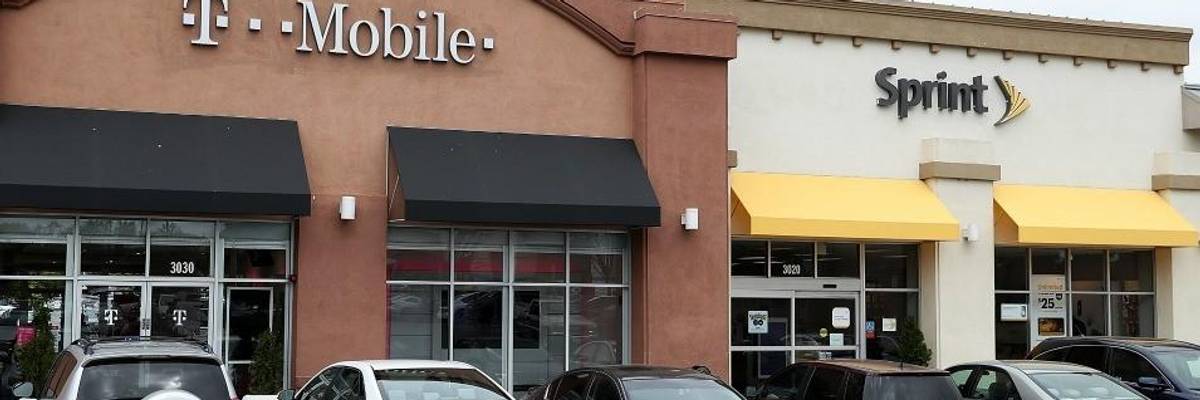
As the Justice Department struck a deal with Sprint and T-Mobile on Friday, consumer advocates vowed, "we'll continue to fight to stop this dangerous merger from going through." (Photo: Justin Sullivan/Getty Images)
Consumer advocates decried the Department of Justice's decision Friday to sign off on T-Mobile and Sprint's proposed merger, warning that allowing the nation's third- and fourth-largest wireless carriers to join forces will drive up prices and negatively impact low-income and marginalized communities.
"The leadership at the Justice Department and the Federal Communications Commission have failed in their job at protecting America's citizens from the concentration of power that would result from this deal."
--Barry Lynn, Open Markets Institute
In a statement, the DOJ announced that it had reached an agreement with five state attorneys general and the companies that makes the merger contingent on the divestment of "Sprint's prepaid business, including Boost Mobile, Virgin Mobile, and Sprint prepaid, to Dish Network Corp., a Colorado-based satellite television provider."
"The proposed settlement also provides for the divestiture of certain spectrum assets to Dish," the statement explained. "Additionally, T-Mobile and Sprint must make available to Dish at least 20,000 cell sites and hundreds of retail locations. T-Mobile must also provide Dish with robust access to the T-Mobile network for a period of seven years while Dish builds out its own 5G network."
DOJ Antitrust Division Assistant Attorney General Makan Delrahim claimed that the deal will enable Dish "to become a facilities-based mobile network operator that can provide a full range of mobile wireless services nationwide," and T-Mobile chief executive John Legere welcomed the settlement as "a win-win for everyone involved."
However, critics such as Common Cause special adviser Michael Copps cautioned that "despite the addition of Dish, this is still a four-to-three merger where Verizon, AT&T, and a post-transaction T-Mobile will call all of the shots."
T-Mobile and Sprint have framed their proposed merger as a bid to compete with AT&T and Verizon, the nation's largest two wireless carriers.
If the merger is allowed to move forward, "consumers can expect to see higher prices, fewer choices, and less innovative offerings across the board," said Copps, who formerly served at the Federal Communications Commission. "Low-income and marginalized communities who rely on prepaid services from T-Mobile and Sprint will face significant consequences and potentially get priced out of wireless service."
Greenlining Institute technology equity director Paul Goodman, in a statement, also denounced the "anti-competitive, anti-consumer merger."
"This deal does nothing to allay concerns that a larger T-Mobile will abandon low-income consumers and consumers of color," said Goodman, whose group advocates for racial and economic justice. "We see no indication that Dish has the ability or incentive to become a meaningful competitor that will serve communities of color."
Free Press research director S. Derek Turner, in a statement Friday, described Dish as "a satellite-TV company with no wireless customers, and a well-earned reputation for hoarding spectrum."
"In truth, this arrangement does not offer cellphone users a viable fourth competitor in the wireless market," Turner said. "Dish has a troubling history when it comes to delivering wireless services, and it continues to squat on valuable spectrum, a delay that's earned Dish considerable criticism from both inside and outside the FCC, including from T-Mobile itself before this newly engineered marriage of convenience."
Turner pointed out that "prior to this last-minute dealmaking, all of the reports were that the Justice Department's antitrust experts had reached the correct conclusion against approving this deal before being overruled by the political appointee leading the antitrust division. The merger would harm all wireless users through higher prices and diminished competition between the remaining three national carriers."
"But the department's antitrust chief has succumbed to political pressure from a White House that favors the deal," Turner said.
Despite the DOJ's approval, the merger still faces other regulatory hurdles before it can be finalized, which The Washington Post outlined Friday:
A federal judge must still approve the merger as must the Federal Communications Commission, though that agency's Republican leaders previously expressed public support for the two wireless giant's plans. T-Mobile and Sprint also must contend with the attorneys general of New York, California, and other states, who sued in recent weeks to stop the deal, arguing it threatens competition and could result in consumers paying higher prices for their phone service.
If the deal goes through, Turner said, DOJ's Delrahim "will have abandoned his long-held belief that antitrust is a matter of law enforcement, and that conditions don't magically make illegal mergers legal."
"The leadership at the Justice Department and the Federal Communications Commission have failed in their job at protecting America's citizens from the concentration of power that would result from this deal," Open Markets Institute executive director Barry Lynn declared Friday, while applauding the attorneys general who are challenging the merger.
Turner also expressed support for the lawsuit brought by the states, and vowed that "we'll continue to fight to stop this dangerous merger from going through."
Dear Common Dreams reader, It’s been nearly 30 years since I co-founded Common Dreams with my late wife, Lina Newhouser. We had the radical notion that journalism should serve the public good, not corporate profits. It was clear to us from the outset what it would take to build such a project. No paid advertisements. No corporate sponsors. No millionaire publisher telling us what to think or do. Many people said we wouldn't last a year, but we proved those doubters wrong. Together with a tremendous team of journalists and dedicated staff, we built an independent media outlet free from the constraints of profits and corporate control. Our mission has always been simple: To inform. To inspire. To ignite change for the common good. Building Common Dreams was not easy. Our survival was never guaranteed. When you take on the most powerful forces—Wall Street greed, fossil fuel industry destruction, Big Tech lobbyists, and uber-rich oligarchs who have spent billions upon billions rigging the economy and democracy in their favor—the only bulwark you have is supporters who believe in your work. But here’s the urgent message from me today. It's never been this bad out there. And it's never been this hard to keep us going. At the very moment Common Dreams is most needed, the threats we face are intensifying. We need your support now more than ever. We don't accept corporate advertising and never will. We don't have a paywall because we don't think people should be blocked from critical news based on their ability to pay. Everything we do is funded by the donations of readers like you. When everyone does the little they can afford, we are strong. But if that support retreats or dries up, so do we. Will you donate now to make sure Common Dreams not only survives but thrives? —Craig Brown, Co-founder |
Consumer advocates decried the Department of Justice's decision Friday to sign off on T-Mobile and Sprint's proposed merger, warning that allowing the nation's third- and fourth-largest wireless carriers to join forces will drive up prices and negatively impact low-income and marginalized communities.
"The leadership at the Justice Department and the Federal Communications Commission have failed in their job at protecting America's citizens from the concentration of power that would result from this deal."
--Barry Lynn, Open Markets Institute
In a statement, the DOJ announced that it had reached an agreement with five state attorneys general and the companies that makes the merger contingent on the divestment of "Sprint's prepaid business, including Boost Mobile, Virgin Mobile, and Sprint prepaid, to Dish Network Corp., a Colorado-based satellite television provider."
"The proposed settlement also provides for the divestiture of certain spectrum assets to Dish," the statement explained. "Additionally, T-Mobile and Sprint must make available to Dish at least 20,000 cell sites and hundreds of retail locations. T-Mobile must also provide Dish with robust access to the T-Mobile network for a period of seven years while Dish builds out its own 5G network."
DOJ Antitrust Division Assistant Attorney General Makan Delrahim claimed that the deal will enable Dish "to become a facilities-based mobile network operator that can provide a full range of mobile wireless services nationwide," and T-Mobile chief executive John Legere welcomed the settlement as "a win-win for everyone involved."
However, critics such as Common Cause special adviser Michael Copps cautioned that "despite the addition of Dish, this is still a four-to-three merger where Verizon, AT&T, and a post-transaction T-Mobile will call all of the shots."
T-Mobile and Sprint have framed their proposed merger as a bid to compete with AT&T and Verizon, the nation's largest two wireless carriers.
If the merger is allowed to move forward, "consumers can expect to see higher prices, fewer choices, and less innovative offerings across the board," said Copps, who formerly served at the Federal Communications Commission. "Low-income and marginalized communities who rely on prepaid services from T-Mobile and Sprint will face significant consequences and potentially get priced out of wireless service."
Greenlining Institute technology equity director Paul Goodman, in a statement, also denounced the "anti-competitive, anti-consumer merger."
"This deal does nothing to allay concerns that a larger T-Mobile will abandon low-income consumers and consumers of color," said Goodman, whose group advocates for racial and economic justice. "We see no indication that Dish has the ability or incentive to become a meaningful competitor that will serve communities of color."
Free Press research director S. Derek Turner, in a statement Friday, described Dish as "a satellite-TV company with no wireless customers, and a well-earned reputation for hoarding spectrum."
"In truth, this arrangement does not offer cellphone users a viable fourth competitor in the wireless market," Turner said. "Dish has a troubling history when it comes to delivering wireless services, and it continues to squat on valuable spectrum, a delay that's earned Dish considerable criticism from both inside and outside the FCC, including from T-Mobile itself before this newly engineered marriage of convenience."
Turner pointed out that "prior to this last-minute dealmaking, all of the reports were that the Justice Department's antitrust experts had reached the correct conclusion against approving this deal before being overruled by the political appointee leading the antitrust division. The merger would harm all wireless users through higher prices and diminished competition between the remaining three national carriers."
"But the department's antitrust chief has succumbed to political pressure from a White House that favors the deal," Turner said.
Despite the DOJ's approval, the merger still faces other regulatory hurdles before it can be finalized, which The Washington Post outlined Friday:
A federal judge must still approve the merger as must the Federal Communications Commission, though that agency's Republican leaders previously expressed public support for the two wireless giant's plans. T-Mobile and Sprint also must contend with the attorneys general of New York, California, and other states, who sued in recent weeks to stop the deal, arguing it threatens competition and could result in consumers paying higher prices for their phone service.
If the deal goes through, Turner said, DOJ's Delrahim "will have abandoned his long-held belief that antitrust is a matter of law enforcement, and that conditions don't magically make illegal mergers legal."
"The leadership at the Justice Department and the Federal Communications Commission have failed in their job at protecting America's citizens from the concentration of power that would result from this deal," Open Markets Institute executive director Barry Lynn declared Friday, while applauding the attorneys general who are challenging the merger.
Turner also expressed support for the lawsuit brought by the states, and vowed that "we'll continue to fight to stop this dangerous merger from going through."
Consumer advocates decried the Department of Justice's decision Friday to sign off on T-Mobile and Sprint's proposed merger, warning that allowing the nation's third- and fourth-largest wireless carriers to join forces will drive up prices and negatively impact low-income and marginalized communities.
"The leadership at the Justice Department and the Federal Communications Commission have failed in their job at protecting America's citizens from the concentration of power that would result from this deal."
--Barry Lynn, Open Markets Institute
In a statement, the DOJ announced that it had reached an agreement with five state attorneys general and the companies that makes the merger contingent on the divestment of "Sprint's prepaid business, including Boost Mobile, Virgin Mobile, and Sprint prepaid, to Dish Network Corp., a Colorado-based satellite television provider."
"The proposed settlement also provides for the divestiture of certain spectrum assets to Dish," the statement explained. "Additionally, T-Mobile and Sprint must make available to Dish at least 20,000 cell sites and hundreds of retail locations. T-Mobile must also provide Dish with robust access to the T-Mobile network for a period of seven years while Dish builds out its own 5G network."
DOJ Antitrust Division Assistant Attorney General Makan Delrahim claimed that the deal will enable Dish "to become a facilities-based mobile network operator that can provide a full range of mobile wireless services nationwide," and T-Mobile chief executive John Legere welcomed the settlement as "a win-win for everyone involved."
However, critics such as Common Cause special adviser Michael Copps cautioned that "despite the addition of Dish, this is still a four-to-three merger where Verizon, AT&T, and a post-transaction T-Mobile will call all of the shots."
T-Mobile and Sprint have framed their proposed merger as a bid to compete with AT&T and Verizon, the nation's largest two wireless carriers.
If the merger is allowed to move forward, "consumers can expect to see higher prices, fewer choices, and less innovative offerings across the board," said Copps, who formerly served at the Federal Communications Commission. "Low-income and marginalized communities who rely on prepaid services from T-Mobile and Sprint will face significant consequences and potentially get priced out of wireless service."
Greenlining Institute technology equity director Paul Goodman, in a statement, also denounced the "anti-competitive, anti-consumer merger."
"This deal does nothing to allay concerns that a larger T-Mobile will abandon low-income consumers and consumers of color," said Goodman, whose group advocates for racial and economic justice. "We see no indication that Dish has the ability or incentive to become a meaningful competitor that will serve communities of color."
Free Press research director S. Derek Turner, in a statement Friday, described Dish as "a satellite-TV company with no wireless customers, and a well-earned reputation for hoarding spectrum."
"In truth, this arrangement does not offer cellphone users a viable fourth competitor in the wireless market," Turner said. "Dish has a troubling history when it comes to delivering wireless services, and it continues to squat on valuable spectrum, a delay that's earned Dish considerable criticism from both inside and outside the FCC, including from T-Mobile itself before this newly engineered marriage of convenience."
Turner pointed out that "prior to this last-minute dealmaking, all of the reports were that the Justice Department's antitrust experts had reached the correct conclusion against approving this deal before being overruled by the political appointee leading the antitrust division. The merger would harm all wireless users through higher prices and diminished competition between the remaining three national carriers."
"But the department's antitrust chief has succumbed to political pressure from a White House that favors the deal," Turner said.
Despite the DOJ's approval, the merger still faces other regulatory hurdles before it can be finalized, which The Washington Post outlined Friday:
A federal judge must still approve the merger as must the Federal Communications Commission, though that agency's Republican leaders previously expressed public support for the two wireless giant's plans. T-Mobile and Sprint also must contend with the attorneys general of New York, California, and other states, who sued in recent weeks to stop the deal, arguing it threatens competition and could result in consumers paying higher prices for their phone service.
If the deal goes through, Turner said, DOJ's Delrahim "will have abandoned his long-held belief that antitrust is a matter of law enforcement, and that conditions don't magically make illegal mergers legal."
"The leadership at the Justice Department and the Federal Communications Commission have failed in their job at protecting America's citizens from the concentration of power that would result from this deal," Open Markets Institute executive director Barry Lynn declared Friday, while applauding the attorneys general who are challenging the merger.
Turner also expressed support for the lawsuit brought by the states, and vowed that "we'll continue to fight to stop this dangerous merger from going through."