

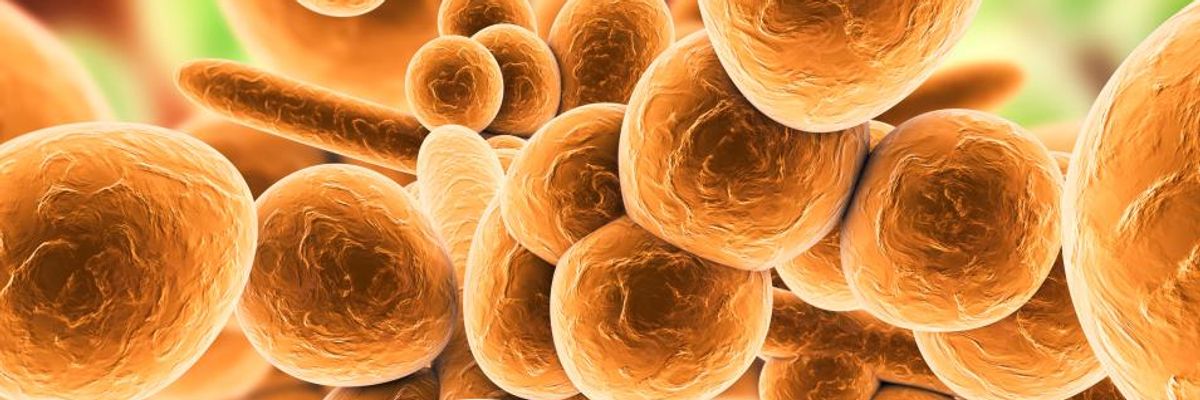
Candida auris was first identified in 2009. It causes serious multidrug-resistant infections in hospitalized patients and has high mortality rates. It causes bloodstream, wound, and ear infections and has also been isolated from respiratory and urine specimens. (Image: Kateryna Kon/Science Photo Library/Getty Images)
'This Is the Beginning': New Study Warns Climate Crisis May Have Been Pivotal in Rise of Drug-Resistant Superbug
Research argues that deadly Candida auris "may be the first example of a new fungal disease emerging from climate change."
A new analysis warns that "global warming may have played a pivotal role" in the recent rise of a multidrug-resistant fungal superbug, sparking questions and concerns about the emerging public health threats of the human-caused climate crisis.
"What this study suggests is this is the beginning of fungi adapting to higher temperatures, and we are going to have more and more problems as the century goes on."
--Arturo Casadevall, lead author
Reporting on the research Tuesday, CNN outlined the history of Candida auris:
Until recently, scientists considered it a mystery how C. auris popped up in more than 30 countries around the globe a decade after it was first discovered in 2009. It emerged simultaneously on three continents--in India, Venezuela, and South Africa--between 2012 and 2015, each strain being genetically distinct.
The study--published Tuesday in mBio, an open-access journal of the American Society for Microbiology--argues that Candida auris "may be the first example of a new fungal disease emerging from climate change."
"The argument that we are making based on comparison to other close relative fungi is that as the climate has gotten warmer, some of these organisms, including Candida auris, have adapted to the higher temperature, and as they adapt, they break through human's protective temperatures," lead author Arturo Casadevall, chair of molecular microbiology and immunology at Johns Hopkins Bloomberg School of Public Health, said in a statement.
Fungal diseases are relatively uncommon in humans because of body temperature--but if they adapt to rising temperatures, and aren't easily treatable with medications, they could increasingly endanger human health on a global scale. Casadevall warned that while C. auris may be the first fungal disease whose emergence scientists have tied to rising temperatures, it potentially won't be the last.
"Global warming may lead to new fungal diseases that we don't even know about right now," he said. "What this study suggests is this is the beginning of fungi adapting to higher temperatures, and we are going to have more and more problems as the century goes on."
Stat News published a piece Tuesday that mentions the new study but also addresses a series of pressing questions about the emerging superbug with help from experts who include Tom Chiller, chief of mycotic diseases at the Centers for Disease Control and Prevention, and Tejas Bouklas, an assistant professor in the department of biomedical sciences at Long Island University.
Among those questions is: "Could C. auris help other fungi adapt to be bigger threats to humans?"
That's a question Bouklas is wondering about. "The more ubiquitous it becomes, the more problematic. Because now it could potentially transmit DNA to other Candida species. And maybe even bacteria," she said.
That idea is not far-fetched. Fungi can mate sexually, Chiller pointed out, allowing them to swap large amounts of DNA.
In light of the potential impacts of the climate crisis on public health highlighted in the study, Casadevall charged in his statement that "we need to make investments in better surveillance of fungal diseases."
"We are pretty good at surveilling influenza and diseases that cause diarrhea or are contagious, but fungal diseases are not usually contagious and therefore nobody has really bothered to document them well," he said. "If more fungi were to cross over, you really wouldn't know until somebody started reporting them in the literature."
Chiller, in his interview with Stat News, agreed that more research on the superbug is vital to protecting the public.
Understanding C. auris's backstory is crucial, Chiller said, because "these things are going to continue to emerge. And understanding how they emerge and where they emerge might lead us to prevention strategies or reactive strategies or preparation strategies for the next big thing."
We are at a crossroads
This country and this world are at a monumental crossroads. In a few short weeks, US voters will have an opportunity to beat back the forces of fascism and confront the billionaires who are rigging the economy, our media system, and our democracy, making it increasingly impossible for ordinary people to get by. We’re not just talking about the election. We’re talking about what must be done once these fascist elements are vanquished from power. We need a bolder set of solutions than what either major party has so far been willing to offer and a working-class movement ready to fight like hell for it. Trump didn't emerge from nowhere. The conditions that fueled MAGA authoritarianism were created by decades of radical neoliberal economic policies and a corrupt political system dominated by corporate interests. They slashed taxes on the super-rich, promising that the benefits would trickle down. They said giveaways to the corporate titans would make life more affordable for the rest of us. It was all bullshit. And when a bitter, betrayed populace searches for someone to blame, right-wing demagogues have little trouble finding scapegoats. People know when they're being lied to, but you won't hear any of this from the corporate media. Only independent journalism—powered and funded by people who believe in building a better world—can deliver truly trustworthy daily news. Our Fall Campaign is underway, and we need your help. To power our newsroom through the rest of the year, we need to raise $125,000 by midnight on October 31. So if you share our vision, please contribute whatever you can to sustain our work. |
A new analysis warns that "global warming may have played a pivotal role" in the recent rise of a multidrug-resistant fungal superbug, sparking questions and concerns about the emerging public health threats of the human-caused climate crisis.
"What this study suggests is this is the beginning of fungi adapting to higher temperatures, and we are going to have more and more problems as the century goes on."
--Arturo Casadevall, lead author
Reporting on the research Tuesday, CNN outlined the history of Candida auris:
Until recently, scientists considered it a mystery how C. auris popped up in more than 30 countries around the globe a decade after it was first discovered in 2009. It emerged simultaneously on three continents--in India, Venezuela, and South Africa--between 2012 and 2015, each strain being genetically distinct.
The study--published Tuesday in mBio, an open-access journal of the American Society for Microbiology--argues that Candida auris "may be the first example of a new fungal disease emerging from climate change."
"The argument that we are making based on comparison to other close relative fungi is that as the climate has gotten warmer, some of these organisms, including Candida auris, have adapted to the higher temperature, and as they adapt, they break through human's protective temperatures," lead author Arturo Casadevall, chair of molecular microbiology and immunology at Johns Hopkins Bloomberg School of Public Health, said in a statement.
Fungal diseases are relatively uncommon in humans because of body temperature--but if they adapt to rising temperatures, and aren't easily treatable with medications, they could increasingly endanger human health on a global scale. Casadevall warned that while C. auris may be the first fungal disease whose emergence scientists have tied to rising temperatures, it potentially won't be the last.
"Global warming may lead to new fungal diseases that we don't even know about right now," he said. "What this study suggests is this is the beginning of fungi adapting to higher temperatures, and we are going to have more and more problems as the century goes on."
Stat News published a piece Tuesday that mentions the new study but also addresses a series of pressing questions about the emerging superbug with help from experts who include Tom Chiller, chief of mycotic diseases at the Centers for Disease Control and Prevention, and Tejas Bouklas, an assistant professor in the department of biomedical sciences at Long Island University.
Among those questions is: "Could C. auris help other fungi adapt to be bigger threats to humans?"
That's a question Bouklas is wondering about. "The more ubiquitous it becomes, the more problematic. Because now it could potentially transmit DNA to other Candida species. And maybe even bacteria," she said.
That idea is not far-fetched. Fungi can mate sexually, Chiller pointed out, allowing them to swap large amounts of DNA.
In light of the potential impacts of the climate crisis on public health highlighted in the study, Casadevall charged in his statement that "we need to make investments in better surveillance of fungal diseases."
"We are pretty good at surveilling influenza and diseases that cause diarrhea or are contagious, but fungal diseases are not usually contagious and therefore nobody has really bothered to document them well," he said. "If more fungi were to cross over, you really wouldn't know until somebody started reporting them in the literature."
Chiller, in his interview with Stat News, agreed that more research on the superbug is vital to protecting the public.
Understanding C. auris's backstory is crucial, Chiller said, because "these things are going to continue to emerge. And understanding how they emerge and where they emerge might lead us to prevention strategies or reactive strategies or preparation strategies for the next big thing."
A new analysis warns that "global warming may have played a pivotal role" in the recent rise of a multidrug-resistant fungal superbug, sparking questions and concerns about the emerging public health threats of the human-caused climate crisis.
"What this study suggests is this is the beginning of fungi adapting to higher temperatures, and we are going to have more and more problems as the century goes on."
--Arturo Casadevall, lead author
Reporting on the research Tuesday, CNN outlined the history of Candida auris:
Until recently, scientists considered it a mystery how C. auris popped up in more than 30 countries around the globe a decade after it was first discovered in 2009. It emerged simultaneously on three continents--in India, Venezuela, and South Africa--between 2012 and 2015, each strain being genetically distinct.
The study--published Tuesday in mBio, an open-access journal of the American Society for Microbiology--argues that Candida auris "may be the first example of a new fungal disease emerging from climate change."
"The argument that we are making based on comparison to other close relative fungi is that as the climate has gotten warmer, some of these organisms, including Candida auris, have adapted to the higher temperature, and as they adapt, they break through human's protective temperatures," lead author Arturo Casadevall, chair of molecular microbiology and immunology at Johns Hopkins Bloomberg School of Public Health, said in a statement.
Fungal diseases are relatively uncommon in humans because of body temperature--but if they adapt to rising temperatures, and aren't easily treatable with medications, they could increasingly endanger human health on a global scale. Casadevall warned that while C. auris may be the first fungal disease whose emergence scientists have tied to rising temperatures, it potentially won't be the last.
"Global warming may lead to new fungal diseases that we don't even know about right now," he said. "What this study suggests is this is the beginning of fungi adapting to higher temperatures, and we are going to have more and more problems as the century goes on."
Stat News published a piece Tuesday that mentions the new study but also addresses a series of pressing questions about the emerging superbug with help from experts who include Tom Chiller, chief of mycotic diseases at the Centers for Disease Control and Prevention, and Tejas Bouklas, an assistant professor in the department of biomedical sciences at Long Island University.
Among those questions is: "Could C. auris help other fungi adapt to be bigger threats to humans?"
That's a question Bouklas is wondering about. "The more ubiquitous it becomes, the more problematic. Because now it could potentially transmit DNA to other Candida species. And maybe even bacteria," she said.
That idea is not far-fetched. Fungi can mate sexually, Chiller pointed out, allowing them to swap large amounts of DNA.
In light of the potential impacts of the climate crisis on public health highlighted in the study, Casadevall charged in his statement that "we need to make investments in better surveillance of fungal diseases."
"We are pretty good at surveilling influenza and diseases that cause diarrhea or are contagious, but fungal diseases are not usually contagious and therefore nobody has really bothered to document them well," he said. "If more fungi were to cross over, you really wouldn't know until somebody started reporting them in the literature."
Chiller, in his interview with Stat News, agreed that more research on the superbug is vital to protecting the public.
Understanding C. auris's backstory is crucial, Chiller said, because "these things are going to continue to emerge. And understanding how they emerge and where they emerge might lead us to prevention strategies or reactive strategies or preparation strategies for the next big thing."