SUBSCRIBE TO OUR FREE NEWSLETTER
Daily news & progressive opinion—funded by the people, not the corporations—delivered straight to your inbox.
5
#000000
#FFFFFF
To donate by check, phone, or other method, see our More Ways to Give page.
Daily news & progressive opinion—funded by the people, not the corporations—delivered straight to your inbox.
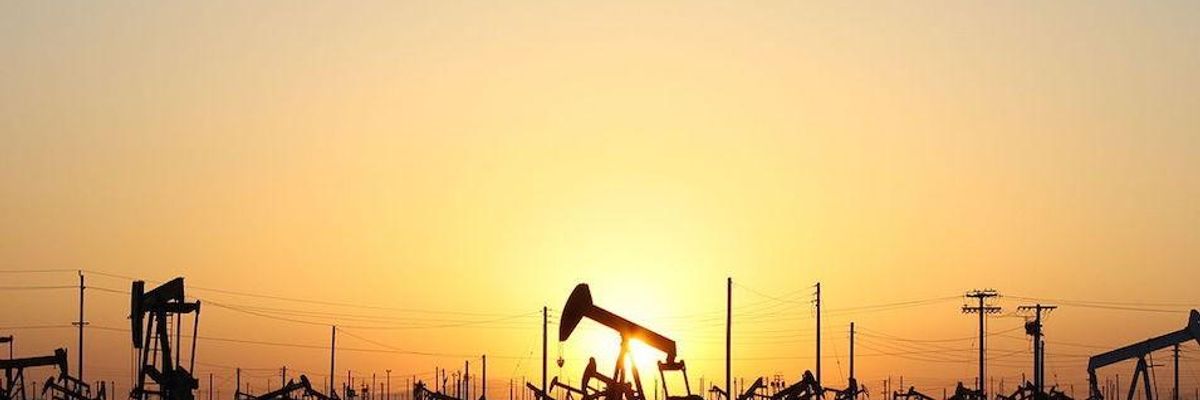
Pumpjacks on Lost Hills Oil Field in California. (Photo: Arne Huckelheim, Wikimedia Commons)
A national conservation group revealed Wednesday that President Donald Trump's drilling leases on public lands could lead to the release of more carbon emissions than the European Union contributes in an entire year.
The Wilderness Society estimates that U.S. companies will release at least 854 million and as much as 4.7 billion metric tons of carbon if it develops leases in public waters and lands.
"These leasing decisions have significant and long-term ramifications for our climate and our ability to stave off the worst impacts of global warming." --Wilderness Society"Taking into account the potency of shorter-lived climate pollutants like methane, lifecycle emissions resulting from the development of these leases could be as high as 5.2 billion metric tons," the group's new report reads.
The 28 countries in the EU released four billion metric tons in one year, according to the most recent available data.
Regardless of exactly how many leases are put to use by oil and gas companies, the Wilderness Society reports, "These leasing decisions have significant and long-term ramifications for our climate and our ability to stave off the worst impacts of global warming."
Since taking office in 2017, Trump has offered up 378 million acres of public land to oil and gas companies and has sought to overturn the Obama administration's ban on coal leases.
Climate action groups and lawmakers have pushed back against the administration's plans. Earlier this month California Gov. Gavin Newsom wrote to the Bureau of Land Management (BLM), saying the federal government's plan to open up more than 725,000 acres across California amounted to an abdication of "our responsibility to protect our residents, our resources, and our right to pursue a future beyond fossil fuels."
In Arizona on Tuesday, the Center for Biological Diversity was among the conservation groups which sued the Trump admininistration over its approval of leases on more than 4,000 acres, which they say will threatan wildlife and water in the Coconino Aquifer and Petrified Forest National Park.
The Wilderness Society noted in its report on what it called "Trump's reckless leasing of public lands" that because of the federal government's lack of transparency regarding emissions on federal property, it can only estimate how much carbon dioxide will be released should the leases be developed.
"The federal government cannot manage what it does not measure, yet the Trump administration is actively seeking to suppress disclosure of the full sweep of climate emissions from fossil energy leases," reads the report.
The Trump administration, the Wilderness Society wrote, is currently discouraging BLM field offices from analyzing the potential effects of oil and gas extraction on public lands:
In June 2019, Trump's Council on Environmental Quality (CEQ) released draft guidance on how federal agencies should consider [greenhouse gas] emissions under the National Environmental Policy Act (NEPA). This guidance essentially allows federal agencies to avoid fully estimating emissions for these leases, enables agencies to skirt accounting for the cumulative effects of emissions across permitted projects, and fails to encourage agencies to identify lower-emitting alternatives.
"As the world works to respond to the dire warning issued last fall by the global climate science body about the pace and scale of greenhouse gas emissions declines needed to avoid catastrophic warming," wrote the Wilderness Society, "the American public cannot even find reliable information about the greenhouse gas emissions and climate impacts of how their resources are being put to use."
This country and this world are at a monumental crossroads. US voters have an opportunity to beat back the forces of fascism and confront the billionaires who are rigging the economy, our media system, and our democracy, making it increasingly impossible for ordinary people to get by. We’re not just talking about the election. We’re talking about what must be done once these fascist elements are vanquished from power. We need a bolder set of solutions than what either major party has so far been willing to offer and a working-class movement ready to fight like hell for it. Trump didn't emerge from nowhere. The conditions that fueled MAGA authoritarianism were created by decades of radical neoliberal economic policies and a corrupt political system dominated by corporate interests. They slashed taxes on the super-rich, promising that the benefits would trickle down. They said giveaways to the corporate titans would make life more affordable for the rest of us. It was all bullshit. And when a bitter, betrayed populace searches for someone to blame, right-wing demagogues have little trouble finding scapegoats. People know when they're being lied to, but you won't hear any of this from the corporate media. Only independent journalism—powered and funded by people who believe in building a better world—can deliver truly trustworthy daily news. If you share our vision, please contribute whatever you can to sustain our work. |
A national conservation group revealed Wednesday that President Donald Trump's drilling leases on public lands could lead to the release of more carbon emissions than the European Union contributes in an entire year.
The Wilderness Society estimates that U.S. companies will release at least 854 million and as much as 4.7 billion metric tons of carbon if it develops leases in public waters and lands.
"These leasing decisions have significant and long-term ramifications for our climate and our ability to stave off the worst impacts of global warming." --Wilderness Society"Taking into account the potency of shorter-lived climate pollutants like methane, lifecycle emissions resulting from the development of these leases could be as high as 5.2 billion metric tons," the group's new report reads.
The 28 countries in the EU released four billion metric tons in one year, according to the most recent available data.
Regardless of exactly how many leases are put to use by oil and gas companies, the Wilderness Society reports, "These leasing decisions have significant and long-term ramifications for our climate and our ability to stave off the worst impacts of global warming."
Since taking office in 2017, Trump has offered up 378 million acres of public land to oil and gas companies and has sought to overturn the Obama administration's ban on coal leases.
Climate action groups and lawmakers have pushed back against the administration's plans. Earlier this month California Gov. Gavin Newsom wrote to the Bureau of Land Management (BLM), saying the federal government's plan to open up more than 725,000 acres across California amounted to an abdication of "our responsibility to protect our residents, our resources, and our right to pursue a future beyond fossil fuels."
In Arizona on Tuesday, the Center for Biological Diversity was among the conservation groups which sued the Trump admininistration over its approval of leases on more than 4,000 acres, which they say will threatan wildlife and water in the Coconino Aquifer and Petrified Forest National Park.
The Wilderness Society noted in its report on what it called "Trump's reckless leasing of public lands" that because of the federal government's lack of transparency regarding emissions on federal property, it can only estimate how much carbon dioxide will be released should the leases be developed.
"The federal government cannot manage what it does not measure, yet the Trump administration is actively seeking to suppress disclosure of the full sweep of climate emissions from fossil energy leases," reads the report.
The Trump administration, the Wilderness Society wrote, is currently discouraging BLM field offices from analyzing the potential effects of oil and gas extraction on public lands:
In June 2019, Trump's Council on Environmental Quality (CEQ) released draft guidance on how federal agencies should consider [greenhouse gas] emissions under the National Environmental Policy Act (NEPA). This guidance essentially allows federal agencies to avoid fully estimating emissions for these leases, enables agencies to skirt accounting for the cumulative effects of emissions across permitted projects, and fails to encourage agencies to identify lower-emitting alternatives.
"As the world works to respond to the dire warning issued last fall by the global climate science body about the pace and scale of greenhouse gas emissions declines needed to avoid catastrophic warming," wrote the Wilderness Society, "the American public cannot even find reliable information about the greenhouse gas emissions and climate impacts of how their resources are being put to use."