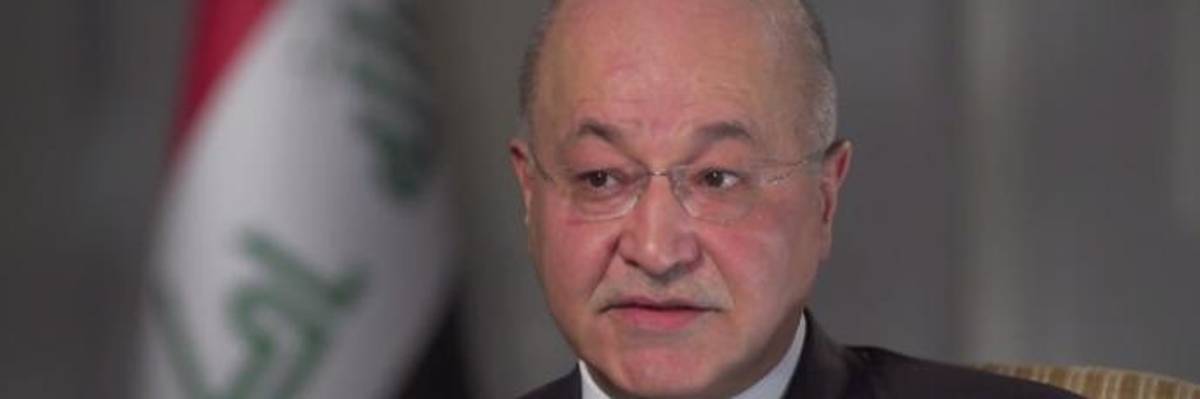
Iraqi President Barham Salih speaking in an interview that aired Tuesday with CNN's Christiane Amanpour. (Screengrab/CNN)
Iraqi President: US Has No Right to Use Iraq as 'Staging Post' for Attack on Iran
"There is no military solution to this problem."
Iraqi President Barham Salih said Tuesday that the United States has no right to use his country as a launchpad for a strike against Iran.
Salih, in his interview with CNN's Christiane Amanpour, also talked about the adverse impacts his own country has felt as a result of U.S. imposed sanctions, stressed the need to prevent another war, and warned that tearing up the nuclear deal entirely "could be disastrous for the entire neighborhood as a whole."
"It's easy to start a war but very, very difficult to end a war."
--Iraqi President Barham SalihTheir conversation, as Amanpour noted, came amid rising tensions between the U.S. and Iran, including new economic sanctions, the deployment of 1,000 more troops to the Middle East, and President Donald Trump's threat Tuesday to "obliterate" areas of the country..
Salih said he welcomed Trump's last minute decision last week to call off an initially-approved strike against Iran because, the Iraqi leader noted, "there is no military solution to this problem."
Instead, he said, "the parties involved need to sit down together and focus on what is important--really combating violent extremism, focusing on regional integration and economic issues."
"This part of the world needs fundamental solutions not another war," said Salih, adding that "it's best to de-escalate."
"The way to solve the problem is dialogue," he said, "sitting down [at] a table and really begin hammering out on the fundamental issues that are affecting that part of the world."
The harms from the new sanctions the U.S. imposed against Tuesday--which Iranian President Hassan Rouhani called "outrageous and idiotic"--are impacts Salih said his country is well acquainted with.
"We in Iraq have suffered from sanctions in the 1990s, and the devastation that has afflicted Iraqi society has been really enduring, even to date," said Salih. "So we feel for the people of Iran."
After Amanpour replayed part of an interview earlier this year in which Trump said he wanted to maintain a U.S. military presence in Iraq to "watch Iran," Salih reaffirmed his stance that doing so is not part of the deal brokered between the U.S. and Iraq.
"The American troops, the coalition troops in Iraq are there... at the invitation of the Iraqi government for the specific, exclusive mission of fighting ISIS," said Salih.
"We do not want our territory to be a staging post for any hostile action against any of our neighbors, including Iran," he added. "And this is definitely not part of the agreement between the Iraqi government and the United States."
Asked by Amanpour if he sees parallels between the lead-up to the Iraq war under the George W. Bush administration and the situation now between the U.S. and Iran, Salih suggested it was a different situation--but there's a clear lesson to be learned.
"I think [Saddam Hussein] was a unique case in history but the parallel is as follows," said Salih. "It's easy to start a war but very, very difficult to end a war."
An Urgent Message From Our Co-Founder
Dear Common Dreams reader, It’s been nearly 30 years since I co-founded Common Dreams with my late wife, Lina Newhouser. We had the radical notion that journalism should serve the public good, not corporate profits. It was clear to us from the outset what it would take to build such a project. No paid advertisements. No corporate sponsors. No millionaire publisher telling us what to think or do. Many people said we wouldn't last a year, but we proved those doubters wrong. Together with a tremendous team of journalists and dedicated staff, we built an independent media outlet free from the constraints of profits and corporate control. Our mission has always been simple: To inform. To inspire. To ignite change for the common good. Building Common Dreams was not easy. Our survival was never guaranteed. When you take on the most powerful forces—Wall Street greed, fossil fuel industry destruction, Big Tech lobbyists, and uber-rich oligarchs who have spent billions upon billions rigging the economy and democracy in their favor—the only bulwark you have is supporters who believe in your work. But here’s the urgent message from me today. It's never been this bad out there. And it's never been this hard to keep us going. At the very moment Common Dreams is most needed, the threats we face are intensifying. We need your support now more than ever. We don't accept corporate advertising and never will. We don't have a paywall because we don't think people should be blocked from critical news based on their ability to pay. Everything we do is funded by the donations of readers like you. When everyone does the little they can afford, we are strong. But if that support retreats or dries up, so do we. Will you donate now to make sure Common Dreams not only survives but thrives? —Craig Brown, Co-founder |
Iraqi President Barham Salih said Tuesday that the United States has no right to use his country as a launchpad for a strike against Iran.
Salih, in his interview with CNN's Christiane Amanpour, also talked about the adverse impacts his own country has felt as a result of U.S. imposed sanctions, stressed the need to prevent another war, and warned that tearing up the nuclear deal entirely "could be disastrous for the entire neighborhood as a whole."
"It's easy to start a war but very, very difficult to end a war."
--Iraqi President Barham SalihTheir conversation, as Amanpour noted, came amid rising tensions between the U.S. and Iran, including new economic sanctions, the deployment of 1,000 more troops to the Middle East, and President Donald Trump's threat Tuesday to "obliterate" areas of the country..
Salih said he welcomed Trump's last minute decision last week to call off an initially-approved strike against Iran because, the Iraqi leader noted, "there is no military solution to this problem."
Instead, he said, "the parties involved need to sit down together and focus on what is important--really combating violent extremism, focusing on regional integration and economic issues."
"This part of the world needs fundamental solutions not another war," said Salih, adding that "it's best to de-escalate."
"The way to solve the problem is dialogue," he said, "sitting down [at] a table and really begin hammering out on the fundamental issues that are affecting that part of the world."
The harms from the new sanctions the U.S. imposed against Tuesday--which Iranian President Hassan Rouhani called "outrageous and idiotic"--are impacts Salih said his country is well acquainted with.
"We in Iraq have suffered from sanctions in the 1990s, and the devastation that has afflicted Iraqi society has been really enduring, even to date," said Salih. "So we feel for the people of Iran."
After Amanpour replayed part of an interview earlier this year in which Trump said he wanted to maintain a U.S. military presence in Iraq to "watch Iran," Salih reaffirmed his stance that doing so is not part of the deal brokered between the U.S. and Iraq.
"The American troops, the coalition troops in Iraq are there... at the invitation of the Iraqi government for the specific, exclusive mission of fighting ISIS," said Salih.
"We do not want our territory to be a staging post for any hostile action against any of our neighbors, including Iran," he added. "And this is definitely not part of the agreement between the Iraqi government and the United States."
Asked by Amanpour if he sees parallels between the lead-up to the Iraq war under the George W. Bush administration and the situation now between the U.S. and Iran, Salih suggested it was a different situation--but there's a clear lesson to be learned.
"I think [Saddam Hussein] was a unique case in history but the parallel is as follows," said Salih. "It's easy to start a war but very, very difficult to end a war."
Iraqi President Barham Salih said Tuesday that the United States has no right to use his country as a launchpad for a strike against Iran.
Salih, in his interview with CNN's Christiane Amanpour, also talked about the adverse impacts his own country has felt as a result of U.S. imposed sanctions, stressed the need to prevent another war, and warned that tearing up the nuclear deal entirely "could be disastrous for the entire neighborhood as a whole."
"It's easy to start a war but very, very difficult to end a war."
--Iraqi President Barham SalihTheir conversation, as Amanpour noted, came amid rising tensions between the U.S. and Iran, including new economic sanctions, the deployment of 1,000 more troops to the Middle East, and President Donald Trump's threat Tuesday to "obliterate" areas of the country..
Salih said he welcomed Trump's last minute decision last week to call off an initially-approved strike against Iran because, the Iraqi leader noted, "there is no military solution to this problem."
Instead, he said, "the parties involved need to sit down together and focus on what is important--really combating violent extremism, focusing on regional integration and economic issues."
"This part of the world needs fundamental solutions not another war," said Salih, adding that "it's best to de-escalate."
"The way to solve the problem is dialogue," he said, "sitting down [at] a table and really begin hammering out on the fundamental issues that are affecting that part of the world."
The harms from the new sanctions the U.S. imposed against Tuesday--which Iranian President Hassan Rouhani called "outrageous and idiotic"--are impacts Salih said his country is well acquainted with.
"We in Iraq have suffered from sanctions in the 1990s, and the devastation that has afflicted Iraqi society has been really enduring, even to date," said Salih. "So we feel for the people of Iran."
After Amanpour replayed part of an interview earlier this year in which Trump said he wanted to maintain a U.S. military presence in Iraq to "watch Iran," Salih reaffirmed his stance that doing so is not part of the deal brokered between the U.S. and Iraq.
"The American troops, the coalition troops in Iraq are there... at the invitation of the Iraqi government for the specific, exclusive mission of fighting ISIS," said Salih.
"We do not want our territory to be a staging post for any hostile action against any of our neighbors, including Iran," he added. "And this is definitely not part of the agreement between the Iraqi government and the United States."
Asked by Amanpour if he sees parallels between the lead-up to the Iraq war under the George W. Bush administration and the situation now between the U.S. and Iran, Salih suggested it was a different situation--but there's a clear lesson to be learned.
"I think [Saddam Hussein] was a unique case in history but the parallel is as follows," said Salih. "It's easy to start a war but very, very difficult to end a war."