SUBSCRIBE TO OUR FREE NEWSLETTER
Daily news & progressive opinion—funded by the people, not the corporations—delivered straight to your inbox.
5
#000000
#FFFFFF
To donate by check, phone, or other method, see our More Ways to Give page.
Warning: This article includes graphic images that may be very difficult for some.
A horrifying and heartbreaking series of photographs of a father and his young daughter from El Salvador who drowned while attempting to seek asylum in the United States--similar to an image of a young Syrian boy, a refugee, whose lifeless body washed ashore in Turkey in 2015--is stirring sorrow and outrage overnight, much of it directed at the Trump administration for intentionally creating conditions in which refugees simply seeking a better life are forced to put their lives at risk.
According to the Associated Press:
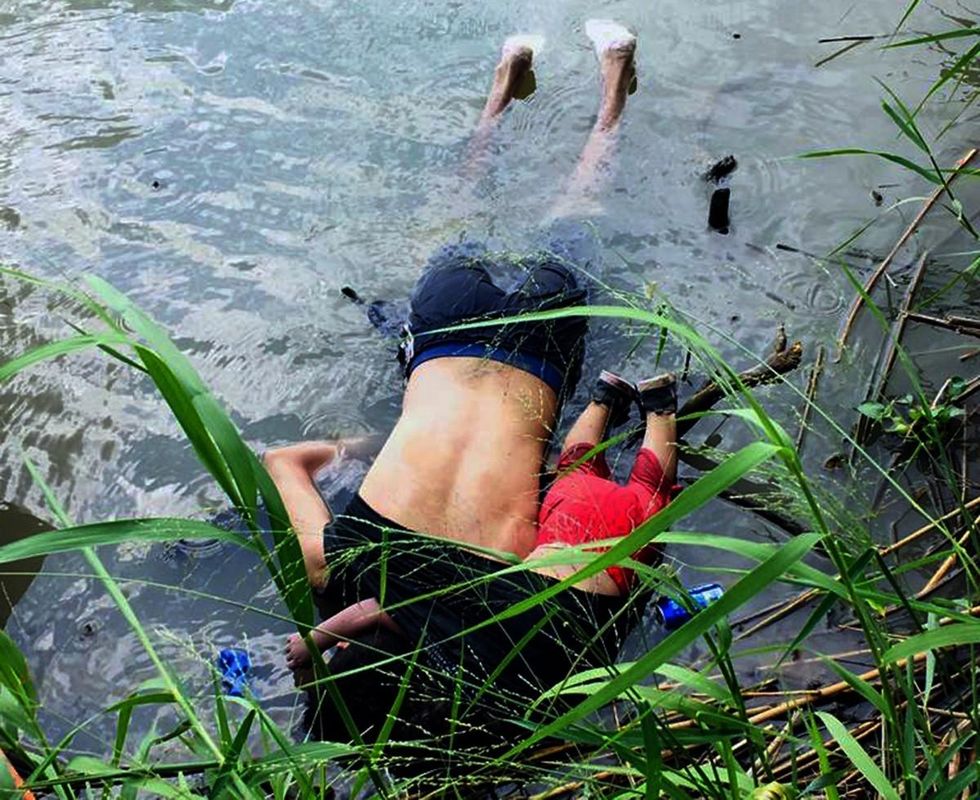
The searing photograph of the sad discovery of their bodies on Monday, captured by journalist Julia Le Duc and published by Mexican newspaper La Jornada, highlights the perils faced by mostly Central American migrants fleeing violence and poverty and hoping for asylum in the United States.
According to Le Duc's reporting for La Jornada, Oscar Alberto Martinez Ramirez, frustrated because the family from El Salvador was unable to present themselves to U.S. authorities and request asylum, swam across the river on Sunday with his daughter, Valeria.
He set her on the U.S. bank of the river and started back for his wife, Tania Vanessa Avalos, but seeing him move away the girl threw herself into the waters. Martinez returned and was able to grab Valeria, but the current swept them both away.
The account was based on remarks by Avalos to police at the scene--"amid tears" and "screams"--Le Duc told The Associated Press.
Once published and then shared on social media, the photos of Ramirez and his daughter--whose name has yet to be released--generated a groundswell of sorrow, anger, and other emotions online [Warning, graphic images follow]:
Warning: the following photo of Ramirez and his daughter is incredibly graphic and may be hard to see:
Rep. Rashida Tlaib (D-Mich.) placed blame for the deaths directly at the feet of President Donald Trump and his administration:
In 2015, when the photographs of Alan Kurdi--the 3-year-old Syrian boy who died while his family tried to reach European shores--were published in the wake of his death, they became a rallying cry across the globe for those calling for an end to Syria's civil war and a heartbreaking reminder of the dangers that millions of refugees face, many of them children, across the world each year.
In that circumstance, as Common Dreams reported at the time, there was a serious debate surrounding the media's responsibility and ethical considerations when it came to publishing the photographs of Kurdi. As explained by Peter Bouckaert, director of emergencies for Human Rights Watch in 2015, the decision was not one taken lightly but in the end he believed it was vital the photographs--as difficult as they were to see--be widely reported and shared.
"Some say the picture is too offensive to share online or print in our newspapers," Bouckaert said. "But what I find offensive is that drowned children are washing up on our shorelines, when more could have been done to prevent their deaths."
To share such "a brutal image of a drowned child" was not easy, he added, "but I care about these children as much as my own. Maybe if Europe's leaders did too, they would try to stem this ghastly spectacle."
On Tuesday night, many in the United States were having a similar argument about the horrifying photographs of Ramirez and his daughter.
"That AP story about the drowned migrant and his toddler daughter includes a heart-breaking, graphic photo," tweeted Washington Post national correspondent Philip Bump. "The photo should not, though, be the story's share image on social."
The immigration rights group United We Dream also asked people not to share the photo:
In his thread, Bump argued that "people should be able to share the story without also necessarily forcing the image itself on people," but other people responding to him said that perhaps people in the U.S. should no longer have the right to look away from the injuries and death that predictably result from government policies and the cruelty inflicted on asylum-seekers at the border.
"Our tax dollars killed that father and little girl," said one in response. "The least we can do is acknowledge the horror of our policy choices."
"Maybe," said another, "we should stop sheltering people from the real world consequences of the policies they push."
For his part, Ricardo Gutierrez, a strategist with Al Otro Lado, which provides legal services to refugees and immigrants facing deportation, said people can longer look away from what is happening to people at the U.S. border.
"People who are fleeing violence and whose lives are endangered have come to our shores, seeking refuge, seeking a helping hand," added Gutierrez. "Instead, for decades, our government has worked very hard to otherize them, to ensure they are dismissed, unwelcome, alien... illegal."
Countering the narrative that abuse and deaths are unfortunate mistakes that result from a chaotic system, as some argue, Gutierrez made the point that, "Brutality is not a bug. It's the main feature."
While looking away is no longer an option, he said, there is much that can be done to help solve the crisis, including closing the concentration camps that Trump has filled beyond capacity near the border with his "zero tolerance" policy and by regular people across the nation opening their homes to those seeking asylum protection, organizing their communities, or supporting groups on the frontline of the crisis.
Warning: This article includes graphic images that may be very difficult for some.
A horrifying and heartbreaking series of photographs of a father and his young daughter from El Salvador who drowned while attempting to seek asylum in the United States--similar to an image of a young Syrian boy, a refugee, whose lifeless body washed ashore in Turkey in 2015--is stirring sorrow and outrage overnight, much of it directed at the Trump administration for intentionally creating conditions in which refugees simply seeking a better life are forced to put their lives at risk.
According to the Associated Press:
The searing photograph of the sad discovery of their bodies on Monday, captured by journalist Julia Le Duc and published by Mexican newspaper La Jornada, highlights the perils faced by mostly Central American migrants fleeing violence and poverty and hoping for asylum in the United States.
According to Le Duc's reporting for La Jornada, Oscar Alberto Martinez Ramirez, frustrated because the family from El Salvador was unable to present themselves to U.S. authorities and request asylum, swam across the river on Sunday with his daughter, Valeria.
He set her on the U.S. bank of the river and started back for his wife, Tania Vanessa Avalos, but seeing him move away the girl threw herself into the waters. Martinez returned and was able to grab Valeria, but the current swept them both away.
The account was based on remarks by Avalos to police at the scene--"amid tears" and "screams"--Le Duc told The Associated Press.
Once published and then shared on social media, the photos of Ramirez and his daughter--whose name has yet to be released--generated a groundswell of sorrow, anger, and other emotions online [Warning, graphic images follow]:
Warning: the following photo of Ramirez and his daughter is incredibly graphic and may be hard to see:
Rep. Rashida Tlaib (D-Mich.) placed blame for the deaths directly at the feet of President Donald Trump and his administration:
In 2015, when the photographs of Alan Kurdi--the 3-year-old Syrian boy who died while his family tried to reach European shores--were published in the wake of his death, they became a rallying cry across the globe for those calling for an end to Syria's civil war and a heartbreaking reminder of the dangers that millions of refugees face, many of them children, across the world each year.
In that circumstance, as Common Dreams reported at the time, there was a serious debate surrounding the media's responsibility and ethical considerations when it came to publishing the photographs of Kurdi. As explained by Peter Bouckaert, director of emergencies for Human Rights Watch in 2015, the decision was not one taken lightly but in the end he believed it was vital the photographs--as difficult as they were to see--be widely reported and shared.
"Some say the picture is too offensive to share online or print in our newspapers," Bouckaert said. "But what I find offensive is that drowned children are washing up on our shorelines, when more could have been done to prevent their deaths."
To share such "a brutal image of a drowned child" was not easy, he added, "but I care about these children as much as my own. Maybe if Europe's leaders did too, they would try to stem this ghastly spectacle."
On Tuesday night, many in the United States were having a similar argument about the horrifying photographs of Ramirez and his daughter.
"That AP story about the drowned migrant and his toddler daughter includes a heart-breaking, graphic photo," tweeted Washington Post national correspondent Philip Bump. "The photo should not, though, be the story's share image on social."
The immigration rights group United We Dream also asked people not to share the photo:
In his thread, Bump argued that "people should be able to share the story without also necessarily forcing the image itself on people," but other people responding to him said that perhaps people in the U.S. should no longer have the right to look away from the injuries and death that predictably result from government policies and the cruelty inflicted on asylum-seekers at the border.
"Our tax dollars killed that father and little girl," said one in response. "The least we can do is acknowledge the horror of our policy choices."
"Maybe," said another, "we should stop sheltering people from the real world consequences of the policies they push."
For his part, Ricardo Gutierrez, a strategist with Al Otro Lado, which provides legal services to refugees and immigrants facing deportation, said people can longer look away from what is happening to people at the U.S. border.
"People who are fleeing violence and whose lives are endangered have come to our shores, seeking refuge, seeking a helping hand," added Gutierrez. "Instead, for decades, our government has worked very hard to otherize them, to ensure they are dismissed, unwelcome, alien... illegal."
Countering the narrative that abuse and deaths are unfortunate mistakes that result from a chaotic system, as some argue, Gutierrez made the point that, "Brutality is not a bug. It's the main feature."
While looking away is no longer an option, he said, there is much that can be done to help solve the crisis, including closing the concentration camps that Trump has filled beyond capacity near the border with his "zero tolerance" policy and by regular people across the nation opening their homes to those seeking asylum protection, organizing their communities, or supporting groups on the frontline of the crisis.
Warning: This article includes graphic images that may be very difficult for some.
A horrifying and heartbreaking series of photographs of a father and his young daughter from El Salvador who drowned while attempting to seek asylum in the United States--similar to an image of a young Syrian boy, a refugee, whose lifeless body washed ashore in Turkey in 2015--is stirring sorrow and outrage overnight, much of it directed at the Trump administration for intentionally creating conditions in which refugees simply seeking a better life are forced to put their lives at risk.
According to the Associated Press:
The searing photograph of the sad discovery of their bodies on Monday, captured by journalist Julia Le Duc and published by Mexican newspaper La Jornada, highlights the perils faced by mostly Central American migrants fleeing violence and poverty and hoping for asylum in the United States.
According to Le Duc's reporting for La Jornada, Oscar Alberto Martinez Ramirez, frustrated because the family from El Salvador was unable to present themselves to U.S. authorities and request asylum, swam across the river on Sunday with his daughter, Valeria.
He set her on the U.S. bank of the river and started back for his wife, Tania Vanessa Avalos, but seeing him move away the girl threw herself into the waters. Martinez returned and was able to grab Valeria, but the current swept them both away.
The account was based on remarks by Avalos to police at the scene--"amid tears" and "screams"--Le Duc told The Associated Press.
Once published and then shared on social media, the photos of Ramirez and his daughter--whose name has yet to be released--generated a groundswell of sorrow, anger, and other emotions online [Warning, graphic images follow]:
Warning: the following photo of Ramirez and his daughter is incredibly graphic and may be hard to see:
Rep. Rashida Tlaib (D-Mich.) placed blame for the deaths directly at the feet of President Donald Trump and his administration:
In 2015, when the photographs of Alan Kurdi--the 3-year-old Syrian boy who died while his family tried to reach European shores--were published in the wake of his death, they became a rallying cry across the globe for those calling for an end to Syria's civil war and a heartbreaking reminder of the dangers that millions of refugees face, many of them children, across the world each year.
In that circumstance, as Common Dreams reported at the time, there was a serious debate surrounding the media's responsibility and ethical considerations when it came to publishing the photographs of Kurdi. As explained by Peter Bouckaert, director of emergencies for Human Rights Watch in 2015, the decision was not one taken lightly but in the end he believed it was vital the photographs--as difficult as they were to see--be widely reported and shared.
"Some say the picture is too offensive to share online or print in our newspapers," Bouckaert said. "But what I find offensive is that drowned children are washing up on our shorelines, when more could have been done to prevent their deaths."
To share such "a brutal image of a drowned child" was not easy, he added, "but I care about these children as much as my own. Maybe if Europe's leaders did too, they would try to stem this ghastly spectacle."
On Tuesday night, many in the United States were having a similar argument about the horrifying photographs of Ramirez and his daughter.
"That AP story about the drowned migrant and his toddler daughter includes a heart-breaking, graphic photo," tweeted Washington Post national correspondent Philip Bump. "The photo should not, though, be the story's share image on social."
The immigration rights group United We Dream also asked people not to share the photo:
In his thread, Bump argued that "people should be able to share the story without also necessarily forcing the image itself on people," but other people responding to him said that perhaps people in the U.S. should no longer have the right to look away from the injuries and death that predictably result from government policies and the cruelty inflicted on asylum-seekers at the border.
"Our tax dollars killed that father and little girl," said one in response. "The least we can do is acknowledge the horror of our policy choices."
"Maybe," said another, "we should stop sheltering people from the real world consequences of the policies they push."
For his part, Ricardo Gutierrez, a strategist with Al Otro Lado, which provides legal services to refugees and immigrants facing deportation, said people can longer look away from what is happening to people at the U.S. border.
"People who are fleeing violence and whose lives are endangered have come to our shores, seeking refuge, seeking a helping hand," added Gutierrez. "Instead, for decades, our government has worked very hard to otherize them, to ensure they are dismissed, unwelcome, alien... illegal."
Countering the narrative that abuse and deaths are unfortunate mistakes that result from a chaotic system, as some argue, Gutierrez made the point that, "Brutality is not a bug. It's the main feature."
While looking away is no longer an option, he said, there is much that can be done to help solve the crisis, including closing the concentration camps that Trump has filled beyond capacity near the border with his "zero tolerance" policy and by regular people across the nation opening their homes to those seeking asylum protection, organizing their communities, or supporting groups on the frontline of the crisis.