

SUBSCRIBE TO OUR FREE NEWSLETTER
Daily news & progressive opinion—funded by the people, not the corporations—delivered straight to your inbox.
5
#000000
#FFFFFF
To donate by check, phone, or other method, see our More Ways to Give page.
Daily news & progressive opinion—funded by the people, not the corporations—delivered straight to your inbox.
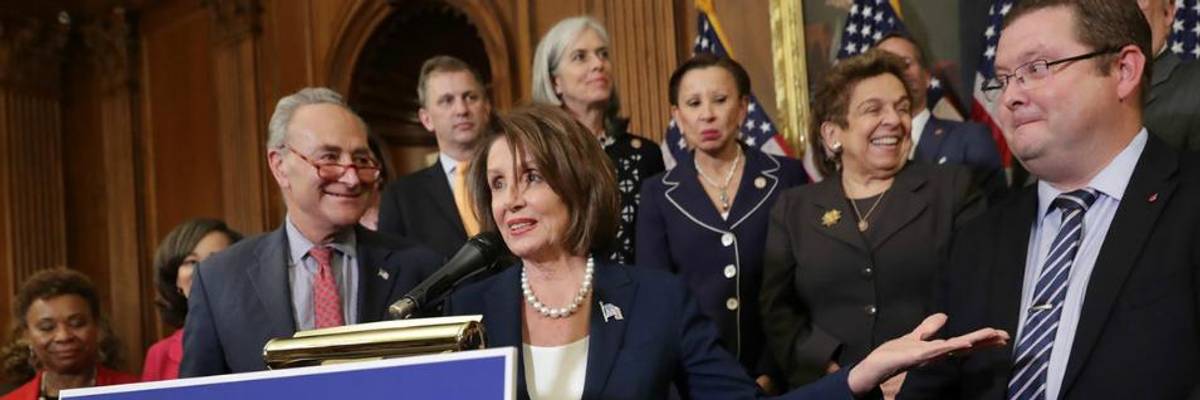
House Speaker Nancy Pelosi (D-Calif.) speaks at a press conference on drug prices. (Photo: Chip Somodevilla/Getty Images)
Amid concerns that the House Democratic leadership is crafting a drug pricing bill that is far too friendly to the pharmaceutical industry, progressives in Congress this week publicly called out House Speaker Nancy Pelosi for writing the legislation in secret and ignoring those who favor a more aggressive approach to lowering out-of-control prescription drug costs.
Rep. Alexandria Ocasio-Cortez (D-N.Y.) was among the progressive Democrats who spoke out Wednesday, telling reporters that the House Democratic leadership has left "most members" completely in the dark on the details of the prescription drug bill.
"That's a problem and it's part of a pattern, I think, where we don't know things until 48 hours before. And then it's like, 'You're either with us or you're against us.'"
--Rep. Alexandria Ocasio-Cortez
"That's a problem and it's part of a pattern, I think, where we don't know things until 48 hours before," Ocasio-Cortez said. "And then it's like, 'You're either with us or you're against us.'"
As Common Dreams reported last month, progressives raised alarm after Pelosi informed Democrats behind closed doors that she is throwing her weight behind a plan that would require the Department of Health and Human Services (HHS) to negotiate the prices of at least 25 drugs each year.
The legislation, according to HuffPost, would do nothing to challenge the monopoly power of pharmaceutical companies.
While the Pelosi-backed plan has not been finalized, Alex Lawson--executive director of the advocacy group Social Security Works--warned that what is known of the proposal is "not even close to sufficient" to address the crisis of soaring drug costs.
Rep. Lloyd Doggett (D-Texas), the sponsor of a more ambitious drug pricing bill, likened Pelosi's approach to the drug pricing legislation with the secretive process the GOP used to craft its Obamacare repeal bill and tax cuts in 2017.
"We have a great history with Republicans where they locked up their healthcare plan so that even Rand Paul couldn't see it, and they held their tax plan to the last minute," Doggett told reporters, "so if there is to be good collaboration here there needs to be more openness."
Under Doggett's bill--which currently has 125 House co-sponsors-- Medicare would be permitted to negotiate drug prices. Should drug price negotiations fail, Doggett's bill would require the government to authorize low-cost generics--which, unlike the Pelosi-backed plan, would threaten Big Pharma's monopoly power over the drug market.
As HuffPost reported last month, Pelosi and the Democratic leadership "have ignored Doggett's bill," which was endorsed by the Congressional Progressive Caucus (CPC) in April.
Reps. Pramila Jayapal (D-Wash.) and Mark Pocan (D-Wis.), co-chairs of the CPC, joined their fellow progressive lawmakers in raising alarm about Pelosi's secretive process this week.
According to Politico, Jayapal said Tuesday that she "sent Democratic leadership staff a list of questions about their drug pricing work, demanding details after the latest plan raised 'lots of concerns' about whether it would make a significant dent in the prices Americans pay for their prescription drugs."
Pocan told reporters on Tuesday that he simply wants "to make sure that everyone is brought on board" and warned of the consequences of crafting milquetoast legislation that does little to tackling soaring drug costs, an issue that polls near the top of the public's healthcare concerns.
"If we don't address this in a big and bold way, a lot of us should go home and start knitting," Pocan said. "To me, if the conversation ends in two weeks, we got screwed."
Dear Common Dreams reader, It’s been nearly 30 years since I co-founded Common Dreams with my late wife, Lina Newhouser. We had the radical notion that journalism should serve the public good, not corporate profits. It was clear to us from the outset what it would take to build such a project. No paid advertisements. No corporate sponsors. No millionaire publisher telling us what to think or do. Many people said we wouldn't last a year, but we proved those doubters wrong. Together with a tremendous team of journalists and dedicated staff, we built an independent media outlet free from the constraints of profits and corporate control. Our mission has always been simple: To inform. To inspire. To ignite change for the common good. Building Common Dreams was not easy. Our survival was never guaranteed. When you take on the most powerful forces—Wall Street greed, fossil fuel industry destruction, Big Tech lobbyists, and uber-rich oligarchs who have spent billions upon billions rigging the economy and democracy in their favor—the only bulwark you have is supporters who believe in your work. But here’s the urgent message from me today. It's never been this bad out there. And it's never been this hard to keep us going. At the very moment Common Dreams is most needed, the threats we face are intensifying. We need your support now more than ever. We don't accept corporate advertising and never will. We don't have a paywall because we don't think people should be blocked from critical news based on their ability to pay. Everything we do is funded by the donations of readers like you. When everyone does the little they can afford, we are strong. But if that support retreats or dries up, so do we. Will you donate now to make sure Common Dreams not only survives but thrives? —Craig Brown, Co-founder |
Amid concerns that the House Democratic leadership is crafting a drug pricing bill that is far too friendly to the pharmaceutical industry, progressives in Congress this week publicly called out House Speaker Nancy Pelosi for writing the legislation in secret and ignoring those who favor a more aggressive approach to lowering out-of-control prescription drug costs.
Rep. Alexandria Ocasio-Cortez (D-N.Y.) was among the progressive Democrats who spoke out Wednesday, telling reporters that the House Democratic leadership has left "most members" completely in the dark on the details of the prescription drug bill.
"That's a problem and it's part of a pattern, I think, where we don't know things until 48 hours before. And then it's like, 'You're either with us or you're against us.'"
--Rep. Alexandria Ocasio-Cortez
"That's a problem and it's part of a pattern, I think, where we don't know things until 48 hours before," Ocasio-Cortez said. "And then it's like, 'You're either with us or you're against us.'"
As Common Dreams reported last month, progressives raised alarm after Pelosi informed Democrats behind closed doors that she is throwing her weight behind a plan that would require the Department of Health and Human Services (HHS) to negotiate the prices of at least 25 drugs each year.
The legislation, according to HuffPost, would do nothing to challenge the monopoly power of pharmaceutical companies.
While the Pelosi-backed plan has not been finalized, Alex Lawson--executive director of the advocacy group Social Security Works--warned that what is known of the proposal is "not even close to sufficient" to address the crisis of soaring drug costs.
Rep. Lloyd Doggett (D-Texas), the sponsor of a more ambitious drug pricing bill, likened Pelosi's approach to the drug pricing legislation with the secretive process the GOP used to craft its Obamacare repeal bill and tax cuts in 2017.
"We have a great history with Republicans where they locked up their healthcare plan so that even Rand Paul couldn't see it, and they held their tax plan to the last minute," Doggett told reporters, "so if there is to be good collaboration here there needs to be more openness."
Under Doggett's bill--which currently has 125 House co-sponsors-- Medicare would be permitted to negotiate drug prices. Should drug price negotiations fail, Doggett's bill would require the government to authorize low-cost generics--which, unlike the Pelosi-backed plan, would threaten Big Pharma's monopoly power over the drug market.
As HuffPost reported last month, Pelosi and the Democratic leadership "have ignored Doggett's bill," which was endorsed by the Congressional Progressive Caucus (CPC) in April.
Reps. Pramila Jayapal (D-Wash.) and Mark Pocan (D-Wis.), co-chairs of the CPC, joined their fellow progressive lawmakers in raising alarm about Pelosi's secretive process this week.
According to Politico, Jayapal said Tuesday that she "sent Democratic leadership staff a list of questions about their drug pricing work, demanding details after the latest plan raised 'lots of concerns' about whether it would make a significant dent in the prices Americans pay for their prescription drugs."
Pocan told reporters on Tuesday that he simply wants "to make sure that everyone is brought on board" and warned of the consequences of crafting milquetoast legislation that does little to tackling soaring drug costs, an issue that polls near the top of the public's healthcare concerns.
"If we don't address this in a big and bold way, a lot of us should go home and start knitting," Pocan said. "To me, if the conversation ends in two weeks, we got screwed."
Amid concerns that the House Democratic leadership is crafting a drug pricing bill that is far too friendly to the pharmaceutical industry, progressives in Congress this week publicly called out House Speaker Nancy Pelosi for writing the legislation in secret and ignoring those who favor a more aggressive approach to lowering out-of-control prescription drug costs.
Rep. Alexandria Ocasio-Cortez (D-N.Y.) was among the progressive Democrats who spoke out Wednesday, telling reporters that the House Democratic leadership has left "most members" completely in the dark on the details of the prescription drug bill.
"That's a problem and it's part of a pattern, I think, where we don't know things until 48 hours before. And then it's like, 'You're either with us or you're against us.'"
--Rep. Alexandria Ocasio-Cortez
"That's a problem and it's part of a pattern, I think, where we don't know things until 48 hours before," Ocasio-Cortez said. "And then it's like, 'You're either with us or you're against us.'"
As Common Dreams reported last month, progressives raised alarm after Pelosi informed Democrats behind closed doors that she is throwing her weight behind a plan that would require the Department of Health and Human Services (HHS) to negotiate the prices of at least 25 drugs each year.
The legislation, according to HuffPost, would do nothing to challenge the monopoly power of pharmaceutical companies.
While the Pelosi-backed plan has not been finalized, Alex Lawson--executive director of the advocacy group Social Security Works--warned that what is known of the proposal is "not even close to sufficient" to address the crisis of soaring drug costs.
Rep. Lloyd Doggett (D-Texas), the sponsor of a more ambitious drug pricing bill, likened Pelosi's approach to the drug pricing legislation with the secretive process the GOP used to craft its Obamacare repeal bill and tax cuts in 2017.
"We have a great history with Republicans where they locked up their healthcare plan so that even Rand Paul couldn't see it, and they held their tax plan to the last minute," Doggett told reporters, "so if there is to be good collaboration here there needs to be more openness."
Under Doggett's bill--which currently has 125 House co-sponsors-- Medicare would be permitted to negotiate drug prices. Should drug price negotiations fail, Doggett's bill would require the government to authorize low-cost generics--which, unlike the Pelosi-backed plan, would threaten Big Pharma's monopoly power over the drug market.
As HuffPost reported last month, Pelosi and the Democratic leadership "have ignored Doggett's bill," which was endorsed by the Congressional Progressive Caucus (CPC) in April.
Reps. Pramila Jayapal (D-Wash.) and Mark Pocan (D-Wis.), co-chairs of the CPC, joined their fellow progressive lawmakers in raising alarm about Pelosi's secretive process this week.
According to Politico, Jayapal said Tuesday that she "sent Democratic leadership staff a list of questions about their drug pricing work, demanding details after the latest plan raised 'lots of concerns' about whether it would make a significant dent in the prices Americans pay for their prescription drugs."
Pocan told reporters on Tuesday that he simply wants "to make sure that everyone is brought on board" and warned of the consequences of crafting milquetoast legislation that does little to tackling soaring drug costs, an issue that polls near the top of the public's healthcare concerns.
"If we don't address this in a big and bold way, a lot of us should go home and start knitting," Pocan said. "To me, if the conversation ends in two weeks, we got screwed."

