SUBSCRIBE TO OUR FREE NEWSLETTER
Daily news & progressive opinion—funded by the people, not the corporations—delivered straight to your inbox.
5
#000000
#FFFFFF
To donate by check, phone, or other method, see our More Ways to Give page.
Daily news & progressive opinion—funded by the people, not the corporations—delivered straight to your inbox.
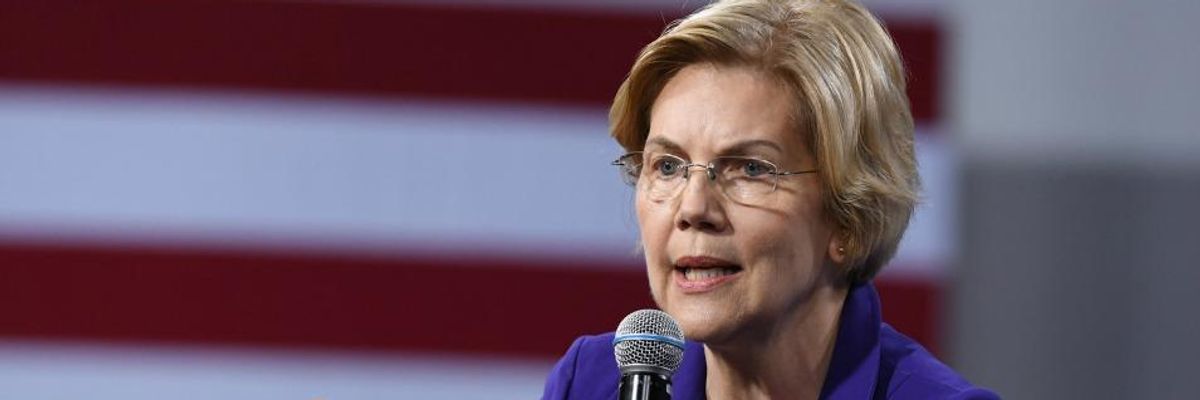
Democratic presidential candidate Sen. Elizabeth Warren (D-Mass.) called for new legislation to make it possible for a president to be indicted. (Photo: Ethan Miller/Getty Images)
Sen. Elizabeth Warren on Friday set out to change a decades-old rule which allows a U.S. president to abuse power in any number of ways without being held accountable.
In a Medium post titled "No President Is Above the Law," the Massachusetts Democrat called on lawmakers to pass legislation that would allow for the indictment of a sitting president--a measure that would have allowed Special Counsel Robert Mueller to act on his decision not to exonerate President Donald Trump.
"Donald Trump believes that he can violate the law, and he believes that the role of the Department of Justice is to help him get away with it," Warren wrote. "That's not how our country is supposed to work."
Warren's newest proposal came two days after Mueller delivered a statement to the press about his report on Trump's 2016 campaign and his alleged attempts to obstruct justice during Mueller's two-year investigation. The special counsel reiterated that he was not confident that the president did not commit a crime, but pointed to a Watergate-era statute which prohibited him from bringing charges against Trump.
"Mueller's statement made clear what those of us who have read his report already knew: He's referring President Trump for impeachment, and it's up to Congress to act," wrote Warren. "But impeachment isn't supposed to be the only way that a president can be held accountable for committing a crime. That's why I've got a plan to make sure that no president is above the law."
"Congress should make it clear that the president can be held accountable for violating the law, just like everyone else."
--Sen. Elizabeth Warren
Under Warren's plan, Congress would pass legislation clarifying that the Department of Justice (DOJ) can indict a sitting president. The new law would negate a determination made by the DOJ's Office of Legal Counsel in 1973 that a criminal case against the president would be detrimental to the country, leaving Congress only with the option of impeaching a president in the case of criminal wrongdoing.
"Yes, Congress has a constitutional obligation to impeach the president when he violates the law," Warren said. "But lawyers for previous presidents have used this constitutional duty to argue that the only way the president can be held accountable for criminal behavior is through impeachment."
"Congress should make it clear that the president can be held accountable for violating the law, just like everyone else," she added.
Warren also called for amendments to obstruction of justice statutes. The new laws would make it clear that actions including Trump's firing of former FBI Director James Comey and his alleged offer to pardon former lawyer Michael Cohen if he lied to Congress on his behalf, would constitute indictable offenses.
"Most people agree that these laws apply to the president, but some partisan extremists, like Attorney General Bill Barr, have argued that they don't," Warren wrote.
Barr, Warren argued, "disgraced himself" when he disobeyed a congressional subpoena to release the unredacted Mueller report and vehemently defended the president in his summary of Mueller's findings. If elected president, the senator wrote, she would appoint an attorney general and other agency officials who would reverse the DOJ's 1973 opinion and "who [know] their job is to objectively advise the executive branch on what it can and cannot do under the Constitution."
"Our democracy only works if everyone can be held accountable," wrote Warren. "These changes will make sure that's the case for generations to come."
Dear Common Dreams reader, It’s been nearly 30 years since I co-founded Common Dreams with my late wife, Lina Newhouser. We had the radical notion that journalism should serve the public good, not corporate profits. It was clear to us from the outset what it would take to build such a project. No paid advertisements. No corporate sponsors. No millionaire publisher telling us what to think or do. Many people said we wouldn't last a year, but we proved those doubters wrong. Together with a tremendous team of journalists and dedicated staff, we built an independent media outlet free from the constraints of profits and corporate control. Our mission has always been simple: To inform. To inspire. To ignite change for the common good. Building Common Dreams was not easy. Our survival was never guaranteed. When you take on the most powerful forces—Wall Street greed, fossil fuel industry destruction, Big Tech lobbyists, and uber-rich oligarchs who have spent billions upon billions rigging the economy and democracy in their favor—the only bulwark you have is supporters who believe in your work. But here’s the urgent message from me today. It's never been this bad out there. And it's never been this hard to keep us going. At the very moment Common Dreams is most needed, the threats we face are intensifying. We need your support now more than ever. We don't accept corporate advertising and never will. We don't have a paywall because we don't think people should be blocked from critical news based on their ability to pay. Everything we do is funded by the donations of readers like you. When everyone does the little they can afford, we are strong. But if that support retreats or dries up, so do we. Will you donate now to make sure Common Dreams not only survives but thrives? —Craig Brown, Co-founder |
Sen. Elizabeth Warren on Friday set out to change a decades-old rule which allows a U.S. president to abuse power in any number of ways without being held accountable.
In a Medium post titled "No President Is Above the Law," the Massachusetts Democrat called on lawmakers to pass legislation that would allow for the indictment of a sitting president--a measure that would have allowed Special Counsel Robert Mueller to act on his decision not to exonerate President Donald Trump.
"Donald Trump believes that he can violate the law, and he believes that the role of the Department of Justice is to help him get away with it," Warren wrote. "That's not how our country is supposed to work."
Warren's newest proposal came two days after Mueller delivered a statement to the press about his report on Trump's 2016 campaign and his alleged attempts to obstruct justice during Mueller's two-year investigation. The special counsel reiterated that he was not confident that the president did not commit a crime, but pointed to a Watergate-era statute which prohibited him from bringing charges against Trump.
"Mueller's statement made clear what those of us who have read his report already knew: He's referring President Trump for impeachment, and it's up to Congress to act," wrote Warren. "But impeachment isn't supposed to be the only way that a president can be held accountable for committing a crime. That's why I've got a plan to make sure that no president is above the law."
"Congress should make it clear that the president can be held accountable for violating the law, just like everyone else."
--Sen. Elizabeth Warren
Under Warren's plan, Congress would pass legislation clarifying that the Department of Justice (DOJ) can indict a sitting president. The new law would negate a determination made by the DOJ's Office of Legal Counsel in 1973 that a criminal case against the president would be detrimental to the country, leaving Congress only with the option of impeaching a president in the case of criminal wrongdoing.
"Yes, Congress has a constitutional obligation to impeach the president when he violates the law," Warren said. "But lawyers for previous presidents have used this constitutional duty to argue that the only way the president can be held accountable for criminal behavior is through impeachment."
"Congress should make it clear that the president can be held accountable for violating the law, just like everyone else," she added.
Warren also called for amendments to obstruction of justice statutes. The new laws would make it clear that actions including Trump's firing of former FBI Director James Comey and his alleged offer to pardon former lawyer Michael Cohen if he lied to Congress on his behalf, would constitute indictable offenses.
"Most people agree that these laws apply to the president, but some partisan extremists, like Attorney General Bill Barr, have argued that they don't," Warren wrote.
Barr, Warren argued, "disgraced himself" when he disobeyed a congressional subpoena to release the unredacted Mueller report and vehemently defended the president in his summary of Mueller's findings. If elected president, the senator wrote, she would appoint an attorney general and other agency officials who would reverse the DOJ's 1973 opinion and "who [know] their job is to objectively advise the executive branch on what it can and cannot do under the Constitution."
"Our democracy only works if everyone can be held accountable," wrote Warren. "These changes will make sure that's the case for generations to come."
Sen. Elizabeth Warren on Friday set out to change a decades-old rule which allows a U.S. president to abuse power in any number of ways without being held accountable.
In a Medium post titled "No President Is Above the Law," the Massachusetts Democrat called on lawmakers to pass legislation that would allow for the indictment of a sitting president--a measure that would have allowed Special Counsel Robert Mueller to act on his decision not to exonerate President Donald Trump.
"Donald Trump believes that he can violate the law, and he believes that the role of the Department of Justice is to help him get away with it," Warren wrote. "That's not how our country is supposed to work."
Warren's newest proposal came two days after Mueller delivered a statement to the press about his report on Trump's 2016 campaign and his alleged attempts to obstruct justice during Mueller's two-year investigation. The special counsel reiterated that he was not confident that the president did not commit a crime, but pointed to a Watergate-era statute which prohibited him from bringing charges against Trump.
"Mueller's statement made clear what those of us who have read his report already knew: He's referring President Trump for impeachment, and it's up to Congress to act," wrote Warren. "But impeachment isn't supposed to be the only way that a president can be held accountable for committing a crime. That's why I've got a plan to make sure that no president is above the law."
"Congress should make it clear that the president can be held accountable for violating the law, just like everyone else."
--Sen. Elizabeth Warren
Under Warren's plan, Congress would pass legislation clarifying that the Department of Justice (DOJ) can indict a sitting president. The new law would negate a determination made by the DOJ's Office of Legal Counsel in 1973 that a criminal case against the president would be detrimental to the country, leaving Congress only with the option of impeaching a president in the case of criminal wrongdoing.
"Yes, Congress has a constitutional obligation to impeach the president when he violates the law," Warren said. "But lawyers for previous presidents have used this constitutional duty to argue that the only way the president can be held accountable for criminal behavior is through impeachment."
"Congress should make it clear that the president can be held accountable for violating the law, just like everyone else," she added.
Warren also called for amendments to obstruction of justice statutes. The new laws would make it clear that actions including Trump's firing of former FBI Director James Comey and his alleged offer to pardon former lawyer Michael Cohen if he lied to Congress on his behalf, would constitute indictable offenses.
"Most people agree that these laws apply to the president, but some partisan extremists, like Attorney General Bill Barr, have argued that they don't," Warren wrote.
Barr, Warren argued, "disgraced himself" when he disobeyed a congressional subpoena to release the unredacted Mueller report and vehemently defended the president in his summary of Mueller's findings. If elected president, the senator wrote, she would appoint an attorney general and other agency officials who would reverse the DOJ's 1973 opinion and "who [know] their job is to objectively advise the executive branch on what it can and cannot do under the Constitution."
"Our democracy only works if everyone can be held accountable," wrote Warren. "These changes will make sure that's the case for generations to come."