SUBSCRIBE TO OUR FREE NEWSLETTER
Daily news & progressive opinion—funded by the people, not the corporations—delivered straight to your inbox.
5
#000000
#FFFFFF
To donate by check, phone, or other method, see our More Ways to Give page.
Daily news & progressive opinion—funded by the people, not the corporations—delivered straight to your inbox.
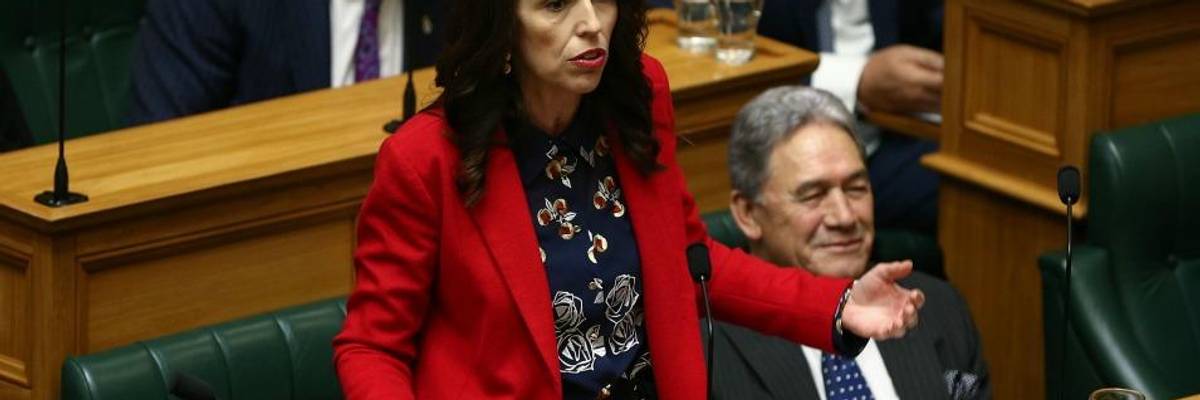
New Zealand Prime Minister Jacinda Ardern speaks during the 2019 budget presentation at Parliament on May 30, 2019 in Wellington, New Zealand. Budget 2019, known as the Wellbeing Budget, has a heavy focus public welfare alongside economic growth. (Photo: Hagen Hopkins/Getty Images)
Pledging to follow through on her promise to form a new kind of government focused on benefiting those often overlooked by lawmakers, the prime minister of New Zealand on Thursday unveiled her proposed spending plan for the coming year--the world's first "wellbeing budget."
The proposed 2019 budget includes billions of dollars for mental health services, support for indigenous people and victims of domestic violence, and funding to help pull children out of poverty.
"We said that we would be a government that did things differently, and for this budget we have done just that," Prime Minister Jacinda Ardern said. "Today we have laid the foundation for not just one wellbeing budget, but a different approach for government decision-making altogether."
Ardern and her finance minister, Grant Robertson, shared a video on social media ahead of their budget presentation before Parliament, explaining how their budget will be different than those in past years.
"We want to make sure that we're growing the economy in a sustainable way," said Robertson.
Ardern directed government agencies to ensure that their policies support working and lower-income families and designed her entire budget around prioritizing the well-being of people who have previously had little political power.
Doing so, Ardern's finance minister said, is a greater key to New Zealand's success than simply measuring the overall economic growth the country is expected to enjoy in the coming years.
"Success is making New Zealand both a great place to make a living, and a great place to make a life," Grant Robertson told Parliament at the administration's budget presentation.
"It could be a game-changer for New Zealand's children." --Andrew Becroft, children's commissioner
Included in the budget proposal is about $1.2 billion for mental health services, including support for people with mild to moderate mental health disorders which may affect quality of life while not requiring hospitalization.
"Almost all of us have lost friends or family members," Ardern said. "Ensuring that New Zealanders can now just show up to their GP or health center and get expert mental health support is a critical first step."
Children living in poverty--who make up about 27 percent of New Zealand's child population according to UNICEF--will be supported by about $1 billion in funding under the new budget.
The wellbeing budget won praise from a number of social welfare groups in New Zealand.
"It could be a game-changer for New Zealand's children," children's commissioner Andrew Becroft said. "That is the hope. If we can mean business about wellbeing, it's got to start with our children and young people--and to see that front and center of this budget is really satisfying and it's a great start."
"Budget 2019 covers many bases in the mental health and addictions space," said the New Zealand Drug Foundation in a statement.
The wellbeing budget represented a stark contrast to the spending priorities of other wealthy countries like the U.K.--where the past decade's austerity policies prompted a recent rebuke from the U.N.'s human rights expert--and the U.S., where the Trump administration proposed hiking military spending by $34 billion in March while claiming $1.1 trillion in Medicaid cuts were necessary.
"Congratulations to New Zealand for prioritizing the well-being of all of its people in its latest budget," tweeted the Center for Social Well-Being and Development at George Washington University. "Hopefully, other nations can follow suit and make similar contributions to enhanced living standards."
Dear Common Dreams reader, It’s been nearly 30 years since I co-founded Common Dreams with my late wife, Lina Newhouser. We had the radical notion that journalism should serve the public good, not corporate profits. It was clear to us from the outset what it would take to build such a project. No paid advertisements. No corporate sponsors. No millionaire publisher telling us what to think or do. Many people said we wouldn't last a year, but we proved those doubters wrong. Together with a tremendous team of journalists and dedicated staff, we built an independent media outlet free from the constraints of profits and corporate control. Our mission has always been simple: To inform. To inspire. To ignite change for the common good. Building Common Dreams was not easy. Our survival was never guaranteed. When you take on the most powerful forces—Wall Street greed, fossil fuel industry destruction, Big Tech lobbyists, and uber-rich oligarchs who have spent billions upon billions rigging the economy and democracy in their favor—the only bulwark you have is supporters who believe in your work. But here’s the urgent message from me today. It's never been this bad out there. And it's never been this hard to keep us going. At the very moment Common Dreams is most needed, the threats we face are intensifying. We need your support now more than ever. We don't accept corporate advertising and never will. We don't have a paywall because we don't think people should be blocked from critical news based on their ability to pay. Everything we do is funded by the donations of readers like you. When everyone does the little they can afford, we are strong. But if that support retreats or dries up, so do we. Will you donate now to make sure Common Dreams not only survives but thrives? —Craig Brown, Co-founder |
Pledging to follow through on her promise to form a new kind of government focused on benefiting those often overlooked by lawmakers, the prime minister of New Zealand on Thursday unveiled her proposed spending plan for the coming year--the world's first "wellbeing budget."
The proposed 2019 budget includes billions of dollars for mental health services, support for indigenous people and victims of domestic violence, and funding to help pull children out of poverty.
"We said that we would be a government that did things differently, and for this budget we have done just that," Prime Minister Jacinda Ardern said. "Today we have laid the foundation for not just one wellbeing budget, but a different approach for government decision-making altogether."
Ardern and her finance minister, Grant Robertson, shared a video on social media ahead of their budget presentation before Parliament, explaining how their budget will be different than those in past years.
"We want to make sure that we're growing the economy in a sustainable way," said Robertson.
Ardern directed government agencies to ensure that their policies support working and lower-income families and designed her entire budget around prioritizing the well-being of people who have previously had little political power.
Doing so, Ardern's finance minister said, is a greater key to New Zealand's success than simply measuring the overall economic growth the country is expected to enjoy in the coming years.
"Success is making New Zealand both a great place to make a living, and a great place to make a life," Grant Robertson told Parliament at the administration's budget presentation.
"It could be a game-changer for New Zealand's children." --Andrew Becroft, children's commissioner
Included in the budget proposal is about $1.2 billion for mental health services, including support for people with mild to moderate mental health disorders which may affect quality of life while not requiring hospitalization.
"Almost all of us have lost friends or family members," Ardern said. "Ensuring that New Zealanders can now just show up to their GP or health center and get expert mental health support is a critical first step."
Children living in poverty--who make up about 27 percent of New Zealand's child population according to UNICEF--will be supported by about $1 billion in funding under the new budget.
The wellbeing budget won praise from a number of social welfare groups in New Zealand.
"It could be a game-changer for New Zealand's children," children's commissioner Andrew Becroft said. "That is the hope. If we can mean business about wellbeing, it's got to start with our children and young people--and to see that front and center of this budget is really satisfying and it's a great start."
"Budget 2019 covers many bases in the mental health and addictions space," said the New Zealand Drug Foundation in a statement.
The wellbeing budget represented a stark contrast to the spending priorities of other wealthy countries like the U.K.--where the past decade's austerity policies prompted a recent rebuke from the U.N.'s human rights expert--and the U.S., where the Trump administration proposed hiking military spending by $34 billion in March while claiming $1.1 trillion in Medicaid cuts were necessary.
"Congratulations to New Zealand for prioritizing the well-being of all of its people in its latest budget," tweeted the Center for Social Well-Being and Development at George Washington University. "Hopefully, other nations can follow suit and make similar contributions to enhanced living standards."
Pledging to follow through on her promise to form a new kind of government focused on benefiting those often overlooked by lawmakers, the prime minister of New Zealand on Thursday unveiled her proposed spending plan for the coming year--the world's first "wellbeing budget."
The proposed 2019 budget includes billions of dollars for mental health services, support for indigenous people and victims of domestic violence, and funding to help pull children out of poverty.
"We said that we would be a government that did things differently, and for this budget we have done just that," Prime Minister Jacinda Ardern said. "Today we have laid the foundation for not just one wellbeing budget, but a different approach for government decision-making altogether."
Ardern and her finance minister, Grant Robertson, shared a video on social media ahead of their budget presentation before Parliament, explaining how their budget will be different than those in past years.
"We want to make sure that we're growing the economy in a sustainable way," said Robertson.
Ardern directed government agencies to ensure that their policies support working and lower-income families and designed her entire budget around prioritizing the well-being of people who have previously had little political power.
Doing so, Ardern's finance minister said, is a greater key to New Zealand's success than simply measuring the overall economic growth the country is expected to enjoy in the coming years.
"Success is making New Zealand both a great place to make a living, and a great place to make a life," Grant Robertson told Parliament at the administration's budget presentation.
"It could be a game-changer for New Zealand's children." --Andrew Becroft, children's commissioner
Included in the budget proposal is about $1.2 billion for mental health services, including support for people with mild to moderate mental health disorders which may affect quality of life while not requiring hospitalization.
"Almost all of us have lost friends or family members," Ardern said. "Ensuring that New Zealanders can now just show up to their GP or health center and get expert mental health support is a critical first step."
Children living in poverty--who make up about 27 percent of New Zealand's child population according to UNICEF--will be supported by about $1 billion in funding under the new budget.
The wellbeing budget won praise from a number of social welfare groups in New Zealand.
"It could be a game-changer for New Zealand's children," children's commissioner Andrew Becroft said. "That is the hope. If we can mean business about wellbeing, it's got to start with our children and young people--and to see that front and center of this budget is really satisfying and it's a great start."
"Budget 2019 covers many bases in the mental health and addictions space," said the New Zealand Drug Foundation in a statement.
The wellbeing budget represented a stark contrast to the spending priorities of other wealthy countries like the U.K.--where the past decade's austerity policies prompted a recent rebuke from the U.N.'s human rights expert--and the U.S., where the Trump administration proposed hiking military spending by $34 billion in March while claiming $1.1 trillion in Medicaid cuts were necessary.
"Congratulations to New Zealand for prioritizing the well-being of all of its people in its latest budget," tweeted the Center for Social Well-Being and Development at George Washington University. "Hopefully, other nations can follow suit and make similar contributions to enhanced living standards."