
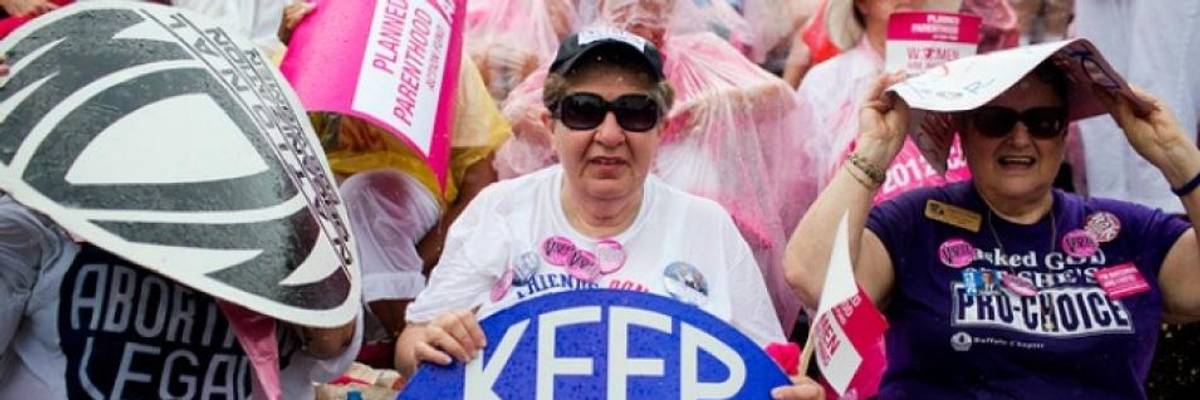
A federal judge on Friday temporarily blocked Mississippi's six-week abortion ban. (Photo: PBS NewsHour/flickr/cc)
Amid Fight to Stop Wave of Anti-Choice Bills, Cheers After Federal Judge Smacks Down Miss. Abortion Ban
"This is fantastic news — but this fight is not over."
Healthcare advocates breathed a sigh of relief but said the "fight is not over" after a federal judge on Friday struck down Mississippi's six-week abortion ban.
The southern state's law, which would have taken effect July 1, is one in a wave of state-level anti-choice measures recently passed that critics say are meant to provoke a challenge to Roe v. Wade.
U.S. Judge Carlton Reeves--who ruled against the state's 15-week abortion ban just six months ago--said Tuesday during arguments that the new law "smacks of defiance to this court."
Reeves also pointed to the law's lack of exception for rape, according to the Clarion Ledger.
"So a child who is raped at 10 or 11 years old, that child does not open their mouth, doesn't tell their parents, the rapist may be in their home, nobody discovers until it's too late--that is a fetal heartbeat has been detected--that child must bring the fetus to term under this statute, if the fetal heartbeat can be detected," Reeves said.
The law, he said in issuing the preliminary injunction on Friday, "threatens immediate harm to women's rights, especially considering most women do not seek abortions services until after six weeks."
Reeves added that "by banning abortions after the detection of a fetal heartbeat, the law prevents a woman's free choice, which is central to personal dignity and autonomy."
The challenge was brought by Center for Reproductive Rights, which cheered the ruling on Twitter.
Other reproductive rights advocates also praised the judge's decision and pointed to ongoing threats to abortion access.
Another anti-choice law--a near total abortion ban in Alabama--was just hit with a lawsuit.
The legal challenge, filed Friday, was brought by the ACLU, ACLU of Alabama, and Planned Parenthood Federation of America.
"This law is blatantly unconstitutional," said Alexa Kolbi-Molinas, senior staff attorney at the ACLU Reproductive Freedom Project, "and the ACLU will not stand by while politicians emboldened by President Trump's anti-abortion agenda exploit our health and our lives for political gain."
An Urgent Message From Our Co-Founder
Dear Common Dreams reader, It’s been nearly 30 years since I co-founded Common Dreams with my late wife, Lina Newhouser. We had the radical notion that journalism should serve the public good, not corporate profits. It was clear to us from the outset what it would take to build such a project. No paid advertisements. No corporate sponsors. No millionaire publisher telling us what to think or do. Many people said we wouldn't last a year, but we proved those doubters wrong. Together with a tremendous team of journalists and dedicated staff, we built an independent media outlet free from the constraints of profits and corporate control. Our mission has always been simple: To inform. To inspire. To ignite change for the common good. Building Common Dreams was not easy. Our survival was never guaranteed. When you take on the most powerful forces—Wall Street greed, fossil fuel industry destruction, Big Tech lobbyists, and uber-rich oligarchs who have spent billions upon billions rigging the economy and democracy in their favor—the only bulwark you have is supporters who believe in your work. But here’s the urgent message from me today. It's never been this bad out there. And it's never been this hard to keep us going. At the very moment Common Dreams is most needed, the threats we face are intensifying. We need your support now more than ever. We don't accept corporate advertising and never will. We don't have a paywall because we don't think people should be blocked from critical news based on their ability to pay. Everything we do is funded by the donations of readers like you. When everyone does the little they can afford, we are strong. But if that support retreats or dries up, so do we. Will you donate now to make sure Common Dreams not only survives but thrives? —Craig Brown, Co-founder |
Healthcare advocates breathed a sigh of relief but said the "fight is not over" after a federal judge on Friday struck down Mississippi's six-week abortion ban.
The southern state's law, which would have taken effect July 1, is one in a wave of state-level anti-choice measures recently passed that critics say are meant to provoke a challenge to Roe v. Wade.
U.S. Judge Carlton Reeves--who ruled against the state's 15-week abortion ban just six months ago--said Tuesday during arguments that the new law "smacks of defiance to this court."
Reeves also pointed to the law's lack of exception for rape, according to the Clarion Ledger.
"So a child who is raped at 10 or 11 years old, that child does not open their mouth, doesn't tell their parents, the rapist may be in their home, nobody discovers until it's too late--that is a fetal heartbeat has been detected--that child must bring the fetus to term under this statute, if the fetal heartbeat can be detected," Reeves said.
The law, he said in issuing the preliminary injunction on Friday, "threatens immediate harm to women's rights, especially considering most women do not seek abortions services until after six weeks."
Reeves added that "by banning abortions after the detection of a fetal heartbeat, the law prevents a woman's free choice, which is central to personal dignity and autonomy."
The challenge was brought by Center for Reproductive Rights, which cheered the ruling on Twitter.
Other reproductive rights advocates also praised the judge's decision and pointed to ongoing threats to abortion access.
Another anti-choice law--a near total abortion ban in Alabama--was just hit with a lawsuit.
The legal challenge, filed Friday, was brought by the ACLU, ACLU of Alabama, and Planned Parenthood Federation of America.
"This law is blatantly unconstitutional," said Alexa Kolbi-Molinas, senior staff attorney at the ACLU Reproductive Freedom Project, "and the ACLU will not stand by while politicians emboldened by President Trump's anti-abortion agenda exploit our health and our lives for political gain."
Healthcare advocates breathed a sigh of relief but said the "fight is not over" after a federal judge on Friday struck down Mississippi's six-week abortion ban.
The southern state's law, which would have taken effect July 1, is one in a wave of state-level anti-choice measures recently passed that critics say are meant to provoke a challenge to Roe v. Wade.
U.S. Judge Carlton Reeves--who ruled against the state's 15-week abortion ban just six months ago--said Tuesday during arguments that the new law "smacks of defiance to this court."
Reeves also pointed to the law's lack of exception for rape, according to the Clarion Ledger.
"So a child who is raped at 10 or 11 years old, that child does not open their mouth, doesn't tell their parents, the rapist may be in their home, nobody discovers until it's too late--that is a fetal heartbeat has been detected--that child must bring the fetus to term under this statute, if the fetal heartbeat can be detected," Reeves said.
The law, he said in issuing the preliminary injunction on Friday, "threatens immediate harm to women's rights, especially considering most women do not seek abortions services until after six weeks."
Reeves added that "by banning abortions after the detection of a fetal heartbeat, the law prevents a woman's free choice, which is central to personal dignity and autonomy."
The challenge was brought by Center for Reproductive Rights, which cheered the ruling on Twitter.
Other reproductive rights advocates also praised the judge's decision and pointed to ongoing threats to abortion access.
Another anti-choice law--a near total abortion ban in Alabama--was just hit with a lawsuit.
The legal challenge, filed Friday, was brought by the ACLU, ACLU of Alabama, and Planned Parenthood Federation of America.
"This law is blatantly unconstitutional," said Alexa Kolbi-Molinas, senior staff attorney at the ACLU Reproductive Freedom Project, "and the ACLU will not stand by while politicians emboldened by President Trump's anti-abortion agenda exploit our health and our lives for political gain."