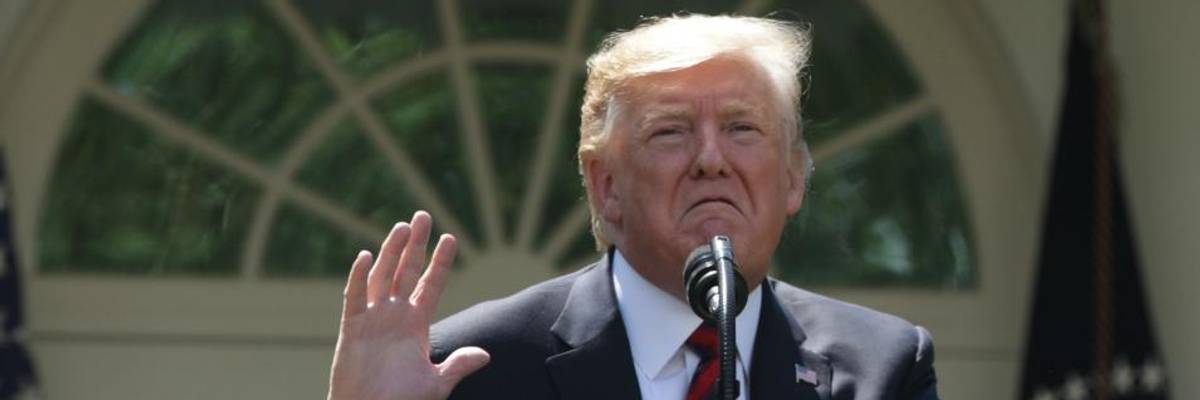
President Donald Trump speaks about immigration reform in the Rose Garden of the White House on May 16, 2019 in Washington, D.C. (Photo: Alex Wong/Getty Images)
'Genocidal': Trump--Who Claims He Doesn't Want War--Threatens 'Official End of Iran'
"President Trump's saber-rattling about Iran has reached a dangerous new low with his threat to 'end' Iran—a country of 83 million men, women, and children."
As military tensions between the U.S. and Iran appeared to be gradually cooling despite dangerous provocations from the White House, President Donald Trump--who said publicly last week that he hopes there is not another war in the Middle East--took to Twitter Sunday to threaten "the official end of Iran," a remark numerous critics condemned as "genocidal."
"If Iran wants to fight, that will be the official end of Iran. Never threaten the United States again!" Trump tweeted, without specifying how Iran threatened the United States.
Matthew Gertz, a senior fellow at Media Matters for America, speculated that Trump's threat was prompted by a Fox News segment on Iran.
The U.S. president's tweet came after a rocket was reportedly fired into Baghdad's fortified Green Zone, about a mile away from the U.S. Embassy in Iraq. There is no evidence that Iran-backed forces were behind the attack, despite reported "suspicions" from Western diplomats.
"President Trump has claimed that he doesn't want war, but his bombastic rhetoric is ensuring that he walks into one."
--Jamal Abdi, National Iranian American Council
Jamal Abdi, president of the National Iranian American Council (NIAC), said in a statement late Sunday that a "similar incident" in Iraq last year "led to Bolton asking the Pentagon for options to militarily strike Iran."
"President Trump's saber-rattling about Iran has reached a dangerous new low with his threat to 'end' Iran--a country of 83 million men, women, and children," Abdi said. "There is no doubt that national security adviser John Bolton will use the slightest Iranian action--even bereft of reliable intelligence--as a pretext to push for the war he's always wanted."
"President Trump has claimed that he doesn't want war, but his bombastic rhetoric is ensuring that he walks into one," Abdi added. "If Trump is sincere about wanting diplomatic compromise, he should cease his policy of economic warfare that is strangling the Iranian people and pursue a tone of mutual respect with Tehran."
Describing Trump's tweet as "genocidal rhetoric," NIAC founder Trita Parsi outlined steps the president should be taking if he actually desires peace with Iran:
Trump's latest threat against Iran came just days after reports on U.S. intelligence challenged the White House narrative of a growing Iranian "threat" in the region, which has been used by American officials like Bolton and Secretary of State Mike Pompeo to justify aggressive posturing in the Persian Gulf.
The president's tweet also came as some corporate media outlets and commentators have portrayed Trump as a lone voice against war with Iran in a White House filled with hawks.
According to the Wall Street Journal, Iranian actions in the Middle East in recent weeks have been defensive moves in response to fears that the U.S. could be planning a military attack.
As Common Dreams reported, Iranian President Hassan Rouhani earlier this month called for diplomacy amid U.S. belligerence and urged new negotiations on the Iran nuclear accord, which Trump unilaterally violated last May.
"Since the president reneged on the Iran nuclear deal last year," said Abdi, "the administration's policies have been geared towards provoking Iran into retaliation to give cover for a perilous escalation favored by administration hawks."
"Simply stated, the current state of heightened tensions between the U.S. and Iran is exclusively due to the policies of the Trump administration, which abandoned a nonproliferation agreement that was working in favor of a so-called 'maximum pressure campaign.'"
We are at a crossroads
This country and this world are at a monumental crossroads. In a few short weeks, US voters will have an opportunity to beat back the forces of fascism and confront the billionaires who are rigging the economy, our media system, and our democracy, making it increasingly impossible for ordinary people to get by. We’re not just talking about the election. We’re talking about what must be done once these fascist elements are vanquished from power. We need a bolder set of solutions than what either major party has so far been willing to offer and a working-class movement ready to fight like hell for it. Trump didn't emerge from nowhere. The conditions that fueled MAGA authoritarianism were created by decades of radical neoliberal economic policies and a corrupt political system dominated by corporate interests. They slashed taxes on the super-rich, promising that the benefits would trickle down. They said giveaways to the corporate titans would make life more affordable for the rest of us. It was all bullshit. And when a bitter, betrayed populace searches for someone to blame, right-wing demagogues have little trouble finding scapegoats. People know when they're being lied to, but you won't hear any of this from the corporate media. Only independent journalism—powered and funded by people who believe in building a better world—can deliver truly trustworthy daily news. Our Fall Campaign is underway, and we need your help. To power our newsroom through the rest of the year, we need to raise $125,000 by midnight on October 31. So if you share our vision, please contribute whatever you can to sustain our work. |
As military tensions between the U.S. and Iran appeared to be gradually cooling despite dangerous provocations from the White House, President Donald Trump--who said publicly last week that he hopes there is not another war in the Middle East--took to Twitter Sunday to threaten "the official end of Iran," a remark numerous critics condemned as "genocidal."
"If Iran wants to fight, that will be the official end of Iran. Never threaten the United States again!" Trump tweeted, without specifying how Iran threatened the United States.
Matthew Gertz, a senior fellow at Media Matters for America, speculated that Trump's threat was prompted by a Fox News segment on Iran.
The U.S. president's tweet came after a rocket was reportedly fired into Baghdad's fortified Green Zone, about a mile away from the U.S. Embassy in Iraq. There is no evidence that Iran-backed forces were behind the attack, despite reported "suspicions" from Western diplomats.
"President Trump has claimed that he doesn't want war, but his bombastic rhetoric is ensuring that he walks into one."
--Jamal Abdi, National Iranian American Council
Jamal Abdi, president of the National Iranian American Council (NIAC), said in a statement late Sunday that a "similar incident" in Iraq last year "led to Bolton asking the Pentagon for options to militarily strike Iran."
"President Trump's saber-rattling about Iran has reached a dangerous new low with his threat to 'end' Iran--a country of 83 million men, women, and children," Abdi said. "There is no doubt that national security adviser John Bolton will use the slightest Iranian action--even bereft of reliable intelligence--as a pretext to push for the war he's always wanted."
"President Trump has claimed that he doesn't want war, but his bombastic rhetoric is ensuring that he walks into one," Abdi added. "If Trump is sincere about wanting diplomatic compromise, he should cease his policy of economic warfare that is strangling the Iranian people and pursue a tone of mutual respect with Tehran."
Describing Trump's tweet as "genocidal rhetoric," NIAC founder Trita Parsi outlined steps the president should be taking if he actually desires peace with Iran:
Trump's latest threat against Iran came just days after reports on U.S. intelligence challenged the White House narrative of a growing Iranian "threat" in the region, which has been used by American officials like Bolton and Secretary of State Mike Pompeo to justify aggressive posturing in the Persian Gulf.
The president's tweet also came as some corporate media outlets and commentators have portrayed Trump as a lone voice against war with Iran in a White House filled with hawks.
According to the Wall Street Journal, Iranian actions in the Middle East in recent weeks have been defensive moves in response to fears that the U.S. could be planning a military attack.
As Common Dreams reported, Iranian President Hassan Rouhani earlier this month called for diplomacy amid U.S. belligerence and urged new negotiations on the Iran nuclear accord, which Trump unilaterally violated last May.
"Since the president reneged on the Iran nuclear deal last year," said Abdi, "the administration's policies have been geared towards provoking Iran into retaliation to give cover for a perilous escalation favored by administration hawks."
"Simply stated, the current state of heightened tensions between the U.S. and Iran is exclusively due to the policies of the Trump administration, which abandoned a nonproliferation agreement that was working in favor of a so-called 'maximum pressure campaign.'"
As military tensions between the U.S. and Iran appeared to be gradually cooling despite dangerous provocations from the White House, President Donald Trump--who said publicly last week that he hopes there is not another war in the Middle East--took to Twitter Sunday to threaten "the official end of Iran," a remark numerous critics condemned as "genocidal."
"If Iran wants to fight, that will be the official end of Iran. Never threaten the United States again!" Trump tweeted, without specifying how Iran threatened the United States.
Matthew Gertz, a senior fellow at Media Matters for America, speculated that Trump's threat was prompted by a Fox News segment on Iran.
The U.S. president's tweet came after a rocket was reportedly fired into Baghdad's fortified Green Zone, about a mile away from the U.S. Embassy in Iraq. There is no evidence that Iran-backed forces were behind the attack, despite reported "suspicions" from Western diplomats.
"President Trump has claimed that he doesn't want war, but his bombastic rhetoric is ensuring that he walks into one."
--Jamal Abdi, National Iranian American Council
Jamal Abdi, president of the National Iranian American Council (NIAC), said in a statement late Sunday that a "similar incident" in Iraq last year "led to Bolton asking the Pentagon for options to militarily strike Iran."
"President Trump's saber-rattling about Iran has reached a dangerous new low with his threat to 'end' Iran--a country of 83 million men, women, and children," Abdi said. "There is no doubt that national security adviser John Bolton will use the slightest Iranian action--even bereft of reliable intelligence--as a pretext to push for the war he's always wanted."
"President Trump has claimed that he doesn't want war, but his bombastic rhetoric is ensuring that he walks into one," Abdi added. "If Trump is sincere about wanting diplomatic compromise, he should cease his policy of economic warfare that is strangling the Iranian people and pursue a tone of mutual respect with Tehran."
Describing Trump's tweet as "genocidal rhetoric," NIAC founder Trita Parsi outlined steps the president should be taking if he actually desires peace with Iran:
Trump's latest threat against Iran came just days after reports on U.S. intelligence challenged the White House narrative of a growing Iranian "threat" in the region, which has been used by American officials like Bolton and Secretary of State Mike Pompeo to justify aggressive posturing in the Persian Gulf.
The president's tweet also came as some corporate media outlets and commentators have portrayed Trump as a lone voice against war with Iran in a White House filled with hawks.
According to the Wall Street Journal, Iranian actions in the Middle East in recent weeks have been defensive moves in response to fears that the U.S. could be planning a military attack.
As Common Dreams reported, Iranian President Hassan Rouhani earlier this month called for diplomacy amid U.S. belligerence and urged new negotiations on the Iran nuclear accord, which Trump unilaterally violated last May.
"Since the president reneged on the Iran nuclear deal last year," said Abdi, "the administration's policies have been geared towards provoking Iran into retaliation to give cover for a perilous escalation favored by administration hawks."
"Simply stated, the current state of heightened tensions between the U.S. and Iran is exclusively due to the policies of the Trump administration, which abandoned a nonproliferation agreement that was working in favor of a so-called 'maximum pressure campaign.'"