SUBSCRIBE TO OUR FREE NEWSLETTER
Daily news & progressive opinion—funded by the people, not the corporations—delivered straight to your inbox.
5
#000000
#FFFFFF
To donate by check, phone, or other method, see our More Ways to Give page.
Daily news & progressive opinion—funded by the people, not the corporations—delivered straight to your inbox.
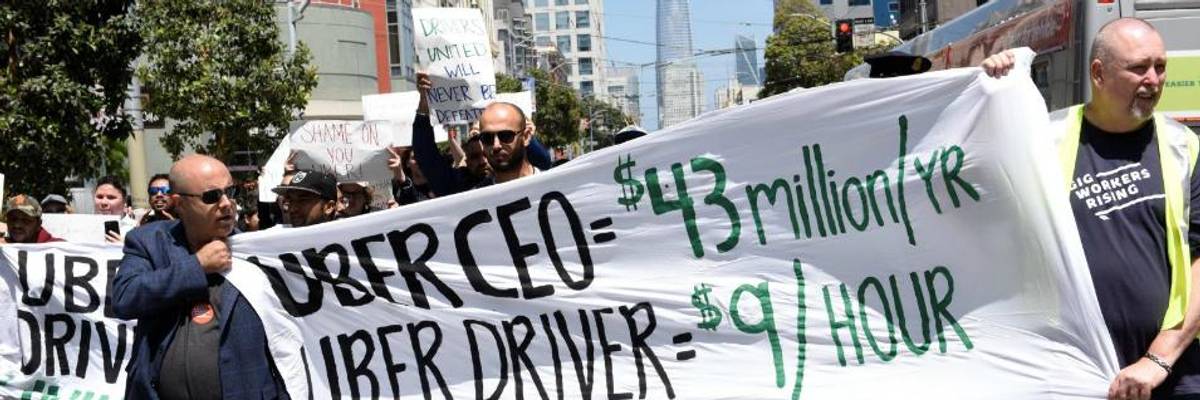
Uber drivers and supporters in San Francisco participate in a global strike demanding a living wage and job security in San Francisco on May 8, 2019. (Photo: Drew Angerer/Getty Images)
Uber was in serious need of a lift after a "bleak" and "disappointing" stock market debut last week, and President Donald Trump's National Labor Relations Board gave it just that Tuesday by ruling that the company's drivers are independent contractors--and thus don't have the rights of traditional employees.
"What does raise eyebrows is the timing of the release of the counsel's memo--a timing so egregious that it almost makes you wonder if Trump's appointees to the NLRB have shares in Uber that they're frantically trying to unload."
--Harold Meyerson, The American Prospect
In addition to denouncing the substance of the ruling--which could make it virtually impossible for Uber drivers to form a union and bargain for better pay--labor rights advocates raised questions about the NLRB's decision to release its memorandum amid Uber's stock market struggles, particularly given that the document was dated April 16.
The advisory memo (pdf) was made public by the office of NLRB General Counsel Peter Robb, a Trump appointee, just days after Uber drivers throughout the United States and across the globe went on strike for better pay and job security.
The American Prospect's Harold Meyerson wrote in a column Tuesday that it is "hardly surprising" that Trump's NLRB "has now consigned Uber drivers to worker hell."
"What does raise eyebrows is the timing of the release of the counsel's memo--a timing so egregious that it almost makes you wonder if Trump's appointees to the NLRB have shares in Uber that they're frantically trying to unload," Meyerson wrote. "In the Anything-Goes presidential administration of Donald Trump, the egregious has become so normalized and stupidity so commonplace that the board's action not only stinks to high heaven but should be investigated by House Democrats."
Author and former New York Times labor reporter Steven Greenhouse echoed Meyerson's concerns, tweeting on Tuesday that the NLRB's memo "seems aimed at pushing up Uber's stock price after its disappointing [initial public offering]."
Veena Dubal, an associate professor of employment law at the University of California, Hastings, told The Guardian that the NLRB's decision to make its month-old memo public on Tuesday was "so political, and not even in a subtle way."
"The fact that the office did not release the letter until this particular moment shows they are trying to deter worker organizing," said Dubal.
Laura Padin, senior staff attorney with the National Employment Law Project, said in a statement following the release of the NLRB's memo that "Uber labels its workers as independent contractors in order to avoid the benefits and protections--including the right to bargain collectively--that are owed to employees."
"In fact, drivers have so little independence that they don't know where they are taking a passenger or what they might expect to earn from a trip until that passenger steps in the car," Padin said. "This board, in direct contrast to the Obama-era board, continues to put its thumb on the scale to reward companies that shirk their obligations to their workforce."
Dear Common Dreams reader, It’s been nearly 30 years since I co-founded Common Dreams with my late wife, Lina Newhouser. We had the radical notion that journalism should serve the public good, not corporate profits. It was clear to us from the outset what it would take to build such a project. No paid advertisements. No corporate sponsors. No millionaire publisher telling us what to think or do. Many people said we wouldn't last a year, but we proved those doubters wrong. Together with a tremendous team of journalists and dedicated staff, we built an independent media outlet free from the constraints of profits and corporate control. Our mission has always been simple: To inform. To inspire. To ignite change for the common good. Building Common Dreams was not easy. Our survival was never guaranteed. When you take on the most powerful forces—Wall Street greed, fossil fuel industry destruction, Big Tech lobbyists, and uber-rich oligarchs who have spent billions upon billions rigging the economy and democracy in their favor—the only bulwark you have is supporters who believe in your work. But here’s the urgent message from me today. It's never been this bad out there. And it's never been this hard to keep us going. At the very moment Common Dreams is most needed, the threats we face are intensifying. We need your support now more than ever. We don't accept corporate advertising and never will. We don't have a paywall because we don't think people should be blocked from critical news based on their ability to pay. Everything we do is funded by the donations of readers like you. When everyone does the little they can afford, we are strong. But if that support retreats or dries up, so do we. Will you donate now to make sure Common Dreams not only survives but thrives? —Craig Brown, Co-founder |
Uber was in serious need of a lift after a "bleak" and "disappointing" stock market debut last week, and President Donald Trump's National Labor Relations Board gave it just that Tuesday by ruling that the company's drivers are independent contractors--and thus don't have the rights of traditional employees.
"What does raise eyebrows is the timing of the release of the counsel's memo--a timing so egregious that it almost makes you wonder if Trump's appointees to the NLRB have shares in Uber that they're frantically trying to unload."
--Harold Meyerson, The American Prospect
In addition to denouncing the substance of the ruling--which could make it virtually impossible for Uber drivers to form a union and bargain for better pay--labor rights advocates raised questions about the NLRB's decision to release its memorandum amid Uber's stock market struggles, particularly given that the document was dated April 16.
The advisory memo (pdf) was made public by the office of NLRB General Counsel Peter Robb, a Trump appointee, just days after Uber drivers throughout the United States and across the globe went on strike for better pay and job security.
The American Prospect's Harold Meyerson wrote in a column Tuesday that it is "hardly surprising" that Trump's NLRB "has now consigned Uber drivers to worker hell."
"What does raise eyebrows is the timing of the release of the counsel's memo--a timing so egregious that it almost makes you wonder if Trump's appointees to the NLRB have shares in Uber that they're frantically trying to unload," Meyerson wrote. "In the Anything-Goes presidential administration of Donald Trump, the egregious has become so normalized and stupidity so commonplace that the board's action not only stinks to high heaven but should be investigated by House Democrats."
Author and former New York Times labor reporter Steven Greenhouse echoed Meyerson's concerns, tweeting on Tuesday that the NLRB's memo "seems aimed at pushing up Uber's stock price after its disappointing [initial public offering]."
Veena Dubal, an associate professor of employment law at the University of California, Hastings, told The Guardian that the NLRB's decision to make its month-old memo public on Tuesday was "so political, and not even in a subtle way."
"The fact that the office did not release the letter until this particular moment shows they are trying to deter worker organizing," said Dubal.
Laura Padin, senior staff attorney with the National Employment Law Project, said in a statement following the release of the NLRB's memo that "Uber labels its workers as independent contractors in order to avoid the benefits and protections--including the right to bargain collectively--that are owed to employees."
"In fact, drivers have so little independence that they don't know where they are taking a passenger or what they might expect to earn from a trip until that passenger steps in the car," Padin said. "This board, in direct contrast to the Obama-era board, continues to put its thumb on the scale to reward companies that shirk their obligations to their workforce."
Uber was in serious need of a lift after a "bleak" and "disappointing" stock market debut last week, and President Donald Trump's National Labor Relations Board gave it just that Tuesday by ruling that the company's drivers are independent contractors--and thus don't have the rights of traditional employees.
"What does raise eyebrows is the timing of the release of the counsel's memo--a timing so egregious that it almost makes you wonder if Trump's appointees to the NLRB have shares in Uber that they're frantically trying to unload."
--Harold Meyerson, The American Prospect
In addition to denouncing the substance of the ruling--which could make it virtually impossible for Uber drivers to form a union and bargain for better pay--labor rights advocates raised questions about the NLRB's decision to release its memorandum amid Uber's stock market struggles, particularly given that the document was dated April 16.
The advisory memo (pdf) was made public by the office of NLRB General Counsel Peter Robb, a Trump appointee, just days after Uber drivers throughout the United States and across the globe went on strike for better pay and job security.
The American Prospect's Harold Meyerson wrote in a column Tuesday that it is "hardly surprising" that Trump's NLRB "has now consigned Uber drivers to worker hell."
"What does raise eyebrows is the timing of the release of the counsel's memo--a timing so egregious that it almost makes you wonder if Trump's appointees to the NLRB have shares in Uber that they're frantically trying to unload," Meyerson wrote. "In the Anything-Goes presidential administration of Donald Trump, the egregious has become so normalized and stupidity so commonplace that the board's action not only stinks to high heaven but should be investigated by House Democrats."
Author and former New York Times labor reporter Steven Greenhouse echoed Meyerson's concerns, tweeting on Tuesday that the NLRB's memo "seems aimed at pushing up Uber's stock price after its disappointing [initial public offering]."
Veena Dubal, an associate professor of employment law at the University of California, Hastings, told The Guardian that the NLRB's decision to make its month-old memo public on Tuesday was "so political, and not even in a subtle way."
"The fact that the office did not release the letter until this particular moment shows they are trying to deter worker organizing," said Dubal.
Laura Padin, senior staff attorney with the National Employment Law Project, said in a statement following the release of the NLRB's memo that "Uber labels its workers as independent contractors in order to avoid the benefits and protections--including the right to bargain collectively--that are owed to employees."
"In fact, drivers have so little independence that they don't know where they are taking a passenger or what they might expect to earn from a trip until that passenger steps in the car," Padin said. "This board, in direct contrast to the Obama-era board, continues to put its thumb on the scale to reward companies that shirk their obligations to their workforce."