SUBSCRIBE TO OUR FREE NEWSLETTER
Daily news & progressive opinion—funded by the people, not the corporations—delivered straight to your inbox.
5
#000000
#FFFFFF
To donate by check, phone, or other method, see our More Ways to Give page.
Daily news & progressive opinion—funded by the people, not the corporations—delivered straight to your inbox.
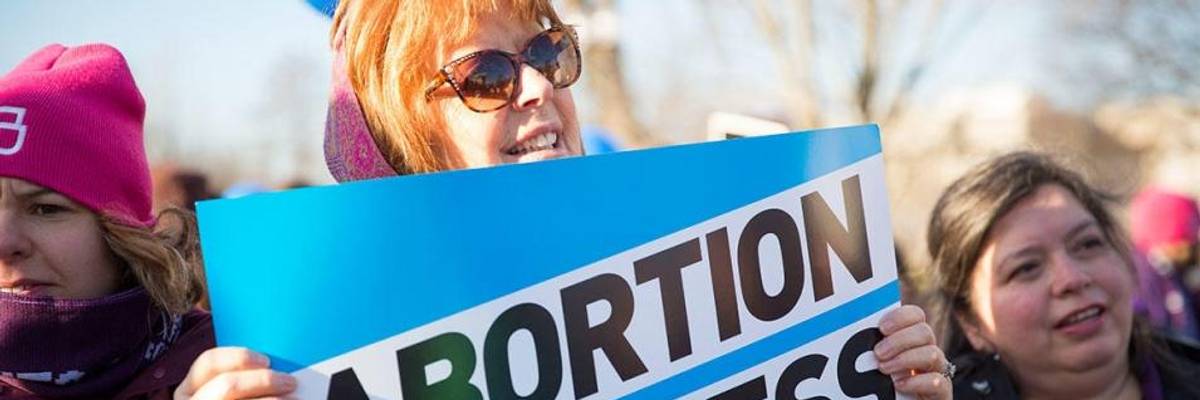
Reproductive rights groups on Tuesday warned that Georgia's new anti-choice law aims to challenge abortion rights at the national level. (Photo: ACLU)
Reproductive rights advocates vowed to fight in court against Georgia's new six-week abortion ban--signed into law Tuesday by Republican Gov. Brian Kemp--while warning that the measure's greater purpose is to challenge the constitutionally protected right to abortion on a national scale.
"What we need to understand is that this is actually something that's happening in state after state with a very specific purpose of overturning Roe v. Wade," Democratic state Sen. Jen Jordan said in a video Planned Parenthood Action posted to Twitter.
The so-called LIFE (Living Infants Fairness and Equality) Act is set to take effect in January of 2020 if it is not blocked by the courts before then. The law (pdf) will outlaw abortion in Georgia--which is notorious for its high maternal death rate--after a fetal heartbeat can be detected, which is around six weeks, before many women even know they are pregnant.
And, as the Atlanta Journal-Constitution reported Tuesday, it is just the latest in a series of similar state laws--in places dominated by Republican legislators--that aim to force the right-wing U.S. Supreme Court to reconsider its landmark Roe ruling:
Governors in Kentucky, Mississippi, and Ohio all have signed similar "heartbeat bills." A federal judge has already issued a preliminary injunction against the Kentucky law, and similar laws enacted in recent years in Iowa and North Dakota have also been struck down in the courts.
As the Georgia bill moved through the legislature earlier this year, it sparked a broader debate--and Jordan, the state senator, gained national notoriety for her viral speech against it.
"It is disappointing, but not surprising, that Gov. Brian Kemp signed an unconstitutional law that disregards the rights of every Georgia woman, including every Georgia mother," Jordan said in a statement Tuesday. "But make no mistake, we have only just begun to fight."
Planned Parenthood Southeast Advocates, the ACLU, and the Center for Reproductive Rights were among the groups that sent Kemp a clear message on Tuesday: "We'll see you in court."
Georgia's new law "is so extreme that it criminalizes doctors who provide life-saving care, and it even allows the state to investigate women for having miscarriages," said Dr. Leana Wen, Planned Parenthood's CEO and president.
"We will fight this bill," she promised. "This is about patients' lives."
"Today's women can only thrive in a state that protects their most basic rights--the right to choose when and whether to start or expand a family. Georgia can't afford to go backwards on women's health and rights," Andrea Young, executive director of the ACLU of Georgia, said in a statement. "We will act to block this assault on women's health, rights, and self-determination."
While the new ban in Georgia has garnered widespread opposition--especially given its ultimate intentions and potential consequences nationally--the legislation has also spurred the state-level #ReclaimGeorgia campaign, launched Tuesday by local reproductive rights advocates.
Laura Simmons of NARAL Pro-Choice Georgia told the Journal-Constitution that the campaign's purpose is to "educate voters and put lawmakers on notice that advocates for reproductive freedom will not let legislators off the hook for turning their backs on women and families by voting to criminalize abortion and punish women."
"We warned you: if you choose to vote against women's rights, we'll be voting against you in the next election," added Staci Fox of Planned Parenthood Southeast Advocates. "That begins now."
Democrat Stacey Abrams narrowly lost the gubernatorial race to Kemp last year in an election rife with allegations--including from Abrams--that the state's Republican leadership engaged in voter suppression.
"Bad policies like the forced pregnancy bill are a direct result of voter suppression," Abrams tweeted Tuesday. "If leaders can silence Georgians' voices at the ballot box, they can ignore Georgians' voices when in office. We will fight back in court and at the voting booth."
EMILY's List is a national group that works to get Democratic pro-choice female candidates elected to political office. Noting that the Georgia measure is designed to challenge Roe, the group said on Twitter, "This is a perfect example of why we need to elect more pro-choice Democratic women to protect our healthcare."
Dear Common Dreams reader, It’s been nearly 30 years since I co-founded Common Dreams with my late wife, Lina Newhouser. We had the radical notion that journalism should serve the public good, not corporate profits. It was clear to us from the outset what it would take to build such a project. No paid advertisements. No corporate sponsors. No millionaire publisher telling us what to think or do. Many people said we wouldn't last a year, but we proved those doubters wrong. Together with a tremendous team of journalists and dedicated staff, we built an independent media outlet free from the constraints of profits and corporate control. Our mission has always been simple: To inform. To inspire. To ignite change for the common good. Building Common Dreams was not easy. Our survival was never guaranteed. When you take on the most powerful forces—Wall Street greed, fossil fuel industry destruction, Big Tech lobbyists, and uber-rich oligarchs who have spent billions upon billions rigging the economy and democracy in their favor—the only bulwark you have is supporters who believe in your work. But here’s the urgent message from me today. It's never been this bad out there. And it's never been this hard to keep us going. At the very moment Common Dreams is most needed, the threats we face are intensifying. We need your support now more than ever. We don't accept corporate advertising and never will. We don't have a paywall because we don't think people should be blocked from critical news based on their ability to pay. Everything we do is funded by the donations of readers like you. When everyone does the little they can afford, we are strong. But if that support retreats or dries up, so do we. Will you donate now to make sure Common Dreams not only survives but thrives? —Craig Brown, Co-founder |
Reproductive rights advocates vowed to fight in court against Georgia's new six-week abortion ban--signed into law Tuesday by Republican Gov. Brian Kemp--while warning that the measure's greater purpose is to challenge the constitutionally protected right to abortion on a national scale.
"What we need to understand is that this is actually something that's happening in state after state with a very specific purpose of overturning Roe v. Wade," Democratic state Sen. Jen Jordan said in a video Planned Parenthood Action posted to Twitter.
The so-called LIFE (Living Infants Fairness and Equality) Act is set to take effect in January of 2020 if it is not blocked by the courts before then. The law (pdf) will outlaw abortion in Georgia--which is notorious for its high maternal death rate--after a fetal heartbeat can be detected, which is around six weeks, before many women even know they are pregnant.
And, as the Atlanta Journal-Constitution reported Tuesday, it is just the latest in a series of similar state laws--in places dominated by Republican legislators--that aim to force the right-wing U.S. Supreme Court to reconsider its landmark Roe ruling:
Governors in Kentucky, Mississippi, and Ohio all have signed similar "heartbeat bills." A federal judge has already issued a preliminary injunction against the Kentucky law, and similar laws enacted in recent years in Iowa and North Dakota have also been struck down in the courts.
As the Georgia bill moved through the legislature earlier this year, it sparked a broader debate--and Jordan, the state senator, gained national notoriety for her viral speech against it.
"It is disappointing, but not surprising, that Gov. Brian Kemp signed an unconstitutional law that disregards the rights of every Georgia woman, including every Georgia mother," Jordan said in a statement Tuesday. "But make no mistake, we have only just begun to fight."
Planned Parenthood Southeast Advocates, the ACLU, and the Center for Reproductive Rights were among the groups that sent Kemp a clear message on Tuesday: "We'll see you in court."
Georgia's new law "is so extreme that it criminalizes doctors who provide life-saving care, and it even allows the state to investigate women for having miscarriages," said Dr. Leana Wen, Planned Parenthood's CEO and president.
"We will fight this bill," she promised. "This is about patients' lives."
"Today's women can only thrive in a state that protects their most basic rights--the right to choose when and whether to start or expand a family. Georgia can't afford to go backwards on women's health and rights," Andrea Young, executive director of the ACLU of Georgia, said in a statement. "We will act to block this assault on women's health, rights, and self-determination."
While the new ban in Georgia has garnered widespread opposition--especially given its ultimate intentions and potential consequences nationally--the legislation has also spurred the state-level #ReclaimGeorgia campaign, launched Tuesday by local reproductive rights advocates.
Laura Simmons of NARAL Pro-Choice Georgia told the Journal-Constitution that the campaign's purpose is to "educate voters and put lawmakers on notice that advocates for reproductive freedom will not let legislators off the hook for turning their backs on women and families by voting to criminalize abortion and punish women."
"We warned you: if you choose to vote against women's rights, we'll be voting against you in the next election," added Staci Fox of Planned Parenthood Southeast Advocates. "That begins now."
Democrat Stacey Abrams narrowly lost the gubernatorial race to Kemp last year in an election rife with allegations--including from Abrams--that the state's Republican leadership engaged in voter suppression.
"Bad policies like the forced pregnancy bill are a direct result of voter suppression," Abrams tweeted Tuesday. "If leaders can silence Georgians' voices at the ballot box, they can ignore Georgians' voices when in office. We will fight back in court and at the voting booth."
EMILY's List is a national group that works to get Democratic pro-choice female candidates elected to political office. Noting that the Georgia measure is designed to challenge Roe, the group said on Twitter, "This is a perfect example of why we need to elect more pro-choice Democratic women to protect our healthcare."
Reproductive rights advocates vowed to fight in court against Georgia's new six-week abortion ban--signed into law Tuesday by Republican Gov. Brian Kemp--while warning that the measure's greater purpose is to challenge the constitutionally protected right to abortion on a national scale.
"What we need to understand is that this is actually something that's happening in state after state with a very specific purpose of overturning Roe v. Wade," Democratic state Sen. Jen Jordan said in a video Planned Parenthood Action posted to Twitter.
The so-called LIFE (Living Infants Fairness and Equality) Act is set to take effect in January of 2020 if it is not blocked by the courts before then. The law (pdf) will outlaw abortion in Georgia--which is notorious for its high maternal death rate--after a fetal heartbeat can be detected, which is around six weeks, before many women even know they are pregnant.
And, as the Atlanta Journal-Constitution reported Tuesday, it is just the latest in a series of similar state laws--in places dominated by Republican legislators--that aim to force the right-wing U.S. Supreme Court to reconsider its landmark Roe ruling:
Governors in Kentucky, Mississippi, and Ohio all have signed similar "heartbeat bills." A federal judge has already issued a preliminary injunction against the Kentucky law, and similar laws enacted in recent years in Iowa and North Dakota have also been struck down in the courts.
As the Georgia bill moved through the legislature earlier this year, it sparked a broader debate--and Jordan, the state senator, gained national notoriety for her viral speech against it.
"It is disappointing, but not surprising, that Gov. Brian Kemp signed an unconstitutional law that disregards the rights of every Georgia woman, including every Georgia mother," Jordan said in a statement Tuesday. "But make no mistake, we have only just begun to fight."
Planned Parenthood Southeast Advocates, the ACLU, and the Center for Reproductive Rights were among the groups that sent Kemp a clear message on Tuesday: "We'll see you in court."
Georgia's new law "is so extreme that it criminalizes doctors who provide life-saving care, and it even allows the state to investigate women for having miscarriages," said Dr. Leana Wen, Planned Parenthood's CEO and president.
"We will fight this bill," she promised. "This is about patients' lives."
"Today's women can only thrive in a state that protects their most basic rights--the right to choose when and whether to start or expand a family. Georgia can't afford to go backwards on women's health and rights," Andrea Young, executive director of the ACLU of Georgia, said in a statement. "We will act to block this assault on women's health, rights, and self-determination."
While the new ban in Georgia has garnered widespread opposition--especially given its ultimate intentions and potential consequences nationally--the legislation has also spurred the state-level #ReclaimGeorgia campaign, launched Tuesday by local reproductive rights advocates.
Laura Simmons of NARAL Pro-Choice Georgia told the Journal-Constitution that the campaign's purpose is to "educate voters and put lawmakers on notice that advocates for reproductive freedom will not let legislators off the hook for turning their backs on women and families by voting to criminalize abortion and punish women."
"We warned you: if you choose to vote against women's rights, we'll be voting against you in the next election," added Staci Fox of Planned Parenthood Southeast Advocates. "That begins now."
Democrat Stacey Abrams narrowly lost the gubernatorial race to Kemp last year in an election rife with allegations--including from Abrams--that the state's Republican leadership engaged in voter suppression.
"Bad policies like the forced pregnancy bill are a direct result of voter suppression," Abrams tweeted Tuesday. "If leaders can silence Georgians' voices at the ballot box, they can ignore Georgians' voices when in office. We will fight back in court and at the voting booth."
EMILY's List is a national group that works to get Democratic pro-choice female candidates elected to political office. Noting that the Georgia measure is designed to challenge Roe, the group said on Twitter, "This is a perfect example of why we need to elect more pro-choice Democratic women to protect our healthcare."