SUBSCRIBE TO OUR FREE NEWSLETTER
Daily news & progressive opinion—funded by the people, not the corporations—delivered straight to your inbox.
5
#000000
#FFFFFF
To donate by check, phone, or other method, see our More Ways to Give page.
Daily news & progressive opinion—funded by the people, not the corporations—delivered straight to your inbox.
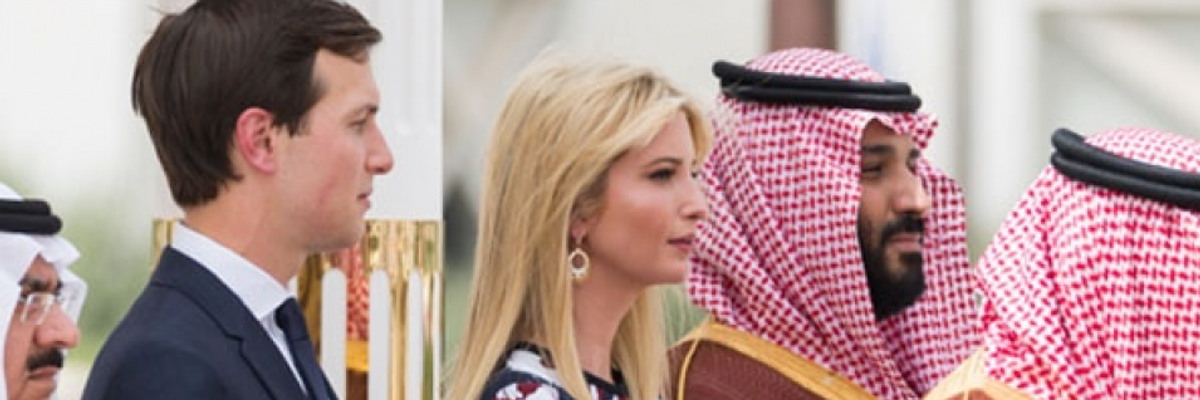
Top advisor Jared Kushner, his wife Ivanka Trump, and Saudi Crown Prince Mohammed bin Sulman at the White House in 2018. (Photo: The White House/flickr)
Just as Jared Kushner answered questions about the close ties between the White House and Saudi Arabia in New York on Tuesday, the Middle Eastern kingdom beheaded 37 people in its largest mass execution in at last three years.
The executions, of mostly Shiite men accused of terrorism related crimes, were part of what Washington's Gulf Institute director Ali Al-Ahmed called "the largest mass execution of Shiites in the kingdom's history."
Al-Ahmed identified 34 of the 37 victims as Shiite.
According to reports, Saudi Arabian security services nailed one of the heads to a poll as a warning and one victim was crucified after his execution.
The killings were announced by Saudi state media Tuesday morning, Eastern time, right before Kushner, President Donald Trump's son-in-law and a senior advisor to the president, took the stage at the Time 100 Summit event honoring the magazine's annual list of the 100 most influential people in the world.
During an interview at the event with Time White House correspondent Brian Bennett, Kushner fielded questions on a number of foreign policy questions, including the Israel/Palestine conflict and the Trump administration's closeness to Russia.
Kushner was also asked a series of questions on Saudi Arabia and the relationship between the U.S. and the kingdom, especially in light of the murder of Jamal Kashoggi in October 2018 and the war on Yemen.
In his replies, Kushner downplayed the significance of the murder, pled ignorance on the details of the crime, and admitted that he offered Saudi Crown Prince Mohammed Bin Salman guidance as the world demanded accountability.
"Obviously, we have to make sure there's accountability for what happened," said Kushner, before pivoting to a series of remarks critical of Iran, the Palestinians, and the Yemeni Houthis.
In response to the beheadings, Maya Foa, director of the U.K.-based human rights groups Reprieve, put the "egregious display of brutality" squarely at the feet of MbS and the Kingdom's western allies which have shielded it from exactly the accountability Kushner says he supports.
"That the Saudi regime believes it has impunity to carry out such patently illegal executions, without notice," Foa said, "should shock its international partners into action."
In March 2018, The Intercept reported that Bin Salman bragged that he had Kushner "in his pocket."
Dear Common Dreams reader, It’s been nearly 30 years since I co-founded Common Dreams with my late wife, Lina Newhouser. We had the radical notion that journalism should serve the public good, not corporate profits. It was clear to us from the outset what it would take to build such a project. No paid advertisements. No corporate sponsors. No millionaire publisher telling us what to think or do. Many people said we wouldn't last a year, but we proved those doubters wrong. Together with a tremendous team of journalists and dedicated staff, we built an independent media outlet free from the constraints of profits and corporate control. Our mission has always been simple: To inform. To inspire. To ignite change for the common good. Building Common Dreams was not easy. Our survival was never guaranteed. When you take on the most powerful forces—Wall Street greed, fossil fuel industry destruction, Big Tech lobbyists, and uber-rich oligarchs who have spent billions upon billions rigging the economy and democracy in their favor—the only bulwark you have is supporters who believe in your work. But here’s the urgent message from me today. It's never been this bad out there. And it's never been this hard to keep us going. At the very moment Common Dreams is most needed, the threats we face are intensifying. We need your support now more than ever. We don't accept corporate advertising and never will. We don't have a paywall because we don't think people should be blocked from critical news based on their ability to pay. Everything we do is funded by the donations of readers like you. When everyone does the little they can afford, we are strong. But if that support retreats or dries up, so do we. Will you donate now to make sure Common Dreams not only survives but thrives? —Craig Brown, Co-founder |
Just as Jared Kushner answered questions about the close ties between the White House and Saudi Arabia in New York on Tuesday, the Middle Eastern kingdom beheaded 37 people in its largest mass execution in at last three years.
The executions, of mostly Shiite men accused of terrorism related crimes, were part of what Washington's Gulf Institute director Ali Al-Ahmed called "the largest mass execution of Shiites in the kingdom's history."
Al-Ahmed identified 34 of the 37 victims as Shiite.
According to reports, Saudi Arabian security services nailed one of the heads to a poll as a warning and one victim was crucified after his execution.
The killings were announced by Saudi state media Tuesday morning, Eastern time, right before Kushner, President Donald Trump's son-in-law and a senior advisor to the president, took the stage at the Time 100 Summit event honoring the magazine's annual list of the 100 most influential people in the world.
During an interview at the event with Time White House correspondent Brian Bennett, Kushner fielded questions on a number of foreign policy questions, including the Israel/Palestine conflict and the Trump administration's closeness to Russia.
Kushner was also asked a series of questions on Saudi Arabia and the relationship between the U.S. and the kingdom, especially in light of the murder of Jamal Kashoggi in October 2018 and the war on Yemen.
In his replies, Kushner downplayed the significance of the murder, pled ignorance on the details of the crime, and admitted that he offered Saudi Crown Prince Mohammed Bin Salman guidance as the world demanded accountability.
"Obviously, we have to make sure there's accountability for what happened," said Kushner, before pivoting to a series of remarks critical of Iran, the Palestinians, and the Yemeni Houthis.
In response to the beheadings, Maya Foa, director of the U.K.-based human rights groups Reprieve, put the "egregious display of brutality" squarely at the feet of MbS and the Kingdom's western allies which have shielded it from exactly the accountability Kushner says he supports.
"That the Saudi regime believes it has impunity to carry out such patently illegal executions, without notice," Foa said, "should shock its international partners into action."
In March 2018, The Intercept reported that Bin Salman bragged that he had Kushner "in his pocket."
Just as Jared Kushner answered questions about the close ties between the White House and Saudi Arabia in New York on Tuesday, the Middle Eastern kingdom beheaded 37 people in its largest mass execution in at last three years.
The executions, of mostly Shiite men accused of terrorism related crimes, were part of what Washington's Gulf Institute director Ali Al-Ahmed called "the largest mass execution of Shiites in the kingdom's history."
Al-Ahmed identified 34 of the 37 victims as Shiite.
According to reports, Saudi Arabian security services nailed one of the heads to a poll as a warning and one victim was crucified after his execution.
The killings were announced by Saudi state media Tuesday morning, Eastern time, right before Kushner, President Donald Trump's son-in-law and a senior advisor to the president, took the stage at the Time 100 Summit event honoring the magazine's annual list of the 100 most influential people in the world.
During an interview at the event with Time White House correspondent Brian Bennett, Kushner fielded questions on a number of foreign policy questions, including the Israel/Palestine conflict and the Trump administration's closeness to Russia.
Kushner was also asked a series of questions on Saudi Arabia and the relationship between the U.S. and the kingdom, especially in light of the murder of Jamal Kashoggi in October 2018 and the war on Yemen.
In his replies, Kushner downplayed the significance of the murder, pled ignorance on the details of the crime, and admitted that he offered Saudi Crown Prince Mohammed Bin Salman guidance as the world demanded accountability.
"Obviously, we have to make sure there's accountability for what happened," said Kushner, before pivoting to a series of remarks critical of Iran, the Palestinians, and the Yemeni Houthis.
In response to the beheadings, Maya Foa, director of the U.K.-based human rights groups Reprieve, put the "egregious display of brutality" squarely at the feet of MbS and the Kingdom's western allies which have shielded it from exactly the accountability Kushner says he supports.
"That the Saudi regime believes it has impunity to carry out such patently illegal executions, without notice," Foa said, "should shock its international partners into action."
In March 2018, The Intercept reported that Bin Salman bragged that he had Kushner "in his pocket."