SUBSCRIBE TO OUR FREE NEWSLETTER
Daily news & progressive opinion—funded by the people, not the corporations—delivered straight to your inbox.
5
#000000
#FFFFFF
To donate by check, phone, or other method, see our More Ways to Give page.
Daily news & progressive opinion—funded by the people, not the corporations—delivered straight to your inbox.
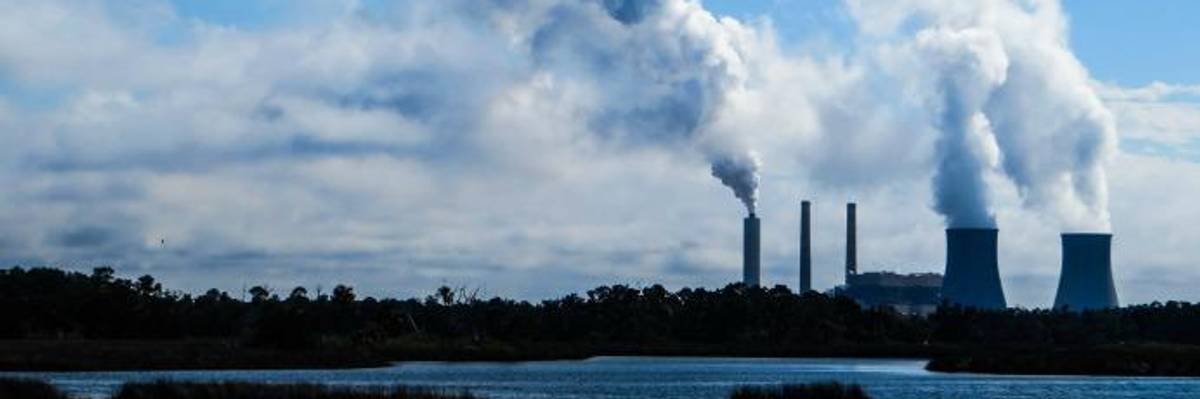
The now-closed Crystal River 3 Nuclear Power Plant in Florida. (Photo: GorissM/flickr/cc)
New reporting highlights how the nation's nuclear power plants are woefully unprepared to handle the growing impacts of the climate crisis.
Despite that threat, says a watchdog, the industry's regulatory capture means its interests are set to continue to take precedence over public health and safety.
As Bloomberg's Christopher Flavelle and Jeremy C.F. Lin laid out Thursday, in the wake of the 2011 Fukushima disaster the five-member Nuclear Regulatory Commission (NRC) tasked the roughly 60 operating plants in the U.S. with assessing what their flood risks were compared to what flood risks the plants were actually built to withstand.
That was a logical step, given many of the American plants' proximity to waterways, and the heightened risk of flooding in the face of the climate crisis.
Shortfalls in the assessments were evident.
According to a Bloomberg review of correspondence between the commission and plant owners, 54 of the nuclear plants operating in the U.S. weren't designed to handle the flood risk they face. Fifty-three weren't built to withstand their current risk from intense precipitation; 25 didn't account for current flood projections from streams and rivers; 19 weren't designed for their expected maximum storm surge. Nineteen face three or more threats that they weren't designed to handle.
What's more, those shortfalls may represent a better case scenario, as the NRC allowed the plant operators--not an outside authority--to perform the flood estimates and were not required to assess projected flood risks.
"It's difficult to come across as an independent regulator and rely on self-assessment" from plants, as Tony Vegel, a Texas-based reactor safety official for the NRC, said previously.
The nuclear industry, as Bloomberg reported, wasn't interested in facility redesigns to better withstand flood risks. Rather, it wanted
to focus mainly on storing emergency generators, pumps, and other equipment in on-site concrete bunkers, a system they call Flex, for Flexible Mitigation Capability. Not only did the NRC agree with that view, it ruled on Jan. 24 that nuclear plants wouldn't have to update that equipment to deal with new, higher levels of expected flooding. It also eliminated a requirement that plants run Flex drills.
The three Trump-appointed commissioners did the industry's bidding and said the existing regulations afforded enough protection. The NRC's two Democratic commissioners disagreed.
Bloomberg quoted Edwin Lyman, head of the Nuclear Safety Project at the Union of Concerned Scientists, as saying, "The NRC basically did everything the industry wanted."
Paul Gunter, director of the Reactor Oversight Project at Beyond Nuclear, concurred with that assessment.
Another issue, he told Common Dreams, is that "the commission's January 2019 vote appears to have violated the federal Administrative Procedures Act by erasing what had been established as mandatory requirements through the agency's rulemaking process for post-Fukushima flooding preparations at U.S. reactors."
"The Commission vote," he said, "inexplicably switched out 'mandatory' requirements with 'voluntary' initiatives after the public comment period on the final rule was closed. The NRC did not receive a single comment from either the public or the industry to make such a change."
Gunter also noted that the NRC's failings didn't just begin once Trump entered the White House.
For example, he said, "following the Fukushima catastrophe, in 2012 the NRC technical staff unanimously agreed that the agency issue an order to 31 U.S. Fukushima-style GE Mark I and II boiling water reactors requiring operators to install severe accident-capable radiation filters on hardened containment vents." These vents, he explained, "would allow operators to vent the containment of a severe accident's extreme heat, pressure, and explosive gases to save the structure while filtering out the release of harmful radiation."
But in a June 2013 vote, "the commission voted to order the installation of hardened containment vents but without the engineered external radiation filters which industry opposed on cost." While the NRC "suggested that the filters could be taken up later in a rulemaking process for public comment," it "abandoned the measure," said Gunter.
In another sign of the NRC's capture by the nuclear industry The Associated Press reported last month:
Annie Caputo, a former nuclear-energy lobbyist now serving as one of four board members appointed or reappointed by President Donald Trump, told an industry meeting this week that she was "open to self-assessments" by nuclear plant operators, who are proposing that self-reporting by operators take the place of some NRC inspections.
The battle lines, said Gunter, are clear.
"The essential step forward must address the regulatory agency's deepening capture by an aging and financially failing nuclear industry," he said. "We do not have an independent regulator that is heeding its mandate to protect public health and safety first."
Dear Common Dreams reader, It’s been nearly 30 years since I co-founded Common Dreams with my late wife, Lina Newhouser. We had the radical notion that journalism should serve the public good, not corporate profits. It was clear to us from the outset what it would take to build such a project. No paid advertisements. No corporate sponsors. No millionaire publisher telling us what to think or do. Many people said we wouldn't last a year, but we proved those doubters wrong. Together with a tremendous team of journalists and dedicated staff, we built an independent media outlet free from the constraints of profits and corporate control. Our mission has always been simple: To inform. To inspire. To ignite change for the common good. Building Common Dreams was not easy. Our survival was never guaranteed. When you take on the most powerful forces—Wall Street greed, fossil fuel industry destruction, Big Tech lobbyists, and uber-rich oligarchs who have spent billions upon billions rigging the economy and democracy in their favor—the only bulwark you have is supporters who believe in your work. But here’s the urgent message from me today. It's never been this bad out there. And it's never been this hard to keep us going. At the very moment Common Dreams is most needed, the threats we face are intensifying. We need your support now more than ever. We don't accept corporate advertising and never will. We don't have a paywall because we don't think people should be blocked from critical news based on their ability to pay. Everything we do is funded by the donations of readers like you. When everyone does the little they can afford, we are strong. But if that support retreats or dries up, so do we. Will you donate now to make sure Common Dreams not only survives but thrives? —Craig Brown, Co-founder |
New reporting highlights how the nation's nuclear power plants are woefully unprepared to handle the growing impacts of the climate crisis.
Despite that threat, says a watchdog, the industry's regulatory capture means its interests are set to continue to take precedence over public health and safety.
As Bloomberg's Christopher Flavelle and Jeremy C.F. Lin laid out Thursday, in the wake of the 2011 Fukushima disaster the five-member Nuclear Regulatory Commission (NRC) tasked the roughly 60 operating plants in the U.S. with assessing what their flood risks were compared to what flood risks the plants were actually built to withstand.
That was a logical step, given many of the American plants' proximity to waterways, and the heightened risk of flooding in the face of the climate crisis.
Shortfalls in the assessments were evident.
According to a Bloomberg review of correspondence between the commission and plant owners, 54 of the nuclear plants operating in the U.S. weren't designed to handle the flood risk they face. Fifty-three weren't built to withstand their current risk from intense precipitation; 25 didn't account for current flood projections from streams and rivers; 19 weren't designed for their expected maximum storm surge. Nineteen face three or more threats that they weren't designed to handle.
What's more, those shortfalls may represent a better case scenario, as the NRC allowed the plant operators--not an outside authority--to perform the flood estimates and were not required to assess projected flood risks.
"It's difficult to come across as an independent regulator and rely on self-assessment" from plants, as Tony Vegel, a Texas-based reactor safety official for the NRC, said previously.
The nuclear industry, as Bloomberg reported, wasn't interested in facility redesigns to better withstand flood risks. Rather, it wanted
to focus mainly on storing emergency generators, pumps, and other equipment in on-site concrete bunkers, a system they call Flex, for Flexible Mitigation Capability. Not only did the NRC agree with that view, it ruled on Jan. 24 that nuclear plants wouldn't have to update that equipment to deal with new, higher levels of expected flooding. It also eliminated a requirement that plants run Flex drills.
The three Trump-appointed commissioners did the industry's bidding and said the existing regulations afforded enough protection. The NRC's two Democratic commissioners disagreed.
Bloomberg quoted Edwin Lyman, head of the Nuclear Safety Project at the Union of Concerned Scientists, as saying, "The NRC basically did everything the industry wanted."
Paul Gunter, director of the Reactor Oversight Project at Beyond Nuclear, concurred with that assessment.
Another issue, he told Common Dreams, is that "the commission's January 2019 vote appears to have violated the federal Administrative Procedures Act by erasing what had been established as mandatory requirements through the agency's rulemaking process for post-Fukushima flooding preparations at U.S. reactors."
"The Commission vote," he said, "inexplicably switched out 'mandatory' requirements with 'voluntary' initiatives after the public comment period on the final rule was closed. The NRC did not receive a single comment from either the public or the industry to make such a change."
Gunter also noted that the NRC's failings didn't just begin once Trump entered the White House.
For example, he said, "following the Fukushima catastrophe, in 2012 the NRC technical staff unanimously agreed that the agency issue an order to 31 U.S. Fukushima-style GE Mark I and II boiling water reactors requiring operators to install severe accident-capable radiation filters on hardened containment vents." These vents, he explained, "would allow operators to vent the containment of a severe accident's extreme heat, pressure, and explosive gases to save the structure while filtering out the release of harmful radiation."
But in a June 2013 vote, "the commission voted to order the installation of hardened containment vents but without the engineered external radiation filters which industry opposed on cost." While the NRC "suggested that the filters could be taken up later in a rulemaking process for public comment," it "abandoned the measure," said Gunter.
In another sign of the NRC's capture by the nuclear industry The Associated Press reported last month:
Annie Caputo, a former nuclear-energy lobbyist now serving as one of four board members appointed or reappointed by President Donald Trump, told an industry meeting this week that she was "open to self-assessments" by nuclear plant operators, who are proposing that self-reporting by operators take the place of some NRC inspections.
The battle lines, said Gunter, are clear.
"The essential step forward must address the regulatory agency's deepening capture by an aging and financially failing nuclear industry," he said. "We do not have an independent regulator that is heeding its mandate to protect public health and safety first."
New reporting highlights how the nation's nuclear power plants are woefully unprepared to handle the growing impacts of the climate crisis.
Despite that threat, says a watchdog, the industry's regulatory capture means its interests are set to continue to take precedence over public health and safety.
As Bloomberg's Christopher Flavelle and Jeremy C.F. Lin laid out Thursday, in the wake of the 2011 Fukushima disaster the five-member Nuclear Regulatory Commission (NRC) tasked the roughly 60 operating plants in the U.S. with assessing what their flood risks were compared to what flood risks the plants were actually built to withstand.
That was a logical step, given many of the American plants' proximity to waterways, and the heightened risk of flooding in the face of the climate crisis.
Shortfalls in the assessments were evident.
According to a Bloomberg review of correspondence between the commission and plant owners, 54 of the nuclear plants operating in the U.S. weren't designed to handle the flood risk they face. Fifty-three weren't built to withstand their current risk from intense precipitation; 25 didn't account for current flood projections from streams and rivers; 19 weren't designed for their expected maximum storm surge. Nineteen face three or more threats that they weren't designed to handle.
What's more, those shortfalls may represent a better case scenario, as the NRC allowed the plant operators--not an outside authority--to perform the flood estimates and were not required to assess projected flood risks.
"It's difficult to come across as an independent regulator and rely on self-assessment" from plants, as Tony Vegel, a Texas-based reactor safety official for the NRC, said previously.
The nuclear industry, as Bloomberg reported, wasn't interested in facility redesigns to better withstand flood risks. Rather, it wanted
to focus mainly on storing emergency generators, pumps, and other equipment in on-site concrete bunkers, a system they call Flex, for Flexible Mitigation Capability. Not only did the NRC agree with that view, it ruled on Jan. 24 that nuclear plants wouldn't have to update that equipment to deal with new, higher levels of expected flooding. It also eliminated a requirement that plants run Flex drills.
The three Trump-appointed commissioners did the industry's bidding and said the existing regulations afforded enough protection. The NRC's two Democratic commissioners disagreed.
Bloomberg quoted Edwin Lyman, head of the Nuclear Safety Project at the Union of Concerned Scientists, as saying, "The NRC basically did everything the industry wanted."
Paul Gunter, director of the Reactor Oversight Project at Beyond Nuclear, concurred with that assessment.
Another issue, he told Common Dreams, is that "the commission's January 2019 vote appears to have violated the federal Administrative Procedures Act by erasing what had been established as mandatory requirements through the agency's rulemaking process for post-Fukushima flooding preparations at U.S. reactors."
"The Commission vote," he said, "inexplicably switched out 'mandatory' requirements with 'voluntary' initiatives after the public comment period on the final rule was closed. The NRC did not receive a single comment from either the public or the industry to make such a change."
Gunter also noted that the NRC's failings didn't just begin once Trump entered the White House.
For example, he said, "following the Fukushima catastrophe, in 2012 the NRC technical staff unanimously agreed that the agency issue an order to 31 U.S. Fukushima-style GE Mark I and II boiling water reactors requiring operators to install severe accident-capable radiation filters on hardened containment vents." These vents, he explained, "would allow operators to vent the containment of a severe accident's extreme heat, pressure, and explosive gases to save the structure while filtering out the release of harmful radiation."
But in a June 2013 vote, "the commission voted to order the installation of hardened containment vents but without the engineered external radiation filters which industry opposed on cost." While the NRC "suggested that the filters could be taken up later in a rulemaking process for public comment," it "abandoned the measure," said Gunter.
In another sign of the NRC's capture by the nuclear industry The Associated Press reported last month:
Annie Caputo, a former nuclear-energy lobbyist now serving as one of four board members appointed or reappointed by President Donald Trump, told an industry meeting this week that she was "open to self-assessments" by nuclear plant operators, who are proposing that self-reporting by operators take the place of some NRC inspections.
The battle lines, said Gunter, are clear.
"The essential step forward must address the regulatory agency's deepening capture by an aging and financially failing nuclear industry," he said. "We do not have an independent regulator that is heeding its mandate to protect public health and safety first."