SUBSCRIBE TO OUR FREE NEWSLETTER
Daily news & progressive opinion—funded by the people, not the corporations—delivered straight to your inbox.
5
#000000
#FFFFFF
To donate by check, phone, or other method, see our More Ways to Give page.
Daily news & progressive opinion—funded by the people, not the corporations—delivered straight to your inbox.
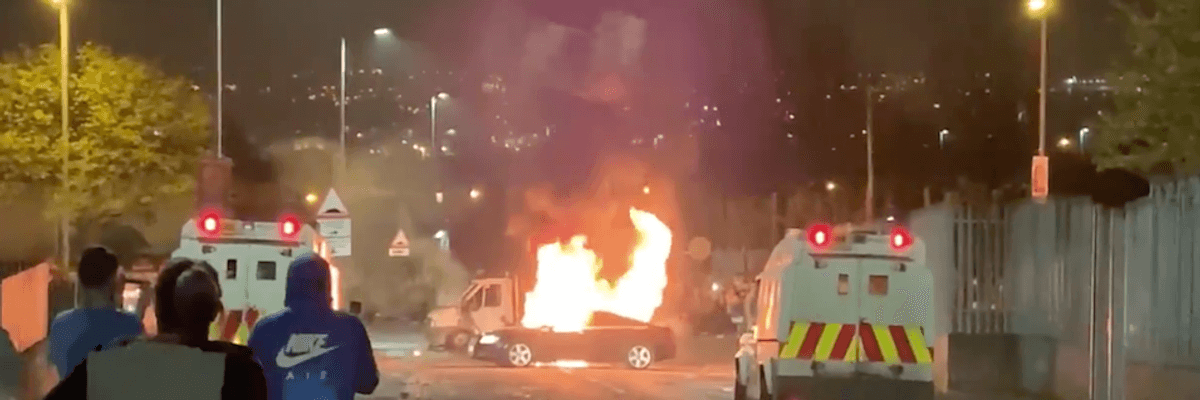
Fires burn in Derry, Northern Ireland, on Thursday night. The violence claimed the life of journalist Lyra McKee. (Photo: screenshot)
A journalist whose work focused on Northern Ireland's troubled past was killed Thursday night in the latest in a series of militant escalations that are increasing in frequency as the United Kingdom and Ireland reckon with Brexit.
Clashes broke out Thursday in the Northern Ireland city of Derry as police forces attempted to raid suspected militant homes.
Lyra McKee was shot, allegedly by dissidents, during the violence. McKee died shortly thereafter.
The raid came in advance of Easter Sunday, which has significance for Northern Irish republicans who want to reunify Northern Ireland with the Republic of Ireland and see the continued division of the island as a leftover from centuries of brutal British colonial rule.
Reaction to McKee's death from leaders on both sides of the Irish Sea stressed the importance of her work and the senselessness of the shooting.
Leo Varadkar, Ireland's Taoiseach (Prime Minister), issued a statement condemning the violence in the country to the north.
"We are all full of sadness after last night's events," said Varadkar. "We cannot allow those who want to propagate violence, fear, and hate to drag us back to the past."
"My thoughts are with the family and loved ones of Lyra McKee, senselessly killed while doing her job as a journalist," said Labour Leader Jeremy Corbyn. "This shocking attack is a reminder of the vital importance of protecting the Good Friday Agreement and Northern Ireland peace process."
Michelle O'Neill, the deputy leader of the Irish party Sinn Fein, said she was "shocked and saddened" by the attack and hoped it would not reopen old wounds.
"The murder of this young woman is a human tragedy for her family," said O'Neill, "but it is also an attack on all the people of this community, an attack on our peace process and an attack on the Good Friday Agreement."
Thursday's shooting is the third violent incident involving dissidents in four months. In January republican militants set off a car bomb outside a Derry courthouse. Two months later, another group of pro-unification dissidents sent at least four, and possibly five, bombs to locations across Britain.
That's a major escalation over recent years; Northern Ireland has been largely quiet since 2007. The country, which is one of four in the U.K., has gone through a generally peaceful spell of time since the 1998 Good Friday Agreement, which began to put an end to "The Troubles"--the Irish and Northern Irish name for the sectarian war that raged along the Northern Irish border for decades.
A number of stressors, chief among them the political instability that comes from the U.K.'s ongoing Brexit struggles, may be to blame for the recent increase in violence.
The U.K., which includes Northern Ireland, has continually put off leaving the E.U. through Brexit. The terms of the departure, which could result in a militarized border with Ireland and subsequent reigniting of "The Troubles," are still up in the air.
As Jochen Bittner put it in The New York Times:
In London, Prime Minister Theresa May has vowed to respect the peace accord and avoid a hard border in Ireland. But neither she nor anyone else has yet explained how not to control a border that separates a European Union country from a nonunion country. Mrs. May's Brexit plan leaves open the possibility of at least customs checks along the border; without a plan in place, a hard border will almost certainly be needed.
That's led to a situation where nobody knows what will happen, or when. The deadline for departure was recently extended to October 31 after May couldn't convince Parliament to sign off on her deal.
The New Yorker's Amy Davidson Sorkin laid out the situation in a recent essay on the effects of Brexit on Northern Ireland:
This is the paradox and the tragedy: Brexit fundamentally conflicts with the Good Friday Agreement, but the U.K. government is in a state of denial about that conflict. It insists that it is committed both to Brexit and to the peace accord: Brexiteers claim that they can maintain a "frictionless" open border with the Republic of Ireland after Brexit--in the same place that the newly hardened border with the E.U. will be.
Relations between the two countries are strained due to Brexit, but, as one unnamed U.K. official told Politico, there aren't a lot of options for either country--so they'll have to make do.
"You can't do without the relationship," said the U.K. official of relations between Ireland and the U.K. "It will survive because it has to. The ties are too strong."
Whatever happens, today the city of Derry, the countries of Northern Ireland and Ireland, and writers across the world are all mourning McKee.
Her supporters in the journalism world shared some of their favorite pieces McKee wrote on "The Troubles" and growing up in Northern Ireland.
And at an emotional ceremony honoring the writer's life just hours after her death, McKee's partner Sara Canning delivered a message of peace.
"Lyra's death must not be in vain," said Canning.
Dear Common Dreams reader, It’s been nearly 30 years since I co-founded Common Dreams with my late wife, Lina Newhouser. We had the radical notion that journalism should serve the public good, not corporate profits. It was clear to us from the outset what it would take to build such a project. No paid advertisements. No corporate sponsors. No millionaire publisher telling us what to think or do. Many people said we wouldn't last a year, but we proved those doubters wrong. Together with a tremendous team of journalists and dedicated staff, we built an independent media outlet free from the constraints of profits and corporate control. Our mission has always been simple: To inform. To inspire. To ignite change for the common good. Building Common Dreams was not easy. Our survival was never guaranteed. When you take on the most powerful forces—Wall Street greed, fossil fuel industry destruction, Big Tech lobbyists, and uber-rich oligarchs who have spent billions upon billions rigging the economy and democracy in their favor—the only bulwark you have is supporters who believe in your work. But here’s the urgent message from me today. It's never been this bad out there. And it's never been this hard to keep us going. At the very moment Common Dreams is most needed, the threats we face are intensifying. We need your support now more than ever. We don't accept corporate advertising and never will. We don't have a paywall because we don't think people should be blocked from critical news based on their ability to pay. Everything we do is funded by the donations of readers like you. When everyone does the little they can afford, we are strong. But if that support retreats or dries up, so do we. Will you donate now to make sure Common Dreams not only survives but thrives? —Craig Brown, Co-founder |
A journalist whose work focused on Northern Ireland's troubled past was killed Thursday night in the latest in a series of militant escalations that are increasing in frequency as the United Kingdom and Ireland reckon with Brexit.
Clashes broke out Thursday in the Northern Ireland city of Derry as police forces attempted to raid suspected militant homes.
Lyra McKee was shot, allegedly by dissidents, during the violence. McKee died shortly thereafter.
The raid came in advance of Easter Sunday, which has significance for Northern Irish republicans who want to reunify Northern Ireland with the Republic of Ireland and see the continued division of the island as a leftover from centuries of brutal British colonial rule.
Reaction to McKee's death from leaders on both sides of the Irish Sea stressed the importance of her work and the senselessness of the shooting.
Leo Varadkar, Ireland's Taoiseach (Prime Minister), issued a statement condemning the violence in the country to the north.
"We are all full of sadness after last night's events," said Varadkar. "We cannot allow those who want to propagate violence, fear, and hate to drag us back to the past."
"My thoughts are with the family and loved ones of Lyra McKee, senselessly killed while doing her job as a journalist," said Labour Leader Jeremy Corbyn. "This shocking attack is a reminder of the vital importance of protecting the Good Friday Agreement and Northern Ireland peace process."
Michelle O'Neill, the deputy leader of the Irish party Sinn Fein, said she was "shocked and saddened" by the attack and hoped it would not reopen old wounds.
"The murder of this young woman is a human tragedy for her family," said O'Neill, "but it is also an attack on all the people of this community, an attack on our peace process and an attack on the Good Friday Agreement."
Thursday's shooting is the third violent incident involving dissidents in four months. In January republican militants set off a car bomb outside a Derry courthouse. Two months later, another group of pro-unification dissidents sent at least four, and possibly five, bombs to locations across Britain.
That's a major escalation over recent years; Northern Ireland has been largely quiet since 2007. The country, which is one of four in the U.K., has gone through a generally peaceful spell of time since the 1998 Good Friday Agreement, which began to put an end to "The Troubles"--the Irish and Northern Irish name for the sectarian war that raged along the Northern Irish border for decades.
A number of stressors, chief among them the political instability that comes from the U.K.'s ongoing Brexit struggles, may be to blame for the recent increase in violence.
The U.K., which includes Northern Ireland, has continually put off leaving the E.U. through Brexit. The terms of the departure, which could result in a militarized border with Ireland and subsequent reigniting of "The Troubles," are still up in the air.
As Jochen Bittner put it in The New York Times:
In London, Prime Minister Theresa May has vowed to respect the peace accord and avoid a hard border in Ireland. But neither she nor anyone else has yet explained how not to control a border that separates a European Union country from a nonunion country. Mrs. May's Brexit plan leaves open the possibility of at least customs checks along the border; without a plan in place, a hard border will almost certainly be needed.
That's led to a situation where nobody knows what will happen, or when. The deadline for departure was recently extended to October 31 after May couldn't convince Parliament to sign off on her deal.
The New Yorker's Amy Davidson Sorkin laid out the situation in a recent essay on the effects of Brexit on Northern Ireland:
This is the paradox and the tragedy: Brexit fundamentally conflicts with the Good Friday Agreement, but the U.K. government is in a state of denial about that conflict. It insists that it is committed both to Brexit and to the peace accord: Brexiteers claim that they can maintain a "frictionless" open border with the Republic of Ireland after Brexit--in the same place that the newly hardened border with the E.U. will be.
Relations between the two countries are strained due to Brexit, but, as one unnamed U.K. official told Politico, there aren't a lot of options for either country--so they'll have to make do.
"You can't do without the relationship," said the U.K. official of relations between Ireland and the U.K. "It will survive because it has to. The ties are too strong."
Whatever happens, today the city of Derry, the countries of Northern Ireland and Ireland, and writers across the world are all mourning McKee.
Her supporters in the journalism world shared some of their favorite pieces McKee wrote on "The Troubles" and growing up in Northern Ireland.
And at an emotional ceremony honoring the writer's life just hours after her death, McKee's partner Sara Canning delivered a message of peace.
"Lyra's death must not be in vain," said Canning.
A journalist whose work focused on Northern Ireland's troubled past was killed Thursday night in the latest in a series of militant escalations that are increasing in frequency as the United Kingdom and Ireland reckon with Brexit.
Clashes broke out Thursday in the Northern Ireland city of Derry as police forces attempted to raid suspected militant homes.
Lyra McKee was shot, allegedly by dissidents, during the violence. McKee died shortly thereafter.
The raid came in advance of Easter Sunday, which has significance for Northern Irish republicans who want to reunify Northern Ireland with the Republic of Ireland and see the continued division of the island as a leftover from centuries of brutal British colonial rule.
Reaction to McKee's death from leaders on both sides of the Irish Sea stressed the importance of her work and the senselessness of the shooting.
Leo Varadkar, Ireland's Taoiseach (Prime Minister), issued a statement condemning the violence in the country to the north.
"We are all full of sadness after last night's events," said Varadkar. "We cannot allow those who want to propagate violence, fear, and hate to drag us back to the past."
"My thoughts are with the family and loved ones of Lyra McKee, senselessly killed while doing her job as a journalist," said Labour Leader Jeremy Corbyn. "This shocking attack is a reminder of the vital importance of protecting the Good Friday Agreement and Northern Ireland peace process."
Michelle O'Neill, the deputy leader of the Irish party Sinn Fein, said she was "shocked and saddened" by the attack and hoped it would not reopen old wounds.
"The murder of this young woman is a human tragedy for her family," said O'Neill, "but it is also an attack on all the people of this community, an attack on our peace process and an attack on the Good Friday Agreement."
Thursday's shooting is the third violent incident involving dissidents in four months. In January republican militants set off a car bomb outside a Derry courthouse. Two months later, another group of pro-unification dissidents sent at least four, and possibly five, bombs to locations across Britain.
That's a major escalation over recent years; Northern Ireland has been largely quiet since 2007. The country, which is one of four in the U.K., has gone through a generally peaceful spell of time since the 1998 Good Friday Agreement, which began to put an end to "The Troubles"--the Irish and Northern Irish name for the sectarian war that raged along the Northern Irish border for decades.
A number of stressors, chief among them the political instability that comes from the U.K.'s ongoing Brexit struggles, may be to blame for the recent increase in violence.
The U.K., which includes Northern Ireland, has continually put off leaving the E.U. through Brexit. The terms of the departure, which could result in a militarized border with Ireland and subsequent reigniting of "The Troubles," are still up in the air.
As Jochen Bittner put it in The New York Times:
In London, Prime Minister Theresa May has vowed to respect the peace accord and avoid a hard border in Ireland. But neither she nor anyone else has yet explained how not to control a border that separates a European Union country from a nonunion country. Mrs. May's Brexit plan leaves open the possibility of at least customs checks along the border; without a plan in place, a hard border will almost certainly be needed.
That's led to a situation where nobody knows what will happen, or when. The deadline for departure was recently extended to October 31 after May couldn't convince Parliament to sign off on her deal.
The New Yorker's Amy Davidson Sorkin laid out the situation in a recent essay on the effects of Brexit on Northern Ireland:
This is the paradox and the tragedy: Brexit fundamentally conflicts with the Good Friday Agreement, but the U.K. government is in a state of denial about that conflict. It insists that it is committed both to Brexit and to the peace accord: Brexiteers claim that they can maintain a "frictionless" open border with the Republic of Ireland after Brexit--in the same place that the newly hardened border with the E.U. will be.
Relations between the two countries are strained due to Brexit, but, as one unnamed U.K. official told Politico, there aren't a lot of options for either country--so they'll have to make do.
"You can't do without the relationship," said the U.K. official of relations between Ireland and the U.K. "It will survive because it has to. The ties are too strong."
Whatever happens, today the city of Derry, the countries of Northern Ireland and Ireland, and writers across the world are all mourning McKee.
Her supporters in the journalism world shared some of their favorite pieces McKee wrote on "The Troubles" and growing up in Northern Ireland.
And at an emotional ceremony honoring the writer's life just hours after her death, McKee's partner Sara Canning delivered a message of peace.
"Lyra's death must not be in vain," said Canning.