SUBSCRIBE TO OUR FREE NEWSLETTER
Daily news & progressive opinion—funded by the people, not the corporations—delivered straight to your inbox.
5
#000000
#FFFFFF
To donate by check, phone, or other method, see our More Ways to Give page.
Daily news & progressive opinion—funded by the people, not the corporations—delivered straight to your inbox.
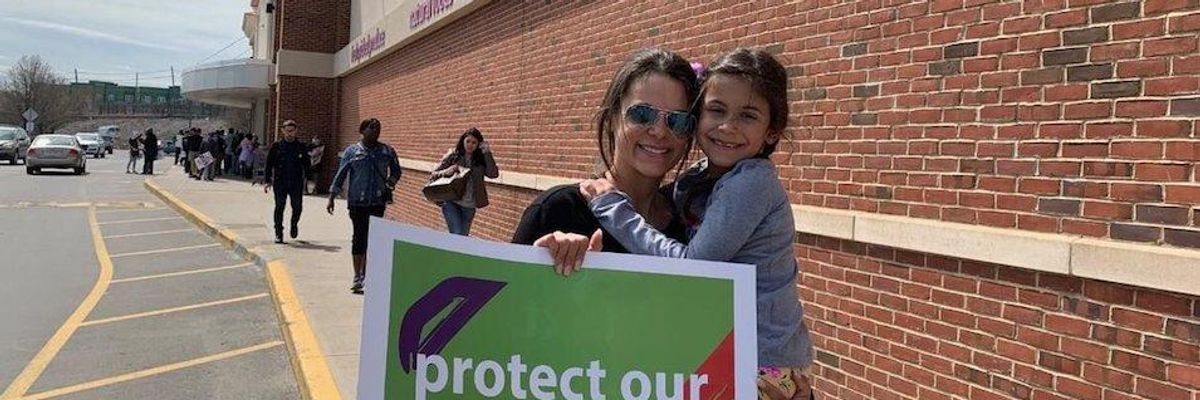
A striker at a New England Stop & Shop. (Photo: UFCW Twitter)
The New England Stop & Shop strike entered its eighth day Friday as the grocery store's parent company continued to refuse to honor the union's demand for a fair contract.
At the heart of the dispute is an inability for Ahold Delhaize, a Dutch grocery conglomerate that owns Stop & Shop, and the United Food and Commercial Workers union (UCFW) to reach an agreement on a new contract. The sticking point is Ahold Delhaize's refusal to back down from its demand that the grocery store's workers take a cut in benefits--even as the parent company is reporting billions in profits.
"We want our pension to be left the way it is, our healthcare not to be taken away from us, to keep our time and a half," Watertown, Mass., striker Chris Pacitto told Hell World's Luke O'Neil. "Everything that we fight for every day."
It's the largest strike in at least three years for a private company and comes on the heels of two years of public school teacher strikes that have transfixed the country from West Virginia to Oakland, California.
The strike, which affects 240 stores in Massachusetts, Connecticut, and Rhode Island, has closed "several dozen" stores--and the ones that are open, according to The Boston Globe, are struggling to keep fresh products in place.
Inside stores, shortages are evident. Meat and produce are rapidly disappearing from shelves, and aren't being replaced because truck drivers in the Teamsters union are refusing to cross the picket line. Workers are blocking other trucks from making deliveries.
The strikers can claim support from progressives, local community members, and Democrats in the region and across the country.
Dan Raferty, the co-chair of western Massachusetts-based Berkshire County Democratic Socialists of America, wrote in a letter to a local paper Friday that the blame for the strike was squarely on the parent company.
"Ahold Delhaize claims that Stop & Shop employees are better paid than direct competitors and that they are the only unionized food retailer in the region," wrote Raferty. "Be that as it may, that is no excuse to take what their workers have labored for."
The Berkshire community has been supportive of the strike in general. UCFW rep Melissa May told local NPR affiliate WAMC that "the support from customers has been unbelievable."
"They have supported us in many ways, first and foremost by not crossing our picket line, which we are asking everybody not to do," said the union rep. "But they have also continued every day to come out with coffee and donuts, with pizza, with personal donations, with gift cards to other stores, just with well wishes too--keeping our spirits up and making sure they won't come back [inside the store] until we get a fair contract."
Customer solidarity is helpful, but some workers are nonetheless worried about their income as the strike continues.
"I've been working paycheck-to-paycheck my entire life," striker Shaunna Beck told Rhode Island news channel WPRI. "I depend on this job."
However, the strike is also presenting issues for Ahold Delhaize--issues that could have long-lasting effects.
In a column published by Common Dreams on Friday, writer Michael Arria pointed out that the longer the strike goes on, the worse for Ahold as far as the health of the business goes. There's historical precedent for a decline in sales that the company may not be able to overcome.
"The current state of Stop & Shop should be a legitimate concern for the company," wrote Arria. "The Southern California grocery strike of 2003 to 2004 led to the establishment of new grocery chains and customers shifting their allegiances after they began shopping at different stores."
Democratic politicians, too, are headed to southern New England to show their support. As Common Dreams reported on April 11, Sens. Elizabeth Warren (D-Mass.) and Bernie Sanders (I-Vt.), both of whom are contending for the Democratic nomination for president in 2020, were two of the first major national politicians to express support for the strikers.
"I stand in solidarity with UFCW for these hard-working families to be treated with the dignity and respect they deserve," Warren said at the time.
The senator joined strikers on the picket line in Somerville, Mass., on April 12.
Not to be outdone, former Vice President Joe Biden, who is expected to announce a bid for the Democratic nomination next week, appeared in Dorchester, a Boston suburb, on Thursday to express his solidarity with the strikers.
Biden was joined at the rally by State Treasurer Deborah Goldberg, whose family founded Stop & Shop. Goldberg supports the strike, she told Bloomberg News's radio show "Bay State Business" Wednesday.
"When we ran Stop & Shop we viewed it as America's version of socialism--in the sense that we wanted the company to grow to employ people to provide middle-class lives," said Goldberg.
Biden, in his remarks Thursday, went after Ahold Delhaize.
"This is morally wrong," Biden said of Ahold's negotiation tactics.
That's a sentiment also endorsed by rabbis in the three states, who said that food purchased from across a picket line is not kosher. Boston's Rabbi Barbara Penzner, who leads services at reconstructionist synagogue Temple Hillel B'nai Torah, explained the reasoning.
"The food that you're buying is the product of oppressed labor and that's not kosher," said Penzner.
Dear Common Dreams reader, It’s been nearly 30 years since I co-founded Common Dreams with my late wife, Lina Newhouser. We had the radical notion that journalism should serve the public good, not corporate profits. It was clear to us from the outset what it would take to build such a project. No paid advertisements. No corporate sponsors. No millionaire publisher telling us what to think or do. Many people said we wouldn't last a year, but we proved those doubters wrong. Together with a tremendous team of journalists and dedicated staff, we built an independent media outlet free from the constraints of profits and corporate control. Our mission has always been simple: To inform. To inspire. To ignite change for the common good. Building Common Dreams was not easy. Our survival was never guaranteed. When you take on the most powerful forces—Wall Street greed, fossil fuel industry destruction, Big Tech lobbyists, and uber-rich oligarchs who have spent billions upon billions rigging the economy and democracy in their favor—the only bulwark you have is supporters who believe in your work. But here’s the urgent message from me today. It's never been this bad out there. And it's never been this hard to keep us going. At the very moment Common Dreams is most needed, the threats we face are intensifying. We need your support now more than ever. We don't accept corporate advertising and never will. We don't have a paywall because we don't think people should be blocked from critical news based on their ability to pay. Everything we do is funded by the donations of readers like you. When everyone does the little they can afford, we are strong. But if that support retreats or dries up, so do we. Will you donate now to make sure Common Dreams not only survives but thrives? —Craig Brown, Co-founder |
The New England Stop & Shop strike entered its eighth day Friday as the grocery store's parent company continued to refuse to honor the union's demand for a fair contract.
At the heart of the dispute is an inability for Ahold Delhaize, a Dutch grocery conglomerate that owns Stop & Shop, and the United Food and Commercial Workers union (UCFW) to reach an agreement on a new contract. The sticking point is Ahold Delhaize's refusal to back down from its demand that the grocery store's workers take a cut in benefits--even as the parent company is reporting billions in profits.
"We want our pension to be left the way it is, our healthcare not to be taken away from us, to keep our time and a half," Watertown, Mass., striker Chris Pacitto told Hell World's Luke O'Neil. "Everything that we fight for every day."
It's the largest strike in at least three years for a private company and comes on the heels of two years of public school teacher strikes that have transfixed the country from West Virginia to Oakland, California.
The strike, which affects 240 stores in Massachusetts, Connecticut, and Rhode Island, has closed "several dozen" stores--and the ones that are open, according to The Boston Globe, are struggling to keep fresh products in place.
Inside stores, shortages are evident. Meat and produce are rapidly disappearing from shelves, and aren't being replaced because truck drivers in the Teamsters union are refusing to cross the picket line. Workers are blocking other trucks from making deliveries.
The strikers can claim support from progressives, local community members, and Democrats in the region and across the country.
Dan Raferty, the co-chair of western Massachusetts-based Berkshire County Democratic Socialists of America, wrote in a letter to a local paper Friday that the blame for the strike was squarely on the parent company.
"Ahold Delhaize claims that Stop & Shop employees are better paid than direct competitors and that they are the only unionized food retailer in the region," wrote Raferty. "Be that as it may, that is no excuse to take what their workers have labored for."
The Berkshire community has been supportive of the strike in general. UCFW rep Melissa May told local NPR affiliate WAMC that "the support from customers has been unbelievable."
"They have supported us in many ways, first and foremost by not crossing our picket line, which we are asking everybody not to do," said the union rep. "But they have also continued every day to come out with coffee and donuts, with pizza, with personal donations, with gift cards to other stores, just with well wishes too--keeping our spirits up and making sure they won't come back [inside the store] until we get a fair contract."
Customer solidarity is helpful, but some workers are nonetheless worried about their income as the strike continues.
"I've been working paycheck-to-paycheck my entire life," striker Shaunna Beck told Rhode Island news channel WPRI. "I depend on this job."
However, the strike is also presenting issues for Ahold Delhaize--issues that could have long-lasting effects.
In a column published by Common Dreams on Friday, writer Michael Arria pointed out that the longer the strike goes on, the worse for Ahold as far as the health of the business goes. There's historical precedent for a decline in sales that the company may not be able to overcome.
"The current state of Stop & Shop should be a legitimate concern for the company," wrote Arria. "The Southern California grocery strike of 2003 to 2004 led to the establishment of new grocery chains and customers shifting their allegiances after they began shopping at different stores."
Democratic politicians, too, are headed to southern New England to show their support. As Common Dreams reported on April 11, Sens. Elizabeth Warren (D-Mass.) and Bernie Sanders (I-Vt.), both of whom are contending for the Democratic nomination for president in 2020, were two of the first major national politicians to express support for the strikers.
"I stand in solidarity with UFCW for these hard-working families to be treated with the dignity and respect they deserve," Warren said at the time.
The senator joined strikers on the picket line in Somerville, Mass., on April 12.
Not to be outdone, former Vice President Joe Biden, who is expected to announce a bid for the Democratic nomination next week, appeared in Dorchester, a Boston suburb, on Thursday to express his solidarity with the strikers.
Biden was joined at the rally by State Treasurer Deborah Goldberg, whose family founded Stop & Shop. Goldberg supports the strike, she told Bloomberg News's radio show "Bay State Business" Wednesday.
"When we ran Stop & Shop we viewed it as America's version of socialism--in the sense that we wanted the company to grow to employ people to provide middle-class lives," said Goldberg.
Biden, in his remarks Thursday, went after Ahold Delhaize.
"This is morally wrong," Biden said of Ahold's negotiation tactics.
That's a sentiment also endorsed by rabbis in the three states, who said that food purchased from across a picket line is not kosher. Boston's Rabbi Barbara Penzner, who leads services at reconstructionist synagogue Temple Hillel B'nai Torah, explained the reasoning.
"The food that you're buying is the product of oppressed labor and that's not kosher," said Penzner.
The New England Stop & Shop strike entered its eighth day Friday as the grocery store's parent company continued to refuse to honor the union's demand for a fair contract.
At the heart of the dispute is an inability for Ahold Delhaize, a Dutch grocery conglomerate that owns Stop & Shop, and the United Food and Commercial Workers union (UCFW) to reach an agreement on a new contract. The sticking point is Ahold Delhaize's refusal to back down from its demand that the grocery store's workers take a cut in benefits--even as the parent company is reporting billions in profits.
"We want our pension to be left the way it is, our healthcare not to be taken away from us, to keep our time and a half," Watertown, Mass., striker Chris Pacitto told Hell World's Luke O'Neil. "Everything that we fight for every day."
It's the largest strike in at least three years for a private company and comes on the heels of two years of public school teacher strikes that have transfixed the country from West Virginia to Oakland, California.
The strike, which affects 240 stores in Massachusetts, Connecticut, and Rhode Island, has closed "several dozen" stores--and the ones that are open, according to The Boston Globe, are struggling to keep fresh products in place.
Inside stores, shortages are evident. Meat and produce are rapidly disappearing from shelves, and aren't being replaced because truck drivers in the Teamsters union are refusing to cross the picket line. Workers are blocking other trucks from making deliveries.
The strikers can claim support from progressives, local community members, and Democrats in the region and across the country.
Dan Raferty, the co-chair of western Massachusetts-based Berkshire County Democratic Socialists of America, wrote in a letter to a local paper Friday that the blame for the strike was squarely on the parent company.
"Ahold Delhaize claims that Stop & Shop employees are better paid than direct competitors and that they are the only unionized food retailer in the region," wrote Raferty. "Be that as it may, that is no excuse to take what their workers have labored for."
The Berkshire community has been supportive of the strike in general. UCFW rep Melissa May told local NPR affiliate WAMC that "the support from customers has been unbelievable."
"They have supported us in many ways, first and foremost by not crossing our picket line, which we are asking everybody not to do," said the union rep. "But they have also continued every day to come out with coffee and donuts, with pizza, with personal donations, with gift cards to other stores, just with well wishes too--keeping our spirits up and making sure they won't come back [inside the store] until we get a fair contract."
Customer solidarity is helpful, but some workers are nonetheless worried about their income as the strike continues.
"I've been working paycheck-to-paycheck my entire life," striker Shaunna Beck told Rhode Island news channel WPRI. "I depend on this job."
However, the strike is also presenting issues for Ahold Delhaize--issues that could have long-lasting effects.
In a column published by Common Dreams on Friday, writer Michael Arria pointed out that the longer the strike goes on, the worse for Ahold as far as the health of the business goes. There's historical precedent for a decline in sales that the company may not be able to overcome.
"The current state of Stop & Shop should be a legitimate concern for the company," wrote Arria. "The Southern California grocery strike of 2003 to 2004 led to the establishment of new grocery chains and customers shifting their allegiances after they began shopping at different stores."
Democratic politicians, too, are headed to southern New England to show their support. As Common Dreams reported on April 11, Sens. Elizabeth Warren (D-Mass.) and Bernie Sanders (I-Vt.), both of whom are contending for the Democratic nomination for president in 2020, were two of the first major national politicians to express support for the strikers.
"I stand in solidarity with UFCW for these hard-working families to be treated with the dignity and respect they deserve," Warren said at the time.
The senator joined strikers on the picket line in Somerville, Mass., on April 12.
Not to be outdone, former Vice President Joe Biden, who is expected to announce a bid for the Democratic nomination next week, appeared in Dorchester, a Boston suburb, on Thursday to express his solidarity with the strikers.
Biden was joined at the rally by State Treasurer Deborah Goldberg, whose family founded Stop & Shop. Goldberg supports the strike, she told Bloomberg News's radio show "Bay State Business" Wednesday.
"When we ran Stop & Shop we viewed it as America's version of socialism--in the sense that we wanted the company to grow to employ people to provide middle-class lives," said Goldberg.
Biden, in his remarks Thursday, went after Ahold Delhaize.
"This is morally wrong," Biden said of Ahold's negotiation tactics.
That's a sentiment also endorsed by rabbis in the three states, who said that food purchased from across a picket line is not kosher. Boston's Rabbi Barbara Penzner, who leads services at reconstructionist synagogue Temple Hillel B'nai Torah, explained the reasoning.
"The food that you're buying is the product of oppressed labor and that's not kosher," said Penzner.