SUBSCRIBE TO OUR FREE NEWSLETTER
Daily news & progressive opinion—funded by the people, not the corporations—delivered straight to your inbox.
5
#000000
#FFFFFF
To donate by check, phone, or other method, see our More Ways to Give page.
Daily news & progressive opinion—funded by the people, not the corporations—delivered straight to your inbox.
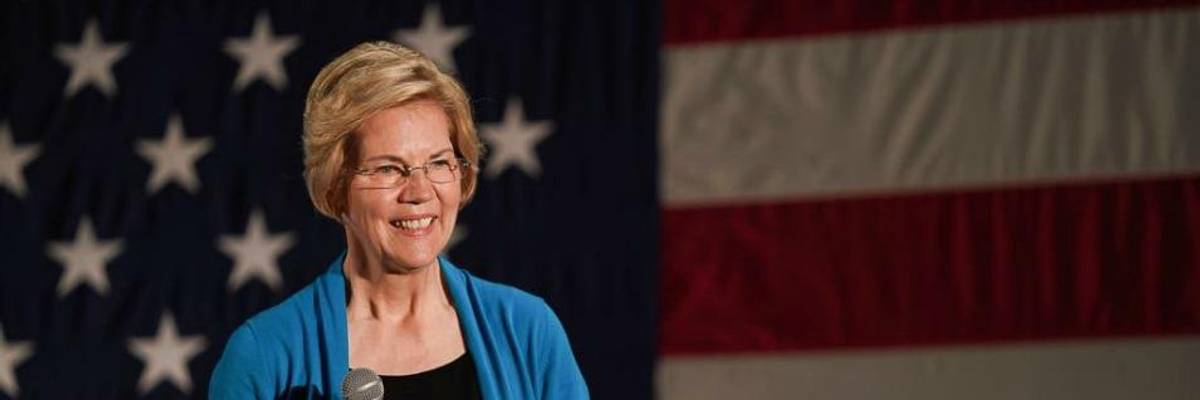
Sen. Elizabeth Warren (D-Mass.) on Thursday introduced a new tax plan targeting the largest U.S. corporations as part of her 2020 campaign platfrom. (Photo: @ewarren/Twitter)
Sen. Elizabeth Warren unveiled yet another bold policy for her 2020 presidential campaign Thursday with a new plan that aims to offset tax loopholes and exemptions exploited by the largest and most profitable U.S. corporations.
"Our corporate tax code is so littered with loopholes that simply raising the regular corporate tax rate alone is not enough."
--Sen. Elizabeth Warren
"Some of the biggest corporations in the country make huge profits but pay zero federal corporate income taxes on those profits," the Democrat from Massachusetts explained in a Medium post about the proposal. "Our corporate tax code is so littered with loopholes that simply raising the regular corporate tax rate alone is not enough."
To ensure that major corporations are paying their fair share, the Real Corporate Profits Tax would impose a 7 percent tax on American companies for all annual profits beyond $100 million--which would have applied to about 1,200 public firms last year, according to Team Warren.
The presidential hopeful, in February, vowed to build her campaign on "ideas and principles" rather than through "fancy receptions" and "big money fundraisers." Her new tax plan follows detailed proposals to establish universal childcare in the United States, help family farmers who are struggling to compete with Big Ag, and break up tech giants like Amazon, Facebook, and Google.
Her latest announcement comes shortly before Tax Day, and as a new analysis reveals that under the "GOP tax scam" that President Donald Trump signed in late 2017, twice as many corporations are paying no taxes compared with previous years--despite making billions of dollars in profits.
"If you've already filed your taxes this year, chances are you paid more than a lot of the big corporations," Warren pointed out in a series of tweets Thursday morning.
Outlining the need for the new tax, Warren explained that "there are two sets of rules for reporting a company's profits."
Companies follow established financial accounting rules to calculate the value of the profits they report to shareholders and the public. But they follow a different set of tax accounting rules to calculate the "profits" they report to the IRS and pay corporate income taxes on. Because of relentless lobbying, our corporate income tax rules are filled with so many loopholes and exemptions and deductions that even companies that tell shareholders they have made more than a billion dollars in profits can end up paying no corporate income taxes.
"We need corporate tax reform," she added, "but we also need to recognize that enormous companies with armies of lawyers and accountants will always try to exploit any deductions and exemptions that remain."
Warren's "small new tax" targeting the nation's "richest, biggest corporations" would help "level the playing field for small businesses trying to compete with the giants," she charged. It would also generate massive revenue that the government could put toward serving the public good.
Overall, according to an analysis (pdf) from by a pair of economists at the University of California, Berkeley, the new tax would raise $1.05 trillion on public companies in just the next decade. Amazon, for example, "would pay $698 million in taxes instead of paying zero."
As Warren concluded an email to supporters Thursday, "Let's make this year the last year any company with massive profits pays zero federal taxes."
This post has been updated to clarify Sen. Elizabeth Warren's other 2020 proposals.
Dear Common Dreams reader, It’s been nearly 30 years since I co-founded Common Dreams with my late wife, Lina Newhouser. We had the radical notion that journalism should serve the public good, not corporate profits. It was clear to us from the outset what it would take to build such a project. No paid advertisements. No corporate sponsors. No millionaire publisher telling us what to think or do. Many people said we wouldn't last a year, but we proved those doubters wrong. Together with a tremendous team of journalists and dedicated staff, we built an independent media outlet free from the constraints of profits and corporate control. Our mission has always been simple: To inform. To inspire. To ignite change for the common good. Building Common Dreams was not easy. Our survival was never guaranteed. When you take on the most powerful forces—Wall Street greed, fossil fuel industry destruction, Big Tech lobbyists, and uber-rich oligarchs who have spent billions upon billions rigging the economy and democracy in their favor—the only bulwark you have is supporters who believe in your work. But here’s the urgent message from me today. It's never been this bad out there. And it's never been this hard to keep us going. At the very moment Common Dreams is most needed, the threats we face are intensifying. We need your support now more than ever. We don't accept corporate advertising and never will. We don't have a paywall because we don't think people should be blocked from critical news based on their ability to pay. Everything we do is funded by the donations of readers like you. When everyone does the little they can afford, we are strong. But if that support retreats or dries up, so do we. Will you donate now to make sure Common Dreams not only survives but thrives? —Craig Brown, Co-founder |
Sen. Elizabeth Warren unveiled yet another bold policy for her 2020 presidential campaign Thursday with a new plan that aims to offset tax loopholes and exemptions exploited by the largest and most profitable U.S. corporations.
"Our corporate tax code is so littered with loopholes that simply raising the regular corporate tax rate alone is not enough."
--Sen. Elizabeth Warren
"Some of the biggest corporations in the country make huge profits but pay zero federal corporate income taxes on those profits," the Democrat from Massachusetts explained in a Medium post about the proposal. "Our corporate tax code is so littered with loopholes that simply raising the regular corporate tax rate alone is not enough."
To ensure that major corporations are paying their fair share, the Real Corporate Profits Tax would impose a 7 percent tax on American companies for all annual profits beyond $100 million--which would have applied to about 1,200 public firms last year, according to Team Warren.
The presidential hopeful, in February, vowed to build her campaign on "ideas and principles" rather than through "fancy receptions" and "big money fundraisers." Her new tax plan follows detailed proposals to establish universal childcare in the United States, help family farmers who are struggling to compete with Big Ag, and break up tech giants like Amazon, Facebook, and Google.
Her latest announcement comes shortly before Tax Day, and as a new analysis reveals that under the "GOP tax scam" that President Donald Trump signed in late 2017, twice as many corporations are paying no taxes compared with previous years--despite making billions of dollars in profits.
"If you've already filed your taxes this year, chances are you paid more than a lot of the big corporations," Warren pointed out in a series of tweets Thursday morning.
Outlining the need for the new tax, Warren explained that "there are two sets of rules for reporting a company's profits."
Companies follow established financial accounting rules to calculate the value of the profits they report to shareholders and the public. But they follow a different set of tax accounting rules to calculate the "profits" they report to the IRS and pay corporate income taxes on. Because of relentless lobbying, our corporate income tax rules are filled with so many loopholes and exemptions and deductions that even companies that tell shareholders they have made more than a billion dollars in profits can end up paying no corporate income taxes.
"We need corporate tax reform," she added, "but we also need to recognize that enormous companies with armies of lawyers and accountants will always try to exploit any deductions and exemptions that remain."
Warren's "small new tax" targeting the nation's "richest, biggest corporations" would help "level the playing field for small businesses trying to compete with the giants," she charged. It would also generate massive revenue that the government could put toward serving the public good.
Overall, according to an analysis (pdf) from by a pair of economists at the University of California, Berkeley, the new tax would raise $1.05 trillion on public companies in just the next decade. Amazon, for example, "would pay $698 million in taxes instead of paying zero."
As Warren concluded an email to supporters Thursday, "Let's make this year the last year any company with massive profits pays zero federal taxes."
This post has been updated to clarify Sen. Elizabeth Warren's other 2020 proposals.
Sen. Elizabeth Warren unveiled yet another bold policy for her 2020 presidential campaign Thursday with a new plan that aims to offset tax loopholes and exemptions exploited by the largest and most profitable U.S. corporations.
"Our corporate tax code is so littered with loopholes that simply raising the regular corporate tax rate alone is not enough."
--Sen. Elizabeth Warren
"Some of the biggest corporations in the country make huge profits but pay zero federal corporate income taxes on those profits," the Democrat from Massachusetts explained in a Medium post about the proposal. "Our corporate tax code is so littered with loopholes that simply raising the regular corporate tax rate alone is not enough."
To ensure that major corporations are paying their fair share, the Real Corporate Profits Tax would impose a 7 percent tax on American companies for all annual profits beyond $100 million--which would have applied to about 1,200 public firms last year, according to Team Warren.
The presidential hopeful, in February, vowed to build her campaign on "ideas and principles" rather than through "fancy receptions" and "big money fundraisers." Her new tax plan follows detailed proposals to establish universal childcare in the United States, help family farmers who are struggling to compete with Big Ag, and break up tech giants like Amazon, Facebook, and Google.
Her latest announcement comes shortly before Tax Day, and as a new analysis reveals that under the "GOP tax scam" that President Donald Trump signed in late 2017, twice as many corporations are paying no taxes compared with previous years--despite making billions of dollars in profits.
"If you've already filed your taxes this year, chances are you paid more than a lot of the big corporations," Warren pointed out in a series of tweets Thursday morning.
Outlining the need for the new tax, Warren explained that "there are two sets of rules for reporting a company's profits."
Companies follow established financial accounting rules to calculate the value of the profits they report to shareholders and the public. But they follow a different set of tax accounting rules to calculate the "profits" they report to the IRS and pay corporate income taxes on. Because of relentless lobbying, our corporate income tax rules are filled with so many loopholes and exemptions and deductions that even companies that tell shareholders they have made more than a billion dollars in profits can end up paying no corporate income taxes.
"We need corporate tax reform," she added, "but we also need to recognize that enormous companies with armies of lawyers and accountants will always try to exploit any deductions and exemptions that remain."
Warren's "small new tax" targeting the nation's "richest, biggest corporations" would help "level the playing field for small businesses trying to compete with the giants," she charged. It would also generate massive revenue that the government could put toward serving the public good.
Overall, according to an analysis (pdf) from by a pair of economists at the University of California, Berkeley, the new tax would raise $1.05 trillion on public companies in just the next decade. Amazon, for example, "would pay $698 million in taxes instead of paying zero."
As Warren concluded an email to supporters Thursday, "Let's make this year the last year any company with massive profits pays zero federal taxes."
This post has been updated to clarify Sen. Elizabeth Warren's other 2020 proposals.