

SUBSCRIBE TO OUR FREE NEWSLETTER
Daily news & progressive opinion—funded by the people, not the corporations—delivered straight to your inbox.
5
#000000
#FFFFFF
To donate by check, phone, or other method, see our More Ways to Give page.
Daily news & progressive opinion—funded by the people, not the corporations—delivered straight to your inbox.
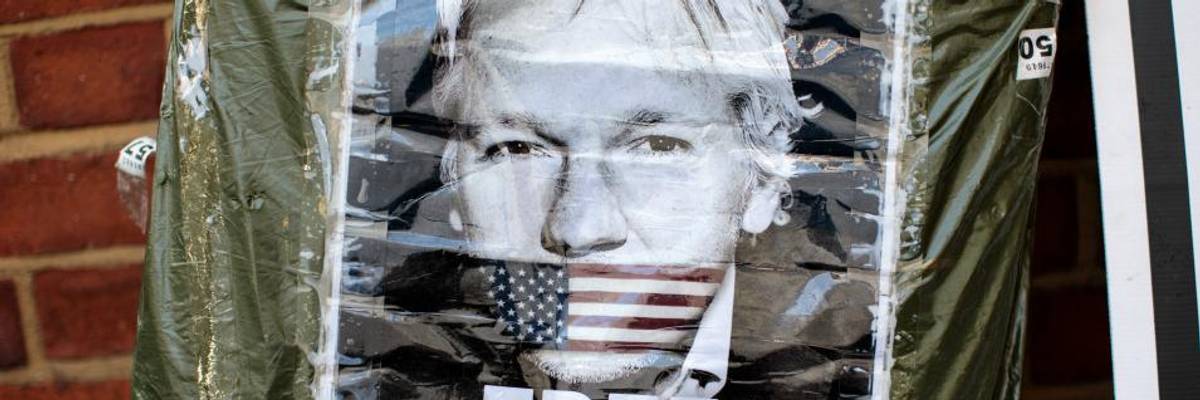
Placards and messages in support of Julian Assange sit outside Ecuadorian Embassy stands in South Kensington on April 5, 2019 in London, England. (Photo: Jack Taylor/Getty Images)
Edward Snowden joined the chorus of advocacy groups, reporters, and critics as the NSA whistleblower described the arrest of WikiLeaks founder and publisher Julian Assange Thursday morning as a "dark moment for press freedom" that could have grave implications for journalism across the globe.
"Mr. Assange deserves the solidarity of the community of investigative journalists. The world is now watching."
--Centre for Investigative Journalism
"Images of Ecuador's ambassador inviting the U.K.'s secret police into the embassy to drag a publisher of--like it or not--award-winning journalism out of the building are going to end up in the history books," Snowden tweeted.
Assange's arrest comes amid concerns that British authorities could be planning to extradite him to the United States.
The U.K. police confirmed that Assange was arrested in part due to "an extradition warrant on behalf of the United States authorities."
Shortly after Assange's arrest, the U.S. Justice Department unsealed charges against the WikiLeaks founder, accusing him of a "computer hacking conspiracy."
"If you're cheering Assange's arrest based on a U.S. extradition request, your allies in your celebration are the most extremist elements of the Trump administration, whose primary and explicit goal is to criminalize reporting on classified docs and punish [WikiLeaks] for exposing war crimes," tweeted The Intercept's Glenn Greenwald.
"All of us in the press should read the charges made against Assange very carefully," wrote Rolling Stone's Matt Taibbi, "as this case has enormous potential ramifications for journalists everywhere."
Greenwald's colleague at The Intercept, investigative reporter Jeremy Scahill, called the arrest "an extremely dangerous crossing of the rubicon" when it comes to press freedoms. "All journalists," he said, "should stand in fierce opposition."
As Common Dreams reported last November, the Trump Justice Department accidentally revealed in an unrelated court filing that it has secretly charged Assange.
"Wikileaks material from Iraq, Afghanistan, and elsewhere has become a unique, invaluable resource for investigative journalists and scholars around the world," the U.K.-based Centre for Investigative Journalism (CIJ) said in a statement Thursday.
"Whatever your view of its philosophy of radical transparency, Wikileaks is a publisher," CIJ added. "Any charges now brought in connection with that material, or any attempt to extradite Mr. Assange to the United States for prosecution under the deeply flawed cudgel of the Espionage Act 1917, is an attack on all of us. Mr. Assange deserves the solidarity of the community of investigative journalists. The world is now watching."
Ben Wizner, director of the American Civil Liberties Union's Speech, Privacy, and Technology Project, warned in a statement that "prosecution by the United States of Mr. Assange for WikiLeaks' publishing operations would be unprecedented and unconstitutional, and would open the door to criminal investigations of other news organizations."
"Moreover, prosecuting a foreign publisher for violating U.S. secrecy laws would set an especially dangerous precedent for U.S. journalists, who routinely violate foreign secrecy laws to deliver information vital to the public's interest," Wizner added.
Journalists were quick to point out that major establishment newspapers like the New York Times and the Washington Post frequently publish classified information. Prosecuting Assange for doing the same, critics argued, would set an extraordinarily dangerous precedent.
In an editorial just two days ago, the U.K.-based Guardian newspaper made clear that while Assange may have some charges to answer for there is simply no defensible reason for the British government to extradite him to the U.S. to face a sealed indictment over his work as a journalist and publisher:
From first to last, the Assange case is a morally tangled web. He believes in publishing things that should not always be published--this has long been a difficult divide between the Guardian and him. But he has also shone a light on things that should never have been hidden. When he first entered the Ecuadorian embassy he was trying to avoid extradition to Sweden over allegations of rape and molestation. That was wrong. But those cases have now been closed. He still faces the English courts for skipping bail. If he leaves the embassy, and is arrested, he should answer for that, perhaps in ways that might result in deportation to his own country, Australia. Nothing about this is easy, least of all Mr. Assange himself. But when the call comes from Washington, it requires a firm and principled no. It would neither be safe nor right for the U.K. to extradite Mr. Assange to Mr Trump's America.
Assange is reportedly set to appear in court as early as Thursday afternoon, according to WikiLeaks.
As he was being carried to a police van by British authorities Thursday morning, Assange shouted, "Resist this attempt by the Trump administration."
This article has been updated to include information about the U.S. Justice Department's indictment against Julian Assange.
Dear Common Dreams reader, It’s been nearly 30 years since I co-founded Common Dreams with my late wife, Lina Newhouser. We had the radical notion that journalism should serve the public good, not corporate profits. It was clear to us from the outset what it would take to build such a project. No paid advertisements. No corporate sponsors. No millionaire publisher telling us what to think or do. Many people said we wouldn't last a year, but we proved those doubters wrong. Together with a tremendous team of journalists and dedicated staff, we built an independent media outlet free from the constraints of profits and corporate control. Our mission has always been simple: To inform. To inspire. To ignite change for the common good. Building Common Dreams was not easy. Our survival was never guaranteed. When you take on the most powerful forces—Wall Street greed, fossil fuel industry destruction, Big Tech lobbyists, and uber-rich oligarchs who have spent billions upon billions rigging the economy and democracy in their favor—the only bulwark you have is supporters who believe in your work. But here’s the urgent message from me today. It's never been this bad out there. And it's never been this hard to keep us going. At the very moment Common Dreams is most needed, the threats we face are intensifying. We need your support now more than ever. We don't accept corporate advertising and never will. We don't have a paywall because we don't think people should be blocked from critical news based on their ability to pay. Everything we do is funded by the donations of readers like you. When everyone does the little they can afford, we are strong. But if that support retreats or dries up, so do we. Will you donate now to make sure Common Dreams not only survives but thrives? —Craig Brown, Co-founder |
Edward Snowden joined the chorus of advocacy groups, reporters, and critics as the NSA whistleblower described the arrest of WikiLeaks founder and publisher Julian Assange Thursday morning as a "dark moment for press freedom" that could have grave implications for journalism across the globe.
"Mr. Assange deserves the solidarity of the community of investigative journalists. The world is now watching."
--Centre for Investigative Journalism
"Images of Ecuador's ambassador inviting the U.K.'s secret police into the embassy to drag a publisher of--like it or not--award-winning journalism out of the building are going to end up in the history books," Snowden tweeted.
Assange's arrest comes amid concerns that British authorities could be planning to extradite him to the United States.
The U.K. police confirmed that Assange was arrested in part due to "an extradition warrant on behalf of the United States authorities."
Shortly after Assange's arrest, the U.S. Justice Department unsealed charges against the WikiLeaks founder, accusing him of a "computer hacking conspiracy."
"If you're cheering Assange's arrest based on a U.S. extradition request, your allies in your celebration are the most extremist elements of the Trump administration, whose primary and explicit goal is to criminalize reporting on classified docs and punish [WikiLeaks] for exposing war crimes," tweeted The Intercept's Glenn Greenwald.
"All of us in the press should read the charges made against Assange very carefully," wrote Rolling Stone's Matt Taibbi, "as this case has enormous potential ramifications for journalists everywhere."
Greenwald's colleague at The Intercept, investigative reporter Jeremy Scahill, called the arrest "an extremely dangerous crossing of the rubicon" when it comes to press freedoms. "All journalists," he said, "should stand in fierce opposition."
As Common Dreams reported last November, the Trump Justice Department accidentally revealed in an unrelated court filing that it has secretly charged Assange.
"Wikileaks material from Iraq, Afghanistan, and elsewhere has become a unique, invaluable resource for investigative journalists and scholars around the world," the U.K.-based Centre for Investigative Journalism (CIJ) said in a statement Thursday.
"Whatever your view of its philosophy of radical transparency, Wikileaks is a publisher," CIJ added. "Any charges now brought in connection with that material, or any attempt to extradite Mr. Assange to the United States for prosecution under the deeply flawed cudgel of the Espionage Act 1917, is an attack on all of us. Mr. Assange deserves the solidarity of the community of investigative journalists. The world is now watching."
Ben Wizner, director of the American Civil Liberties Union's Speech, Privacy, and Technology Project, warned in a statement that "prosecution by the United States of Mr. Assange for WikiLeaks' publishing operations would be unprecedented and unconstitutional, and would open the door to criminal investigations of other news organizations."
"Moreover, prosecuting a foreign publisher for violating U.S. secrecy laws would set an especially dangerous precedent for U.S. journalists, who routinely violate foreign secrecy laws to deliver information vital to the public's interest," Wizner added.
Journalists were quick to point out that major establishment newspapers like the New York Times and the Washington Post frequently publish classified information. Prosecuting Assange for doing the same, critics argued, would set an extraordinarily dangerous precedent.
In an editorial just two days ago, the U.K.-based Guardian newspaper made clear that while Assange may have some charges to answer for there is simply no defensible reason for the British government to extradite him to the U.S. to face a sealed indictment over his work as a journalist and publisher:
From first to last, the Assange case is a morally tangled web. He believes in publishing things that should not always be published--this has long been a difficult divide between the Guardian and him. But he has also shone a light on things that should never have been hidden. When he first entered the Ecuadorian embassy he was trying to avoid extradition to Sweden over allegations of rape and molestation. That was wrong. But those cases have now been closed. He still faces the English courts for skipping bail. If he leaves the embassy, and is arrested, he should answer for that, perhaps in ways that might result in deportation to his own country, Australia. Nothing about this is easy, least of all Mr. Assange himself. But when the call comes from Washington, it requires a firm and principled no. It would neither be safe nor right for the U.K. to extradite Mr. Assange to Mr Trump's America.
Assange is reportedly set to appear in court as early as Thursday afternoon, according to WikiLeaks.
As he was being carried to a police van by British authorities Thursday morning, Assange shouted, "Resist this attempt by the Trump administration."
This article has been updated to include information about the U.S. Justice Department's indictment against Julian Assange.
Edward Snowden joined the chorus of advocacy groups, reporters, and critics as the NSA whistleblower described the arrest of WikiLeaks founder and publisher Julian Assange Thursday morning as a "dark moment for press freedom" that could have grave implications for journalism across the globe.
"Mr. Assange deserves the solidarity of the community of investigative journalists. The world is now watching."
--Centre for Investigative Journalism
"Images of Ecuador's ambassador inviting the U.K.'s secret police into the embassy to drag a publisher of--like it or not--award-winning journalism out of the building are going to end up in the history books," Snowden tweeted.
Assange's arrest comes amid concerns that British authorities could be planning to extradite him to the United States.
The U.K. police confirmed that Assange was arrested in part due to "an extradition warrant on behalf of the United States authorities."
Shortly after Assange's arrest, the U.S. Justice Department unsealed charges against the WikiLeaks founder, accusing him of a "computer hacking conspiracy."
"If you're cheering Assange's arrest based on a U.S. extradition request, your allies in your celebration are the most extremist elements of the Trump administration, whose primary and explicit goal is to criminalize reporting on classified docs and punish [WikiLeaks] for exposing war crimes," tweeted The Intercept's Glenn Greenwald.
"All of us in the press should read the charges made against Assange very carefully," wrote Rolling Stone's Matt Taibbi, "as this case has enormous potential ramifications for journalists everywhere."
Greenwald's colleague at The Intercept, investigative reporter Jeremy Scahill, called the arrest "an extremely dangerous crossing of the rubicon" when it comes to press freedoms. "All journalists," he said, "should stand in fierce opposition."
As Common Dreams reported last November, the Trump Justice Department accidentally revealed in an unrelated court filing that it has secretly charged Assange.
"Wikileaks material from Iraq, Afghanistan, and elsewhere has become a unique, invaluable resource for investigative journalists and scholars around the world," the U.K.-based Centre for Investigative Journalism (CIJ) said in a statement Thursday.
"Whatever your view of its philosophy of radical transparency, Wikileaks is a publisher," CIJ added. "Any charges now brought in connection with that material, or any attempt to extradite Mr. Assange to the United States for prosecution under the deeply flawed cudgel of the Espionage Act 1917, is an attack on all of us. Mr. Assange deserves the solidarity of the community of investigative journalists. The world is now watching."
Ben Wizner, director of the American Civil Liberties Union's Speech, Privacy, and Technology Project, warned in a statement that "prosecution by the United States of Mr. Assange for WikiLeaks' publishing operations would be unprecedented and unconstitutional, and would open the door to criminal investigations of other news organizations."
"Moreover, prosecuting a foreign publisher for violating U.S. secrecy laws would set an especially dangerous precedent for U.S. journalists, who routinely violate foreign secrecy laws to deliver information vital to the public's interest," Wizner added.
Journalists were quick to point out that major establishment newspapers like the New York Times and the Washington Post frequently publish classified information. Prosecuting Assange for doing the same, critics argued, would set an extraordinarily dangerous precedent.
In an editorial just two days ago, the U.K.-based Guardian newspaper made clear that while Assange may have some charges to answer for there is simply no defensible reason for the British government to extradite him to the U.S. to face a sealed indictment over his work as a journalist and publisher:
From first to last, the Assange case is a morally tangled web. He believes in publishing things that should not always be published--this has long been a difficult divide between the Guardian and him. But he has also shone a light on things that should never have been hidden. When he first entered the Ecuadorian embassy he was trying to avoid extradition to Sweden over allegations of rape and molestation. That was wrong. But those cases have now been closed. He still faces the English courts for skipping bail. If he leaves the embassy, and is arrested, he should answer for that, perhaps in ways that might result in deportation to his own country, Australia. Nothing about this is easy, least of all Mr. Assange himself. But when the call comes from Washington, it requires a firm and principled no. It would neither be safe nor right for the U.K. to extradite Mr. Assange to Mr Trump's America.
Assange is reportedly set to appear in court as early as Thursday afternoon, according to WikiLeaks.
As he was being carried to a police van by British authorities Thursday morning, Assange shouted, "Resist this attempt by the Trump administration."
This article has been updated to include information about the U.S. Justice Department's indictment against Julian Assange.

