SUBSCRIBE TO OUR FREE NEWSLETTER
Daily news & progressive opinion—funded by the people, not the corporations—delivered straight to your inbox.
5
#000000
#FFFFFF
To donate by check, phone, or other method, see our More Ways to Give page.
Daily news & progressive opinion—funded by the people, not the corporations—delivered straight to your inbox.
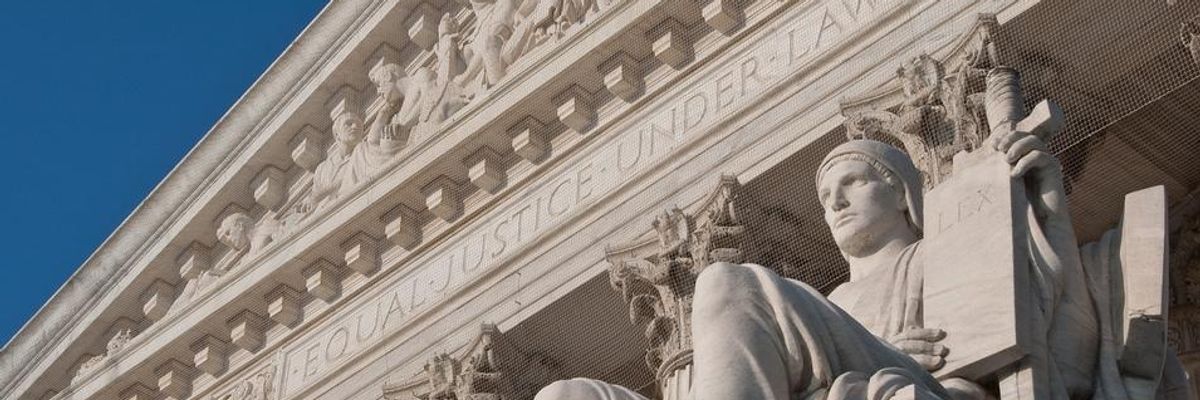
"The Guardian" or "Authority of Law" statue by James Earle Frasier in front of the United States Supreme Court building in Washington, DC. (Photo: Mark Fischer Flickr)
A Supreme Court ruling Tuesday stating undocumented immigrants with criminal records can be detained indefinitely by U.S. authorities at any time after an initial arrest--even years later--generated outrage and disappointment from advocacy groups around the country.
The case, Nielsen v. Preap, was decided by a majority of 5-4. The American Civil Liberties Union (ACLU) brought the suit against Department of Homeland Security (DHS) Secretary Kirstjen Nielsen to the Supreme Court in October 2018.
The case rested on whether or not the government can detain immigrants convicted of crimes at any time after their sentences and for any amount of time.
A law passed by Congress in 1996 allowed for the detention of undocumented immigrants after their sentence was served, but that law had largely, until now, been interpreted as only applying immediately after sentencing. Tuesday's ruling means that application parameter no longer exists.
"For two terms in a row now, the Supreme Court has endorsed the most extreme interpretation of immigration detention statutes, allowing mass incarceration of people without any hearing, simply because they are defending themselves against a deportation charge," Cecilia Wang, ACLU deputy legal director, said in a statement. "We will continue to fight the gross overuse of detention in the immigration system."
Wang argued the case in front of the judges.
Justice Samuel Alito wrote the decision, joined by justices Brett Kavanaugh, Neil Gorsuch, John Roberts, and Clarence Thomas. The quintet are considered the court's conservative block.
The liberal minority of Justices Stephen Breyer, Sonia Sotomayor, Ruth Bader-Ginsberg, and Elena Kagan was represented in a dissent by Breyer which asked if Congress "meant to allow the government to apprehend persons years after their release from prison and hold them indefinitely without a bail hearing."
"This is terrible news," said Slate writer Mark Joseph Stern.
In a late February piece for Slate, Stern argued that the court's decision in Jennings v. Rodriguez, where the court sent a case involving indefinite detention of immigrants back to lower courts, indicated the new majority was prepared to strip immigrants of Constitutional protections.
We should all be concerned that Breyer found it necessary to explain these first principles to the court. So many rights flow from the Due Process Clause's liberty component: not just the right to be free from arbitrary detention and degrading treatment, but also the right to bodily integrity and to equal dignity. Should the court rule that undocumented immigrants lack these basic liberties, what's to stop the government from torturing them, executing them, or keeping them imprisoned forever?
That's what happened on Tuesday, Scott Hechinger, senior attorney and director of policy at Brooklyn Defender Services, said on social media: the majority ruled "in favor of *indefinite detention* for immigrants."
The ruling was "a major setback for civil liberties," said the Asian Law Caucus, "but the battle isn't over."
Despite the setback, the ACLU's Wang promised that the organization would continue bringing cases like Preap to the court.
"We will never give up fighting against the senseless mass incarceration without a hearing," said Wang.
Dear Common Dreams reader, It’s been nearly 30 years since I co-founded Common Dreams with my late wife, Lina Newhouser. We had the radical notion that journalism should serve the public good, not corporate profits. It was clear to us from the outset what it would take to build such a project. No paid advertisements. No corporate sponsors. No millionaire publisher telling us what to think or do. Many people said we wouldn't last a year, but we proved those doubters wrong. Together with a tremendous team of journalists and dedicated staff, we built an independent media outlet free from the constraints of profits and corporate control. Our mission has always been simple: To inform. To inspire. To ignite change for the common good. Building Common Dreams was not easy. Our survival was never guaranteed. When you take on the most powerful forces—Wall Street greed, fossil fuel industry destruction, Big Tech lobbyists, and uber-rich oligarchs who have spent billions upon billions rigging the economy and democracy in their favor—the only bulwark you have is supporters who believe in your work. But here’s the urgent message from me today. It's never been this bad out there. And it's never been this hard to keep us going. At the very moment Common Dreams is most needed, the threats we face are intensifying. We need your support now more than ever. We don't accept corporate advertising and never will. We don't have a paywall because we don't think people should be blocked from critical news based on their ability to pay. Everything we do is funded by the donations of readers like you. When everyone does the little they can afford, we are strong. But if that support retreats or dries up, so do we. Will you donate now to make sure Common Dreams not only survives but thrives? —Craig Brown, Co-founder |
A Supreme Court ruling Tuesday stating undocumented immigrants with criminal records can be detained indefinitely by U.S. authorities at any time after an initial arrest--even years later--generated outrage and disappointment from advocacy groups around the country.
The case, Nielsen v. Preap, was decided by a majority of 5-4. The American Civil Liberties Union (ACLU) brought the suit against Department of Homeland Security (DHS) Secretary Kirstjen Nielsen to the Supreme Court in October 2018.
The case rested on whether or not the government can detain immigrants convicted of crimes at any time after their sentences and for any amount of time.
A law passed by Congress in 1996 allowed for the detention of undocumented immigrants after their sentence was served, but that law had largely, until now, been interpreted as only applying immediately after sentencing. Tuesday's ruling means that application parameter no longer exists.
"For two terms in a row now, the Supreme Court has endorsed the most extreme interpretation of immigration detention statutes, allowing mass incarceration of people without any hearing, simply because they are defending themselves against a deportation charge," Cecilia Wang, ACLU deputy legal director, said in a statement. "We will continue to fight the gross overuse of detention in the immigration system."
Wang argued the case in front of the judges.
Justice Samuel Alito wrote the decision, joined by justices Brett Kavanaugh, Neil Gorsuch, John Roberts, and Clarence Thomas. The quintet are considered the court's conservative block.
The liberal minority of Justices Stephen Breyer, Sonia Sotomayor, Ruth Bader-Ginsberg, and Elena Kagan was represented in a dissent by Breyer which asked if Congress "meant to allow the government to apprehend persons years after their release from prison and hold them indefinitely without a bail hearing."
"This is terrible news," said Slate writer Mark Joseph Stern.
In a late February piece for Slate, Stern argued that the court's decision in Jennings v. Rodriguez, where the court sent a case involving indefinite detention of immigrants back to lower courts, indicated the new majority was prepared to strip immigrants of Constitutional protections.
We should all be concerned that Breyer found it necessary to explain these first principles to the court. So many rights flow from the Due Process Clause's liberty component: not just the right to be free from arbitrary detention and degrading treatment, but also the right to bodily integrity and to equal dignity. Should the court rule that undocumented immigrants lack these basic liberties, what's to stop the government from torturing them, executing them, or keeping them imprisoned forever?
That's what happened on Tuesday, Scott Hechinger, senior attorney and director of policy at Brooklyn Defender Services, said on social media: the majority ruled "in favor of *indefinite detention* for immigrants."
The ruling was "a major setback for civil liberties," said the Asian Law Caucus, "but the battle isn't over."
Despite the setback, the ACLU's Wang promised that the organization would continue bringing cases like Preap to the court.
"We will never give up fighting against the senseless mass incarceration without a hearing," said Wang.
A Supreme Court ruling Tuesday stating undocumented immigrants with criminal records can be detained indefinitely by U.S. authorities at any time after an initial arrest--even years later--generated outrage and disappointment from advocacy groups around the country.
The case, Nielsen v. Preap, was decided by a majority of 5-4. The American Civil Liberties Union (ACLU) brought the suit against Department of Homeland Security (DHS) Secretary Kirstjen Nielsen to the Supreme Court in October 2018.
The case rested on whether or not the government can detain immigrants convicted of crimes at any time after their sentences and for any amount of time.
A law passed by Congress in 1996 allowed for the detention of undocumented immigrants after their sentence was served, but that law had largely, until now, been interpreted as only applying immediately after sentencing. Tuesday's ruling means that application parameter no longer exists.
"For two terms in a row now, the Supreme Court has endorsed the most extreme interpretation of immigration detention statutes, allowing mass incarceration of people without any hearing, simply because they are defending themselves against a deportation charge," Cecilia Wang, ACLU deputy legal director, said in a statement. "We will continue to fight the gross overuse of detention in the immigration system."
Wang argued the case in front of the judges.
Justice Samuel Alito wrote the decision, joined by justices Brett Kavanaugh, Neil Gorsuch, John Roberts, and Clarence Thomas. The quintet are considered the court's conservative block.
The liberal minority of Justices Stephen Breyer, Sonia Sotomayor, Ruth Bader-Ginsberg, and Elena Kagan was represented in a dissent by Breyer which asked if Congress "meant to allow the government to apprehend persons years after their release from prison and hold them indefinitely without a bail hearing."
"This is terrible news," said Slate writer Mark Joseph Stern.
In a late February piece for Slate, Stern argued that the court's decision in Jennings v. Rodriguez, where the court sent a case involving indefinite detention of immigrants back to lower courts, indicated the new majority was prepared to strip immigrants of Constitutional protections.
We should all be concerned that Breyer found it necessary to explain these first principles to the court. So many rights flow from the Due Process Clause's liberty component: not just the right to be free from arbitrary detention and degrading treatment, but also the right to bodily integrity and to equal dignity. Should the court rule that undocumented immigrants lack these basic liberties, what's to stop the government from torturing them, executing them, or keeping them imprisoned forever?
That's what happened on Tuesday, Scott Hechinger, senior attorney and director of policy at Brooklyn Defender Services, said on social media: the majority ruled "in favor of *indefinite detention* for immigrants."
The ruling was "a major setback for civil liberties," said the Asian Law Caucus, "but the battle isn't over."
Despite the setback, the ACLU's Wang promised that the organization would continue bringing cases like Preap to the court.
"We will never give up fighting against the senseless mass incarceration without a hearing," said Wang.