SUBSCRIBE TO OUR FREE NEWSLETTER
Daily news & progressive opinion—funded by the people, not the corporations—delivered straight to your inbox.
5
#000000
#FFFFFF
To donate by check, phone, or other method, see our More Ways to Give page.
Daily news & progressive opinion—funded by the people, not the corporations—delivered straight to your inbox.
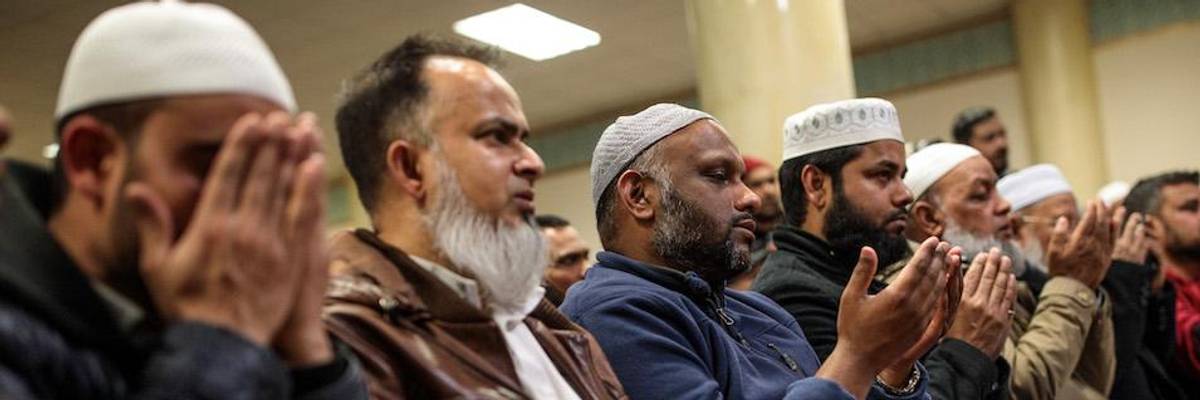
Muslims attend a vigil at the East London Mosque for the victims of the New Zealand mosque attacks on March 15, 2019 in London, England. (Photo: Jack Taylor/Getty Images)
Progressives, many of them Muslim, decried the mainstreaming of Islamophobia as providing fuel for the hatred and violence which led to Friday's attack on two mosques in New Zealand that killed at least 49 people.
The one attacker that has been charged, identified as Australian Brenton Tarrant, cited a number of familiar xenophobic and Islamophobic talking points against immigrants and Muslims in a manifesto posted online. The sentiments were placed alongside more blatant white supremacist rhetoric about "white genocide" and declining birth rates.
For many on the left, the attacker's apparent motivations were the inevitable result of years of anti-Muslim rhetoric in politics and media across the West.
"From the US to France to Australia, Muslims are persistently vilified and attacked, while biases against them are normalized," said Remi Kanazi, a Palestinian-American poet, on Twitter. "Then when white supremacy violence kills dozens, society disingenuously throws its hands up and wonders how this could ever happen."
Humanitarian non-profit Islamic Relief USA, in a statement from the organization's chief executive officer Sharif Aly, called for an understanding of how things got to this point while also hoping for peace and dialogue.
"We cannot address this horrific tragedy against Muslims," said Aly, "without addressing the root causes of racism, bigotry, xenophobia, anti-Semitism, Islamophobia, and other forms of hatred and violence."
Pointing out that those root causes are increasingly accepted in society, Imraan Siddiqi, the executive director for the Council on American Islamic Relations in Arizona, said on Twitter that Friday's attack was something that was a long time coming.
"All it takes is one individual to be radicalized by these messages and to act out violently," said Siddiqi.
The attacks were "a moment of reckoning for leaders across the world who have encouraged or turned a blind eye to the scourge of Islamophobia," said Amnesty International secretary general Kumi Naidoo in a statement.
"The politics of demonization has today cost 49 people their lives," Nadoo added. "Reports that the attackers followed a white supremacist manifesto must galvanize world leaders to start standing against this hate-filled ideology."
That may be easier said than done, however. A number of commentators pointed to statements made by influential American conservatives as indicative of the mainstreaming of the hate.
Of course, as National Iranian American Council president Jamal Abdi made clear in a statement on the attacks, the blame doesn't end there.
"The U.S. now has a President that is a global leader in spreading such bigotry and who has failed on numerous occasions to halt his hateful rhetoric and the policies that are inspired by it," said Abdi. "We reiterate our call for Donald Trump to make a clean break from his white nationalist and Islamophobic roots and condemn in the strongest possible terms the vile acts of terror that spring from such hatred."
Activist Linda Sarsour, co-founder of the Muslim advocacy group MPower Change, echoed Abdi's call for the president to step up and change his way of speaking about Muslims.
Amid calls for accountability and change, many people continued to express sorrow over the attacks and returned their thoughts to the victims.
"Dreadful news coming out of New Zealand this morning," tweeted Liverpool football star Mohamed Salah. "My condolences go out to the families of those innocent victims who lost their lives in this act of pure evil."
Dear Common Dreams reader, It’s been nearly 30 years since I co-founded Common Dreams with my late wife, Lina Newhouser. We had the radical notion that journalism should serve the public good, not corporate profits. It was clear to us from the outset what it would take to build such a project. No paid advertisements. No corporate sponsors. No millionaire publisher telling us what to think or do. Many people said we wouldn't last a year, but we proved those doubters wrong. Together with a tremendous team of journalists and dedicated staff, we built an independent media outlet free from the constraints of profits and corporate control. Our mission has always been simple: To inform. To inspire. To ignite change for the common good. Building Common Dreams was not easy. Our survival was never guaranteed. When you take on the most powerful forces—Wall Street greed, fossil fuel industry destruction, Big Tech lobbyists, and uber-rich oligarchs who have spent billions upon billions rigging the economy and democracy in their favor—the only bulwark you have is supporters who believe in your work. But here’s the urgent message from me today. It's never been this bad out there. And it's never been this hard to keep us going. At the very moment Common Dreams is most needed, the threats we face are intensifying. We need your support now more than ever. We don't accept corporate advertising and never will. We don't have a paywall because we don't think people should be blocked from critical news based on their ability to pay. Everything we do is funded by the donations of readers like you. When everyone does the little they can afford, we are strong. But if that support retreats or dries up, so do we. Will you donate now to make sure Common Dreams not only survives but thrives? —Craig Brown, Co-founder |
Progressives, many of them Muslim, decried the mainstreaming of Islamophobia as providing fuel for the hatred and violence which led to Friday's attack on two mosques in New Zealand that killed at least 49 people.
The one attacker that has been charged, identified as Australian Brenton Tarrant, cited a number of familiar xenophobic and Islamophobic talking points against immigrants and Muslims in a manifesto posted online. The sentiments were placed alongside more blatant white supremacist rhetoric about "white genocide" and declining birth rates.
For many on the left, the attacker's apparent motivations were the inevitable result of years of anti-Muslim rhetoric in politics and media across the West.
"From the US to France to Australia, Muslims are persistently vilified and attacked, while biases against them are normalized," said Remi Kanazi, a Palestinian-American poet, on Twitter. "Then when white supremacy violence kills dozens, society disingenuously throws its hands up and wonders how this could ever happen."
Humanitarian non-profit Islamic Relief USA, in a statement from the organization's chief executive officer Sharif Aly, called for an understanding of how things got to this point while also hoping for peace and dialogue.
"We cannot address this horrific tragedy against Muslims," said Aly, "without addressing the root causes of racism, bigotry, xenophobia, anti-Semitism, Islamophobia, and other forms of hatred and violence."
Pointing out that those root causes are increasingly accepted in society, Imraan Siddiqi, the executive director for the Council on American Islamic Relations in Arizona, said on Twitter that Friday's attack was something that was a long time coming.
"All it takes is one individual to be radicalized by these messages and to act out violently," said Siddiqi.
The attacks were "a moment of reckoning for leaders across the world who have encouraged or turned a blind eye to the scourge of Islamophobia," said Amnesty International secretary general Kumi Naidoo in a statement.
"The politics of demonization has today cost 49 people their lives," Nadoo added. "Reports that the attackers followed a white supremacist manifesto must galvanize world leaders to start standing against this hate-filled ideology."
That may be easier said than done, however. A number of commentators pointed to statements made by influential American conservatives as indicative of the mainstreaming of the hate.
Of course, as National Iranian American Council president Jamal Abdi made clear in a statement on the attacks, the blame doesn't end there.
"The U.S. now has a President that is a global leader in spreading such bigotry and who has failed on numerous occasions to halt his hateful rhetoric and the policies that are inspired by it," said Abdi. "We reiterate our call for Donald Trump to make a clean break from his white nationalist and Islamophobic roots and condemn in the strongest possible terms the vile acts of terror that spring from such hatred."
Activist Linda Sarsour, co-founder of the Muslim advocacy group MPower Change, echoed Abdi's call for the president to step up and change his way of speaking about Muslims.
Amid calls for accountability and change, many people continued to express sorrow over the attacks and returned their thoughts to the victims.
"Dreadful news coming out of New Zealand this morning," tweeted Liverpool football star Mohamed Salah. "My condolences go out to the families of those innocent victims who lost their lives in this act of pure evil."
Progressives, many of them Muslim, decried the mainstreaming of Islamophobia as providing fuel for the hatred and violence which led to Friday's attack on two mosques in New Zealand that killed at least 49 people.
The one attacker that has been charged, identified as Australian Brenton Tarrant, cited a number of familiar xenophobic and Islamophobic talking points against immigrants and Muslims in a manifesto posted online. The sentiments were placed alongside more blatant white supremacist rhetoric about "white genocide" and declining birth rates.
For many on the left, the attacker's apparent motivations were the inevitable result of years of anti-Muslim rhetoric in politics and media across the West.
"From the US to France to Australia, Muslims are persistently vilified and attacked, while biases against them are normalized," said Remi Kanazi, a Palestinian-American poet, on Twitter. "Then when white supremacy violence kills dozens, society disingenuously throws its hands up and wonders how this could ever happen."
Humanitarian non-profit Islamic Relief USA, in a statement from the organization's chief executive officer Sharif Aly, called for an understanding of how things got to this point while also hoping for peace and dialogue.
"We cannot address this horrific tragedy against Muslims," said Aly, "without addressing the root causes of racism, bigotry, xenophobia, anti-Semitism, Islamophobia, and other forms of hatred and violence."
Pointing out that those root causes are increasingly accepted in society, Imraan Siddiqi, the executive director for the Council on American Islamic Relations in Arizona, said on Twitter that Friday's attack was something that was a long time coming.
"All it takes is one individual to be radicalized by these messages and to act out violently," said Siddiqi.
The attacks were "a moment of reckoning for leaders across the world who have encouraged or turned a blind eye to the scourge of Islamophobia," said Amnesty International secretary general Kumi Naidoo in a statement.
"The politics of demonization has today cost 49 people their lives," Nadoo added. "Reports that the attackers followed a white supremacist manifesto must galvanize world leaders to start standing against this hate-filled ideology."
That may be easier said than done, however. A number of commentators pointed to statements made by influential American conservatives as indicative of the mainstreaming of the hate.
Of course, as National Iranian American Council president Jamal Abdi made clear in a statement on the attacks, the blame doesn't end there.
"The U.S. now has a President that is a global leader in spreading such bigotry and who has failed on numerous occasions to halt his hateful rhetoric and the policies that are inspired by it," said Abdi. "We reiterate our call for Donald Trump to make a clean break from his white nationalist and Islamophobic roots and condemn in the strongest possible terms the vile acts of terror that spring from such hatred."
Activist Linda Sarsour, co-founder of the Muslim advocacy group MPower Change, echoed Abdi's call for the president to step up and change his way of speaking about Muslims.
Amid calls for accountability and change, many people continued to express sorrow over the attacks and returned their thoughts to the victims.
"Dreadful news coming out of New Zealand this morning," tweeted Liverpool football star Mohamed Salah. "My condolences go out to the families of those innocent victims who lost their lives in this act of pure evil."