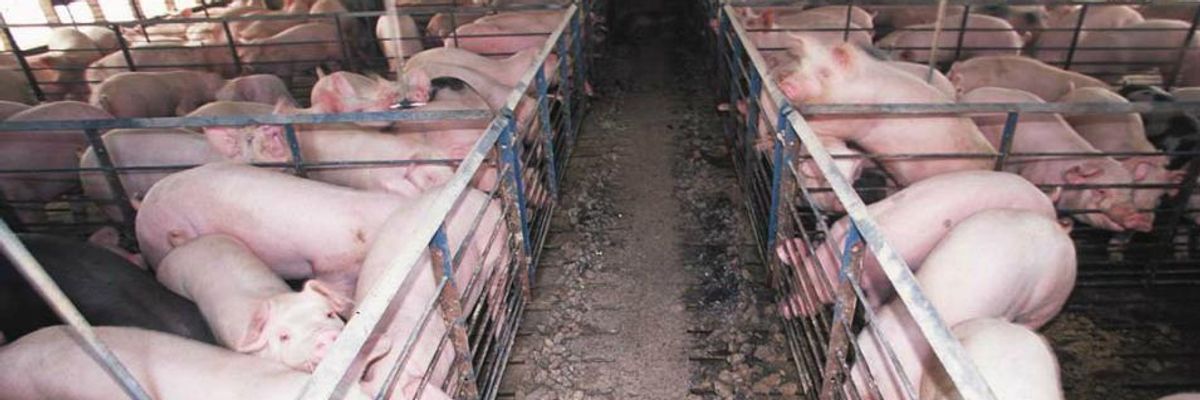
Iowa lawmakers just passed a new "ag-law" law that critics say, like the previous version struck down in federal court, is unconstitutional. (Photo: EPA)

After Last Version Blocked, Iowa's New Ag-Gag Bill 'Gives Middle Finger to Free Speech, Consumer Protection, Food Safety, and Animal Welfare'
"Consumers have a right to know how their food is produced and how animals at factory farms are mistreated."
Iowa's GOP-controlled legislature on Tuesday rushed through a new legally questionable bill that critics say "aims to criminalize whistleblowing on factory farms and other agricultural facilities"--just two months after a federal court struck down a similar 2012 law as unconstitutional.
"Without undercover investigations, there are no effective watchdogs protecting animals from egregious cruelty."
--Leah Garces, Mercy For Animals
"Without undercover investigations, there are no effective watchdogs protecting animals from egregious cruelty," Mercy For Animals president Leah Garces told Common Dreams. "Consumers have a right to know how their food is produced and how animals at factory farms are mistreated."
The legislation would create a new crime called "agricultural production facility trespass," enabling state law enforcement to charge someone with a misdemeanor if they use "deception" to gain access to a facility "with the intent to cause physical or economic harm or other injury to the agricultural production facility's operations, agricultural animals, crop, owner, personnel, equipment, building, premises, business interest, or customer."
While a spokesperson for Republican Gov. Kim Reynolds confirmed to the Des Moines Register that she intends to sign the measure into law, legal advocacy groups are already gearing up to challenge it in court. As the newspaper reported:
Daniel Zeno, policy director for the ACLU of Iowa, said the latest measure, like the last one, will not meet constitutional muster. He said Iowa law already prohibits illegal trespassing on private property including agriculture facilities. He also said people are already prohibited from causing physical harm to buildings and livestock. Zeno also pointed out that there are existing regulations on biosecurity measures.
"They're going after speech," he said of lawmakers who support the legislation.
The push to send the new bill to the governor came after Senior Judge James Gritzner of the U.S. District Court for the Southern District of Iowa ruled in January that the state's lawyers had failed to prove that the initial ag-gag law's prohibitions on speech "are actually necessary to protect perceived harms to property and biosecurity."
The Animal Legal Defense Fund (ALDF), which led the coalition challenging the previous law's constitutionality, noted in a blog post last week, "Iowa has appealed the district court's decision--though given the ample precedent finding ag-gag laws to be unconstitutional, their odds of success seem slim." An ALDF spokesperson told The Associated Press the group is prepared to file another lawsuit targeting the new bill.
The new legislation, which backers argue is narrowly tailored enough to stand up in court, passed both the state House and Senate with bipartisan support--though some Democrats did vote against it.
"Truthful revelation may indeed cause economic harm, but quite often truthful revelation has led to the saving of lots of human lives."
--Iowa State Sen. Herman Quirmbach
"This bill gives the middle finger to free speech, consumer protection, food safety, and animal welfare," state Rep. Liz Bennett (D) of Cedar Rapids told the Register. She expressed concern that it will silence all agricultural industry whistleblowers, including any longtime employees.
State Sen. Herman Quirmbach (D) of Ames also opposed the bill--invoking the memory of muckraker Upton Sinclair. His novel The Jungle, informed by Sinclair's undercover work in Chicago's meatpacking industry during the early 20th century, exposed the awful conditions of American slaughterhouses and led to new federal food safety regulations.
"Truthful revelation may indeed cause economic harm, but quite often truthful revelation has led to the saving of lots of human lives," Quirmbach told the paper. "Punishing people whose truthful revelation of information causes economic harm is something we should not do."
We are at a crossroads
This country and this world are at a monumental crossroads. In a few short weeks, US voters will have an opportunity to beat back the forces of fascism and confront the billionaires who are rigging the economy, our media system, and our democracy, making it increasingly impossible for ordinary people to get by. We’re not just talking about the election. We’re talking about what must be done once these fascist elements are vanquished from power. We need a bolder set of solutions than what either major party has so far been willing to offer and a working-class movement ready to fight like hell for it. Trump didn't emerge from nowhere. The conditions that fueled MAGA authoritarianism were created by decades of radical neoliberal economic policies and a corrupt political system dominated by corporate interests. They slashed taxes on the super-rich, promising that the benefits would trickle down. They said giveaways to the corporate titans would make life more affordable for the rest of us. It was all bullshit. And when a bitter, betrayed populace searches for someone to blame, right-wing demagogues have little trouble finding scapegoats. People know when they're being lied to, but you won't hear any of this from the corporate media. Only independent journalism—powered and funded by people who believe in building a better world—can deliver truly trustworthy daily news. Our Fall Campaign is underway, and we need your help. To power our newsroom through the rest of the year, we need to raise $125,000 by midnight on October 31. So if you share our vision, please contribute whatever you can to sustain our work. |
Iowa's GOP-controlled legislature on Tuesday rushed through a new legally questionable bill that critics say "aims to criminalize whistleblowing on factory farms and other agricultural facilities"--just two months after a federal court struck down a similar 2012 law as unconstitutional.
"Without undercover investigations, there are no effective watchdogs protecting animals from egregious cruelty."
--Leah Garces, Mercy For Animals
"Without undercover investigations, there are no effective watchdogs protecting animals from egregious cruelty," Mercy For Animals president Leah Garces told Common Dreams. "Consumers have a right to know how their food is produced and how animals at factory farms are mistreated."
The legislation would create a new crime called "agricultural production facility trespass," enabling state law enforcement to charge someone with a misdemeanor if they use "deception" to gain access to a facility "with the intent to cause physical or economic harm or other injury to the agricultural production facility's operations, agricultural animals, crop, owner, personnel, equipment, building, premises, business interest, or customer."
While a spokesperson for Republican Gov. Kim Reynolds confirmed to the Des Moines Register that she intends to sign the measure into law, legal advocacy groups are already gearing up to challenge it in court. As the newspaper reported:
Daniel Zeno, policy director for the ACLU of Iowa, said the latest measure, like the last one, will not meet constitutional muster. He said Iowa law already prohibits illegal trespassing on private property including agriculture facilities. He also said people are already prohibited from causing physical harm to buildings and livestock. Zeno also pointed out that there are existing regulations on biosecurity measures.
"They're going after speech," he said of lawmakers who support the legislation.
The push to send the new bill to the governor came after Senior Judge James Gritzner of the U.S. District Court for the Southern District of Iowa ruled in January that the state's lawyers had failed to prove that the initial ag-gag law's prohibitions on speech "are actually necessary to protect perceived harms to property and biosecurity."
The Animal Legal Defense Fund (ALDF), which led the coalition challenging the previous law's constitutionality, noted in a blog post last week, "Iowa has appealed the district court's decision--though given the ample precedent finding ag-gag laws to be unconstitutional, their odds of success seem slim." An ALDF spokesperson told The Associated Press the group is prepared to file another lawsuit targeting the new bill.
The new legislation, which backers argue is narrowly tailored enough to stand up in court, passed both the state House and Senate with bipartisan support--though some Democrats did vote against it.
"Truthful revelation may indeed cause economic harm, but quite often truthful revelation has led to the saving of lots of human lives."
--Iowa State Sen. Herman Quirmbach
"This bill gives the middle finger to free speech, consumer protection, food safety, and animal welfare," state Rep. Liz Bennett (D) of Cedar Rapids told the Register. She expressed concern that it will silence all agricultural industry whistleblowers, including any longtime employees.
State Sen. Herman Quirmbach (D) of Ames also opposed the bill--invoking the memory of muckraker Upton Sinclair. His novel The Jungle, informed by Sinclair's undercover work in Chicago's meatpacking industry during the early 20th century, exposed the awful conditions of American slaughterhouses and led to new federal food safety regulations.
"Truthful revelation may indeed cause economic harm, but quite often truthful revelation has led to the saving of lots of human lives," Quirmbach told the paper. "Punishing people whose truthful revelation of information causes economic harm is something we should not do."
Iowa's GOP-controlled legislature on Tuesday rushed through a new legally questionable bill that critics say "aims to criminalize whistleblowing on factory farms and other agricultural facilities"--just two months after a federal court struck down a similar 2012 law as unconstitutional.
"Without undercover investigations, there are no effective watchdogs protecting animals from egregious cruelty."
--Leah Garces, Mercy For Animals
"Without undercover investigations, there are no effective watchdogs protecting animals from egregious cruelty," Mercy For Animals president Leah Garces told Common Dreams. "Consumers have a right to know how their food is produced and how animals at factory farms are mistreated."
The legislation would create a new crime called "agricultural production facility trespass," enabling state law enforcement to charge someone with a misdemeanor if they use "deception" to gain access to a facility "with the intent to cause physical or economic harm or other injury to the agricultural production facility's operations, agricultural animals, crop, owner, personnel, equipment, building, premises, business interest, or customer."
While a spokesperson for Republican Gov. Kim Reynolds confirmed to the Des Moines Register that she intends to sign the measure into law, legal advocacy groups are already gearing up to challenge it in court. As the newspaper reported:
Daniel Zeno, policy director for the ACLU of Iowa, said the latest measure, like the last one, will not meet constitutional muster. He said Iowa law already prohibits illegal trespassing on private property including agriculture facilities. He also said people are already prohibited from causing physical harm to buildings and livestock. Zeno also pointed out that there are existing regulations on biosecurity measures.
"They're going after speech," he said of lawmakers who support the legislation.
The push to send the new bill to the governor came after Senior Judge James Gritzner of the U.S. District Court for the Southern District of Iowa ruled in January that the state's lawyers had failed to prove that the initial ag-gag law's prohibitions on speech "are actually necessary to protect perceived harms to property and biosecurity."
The Animal Legal Defense Fund (ALDF), which led the coalition challenging the previous law's constitutionality, noted in a blog post last week, "Iowa has appealed the district court's decision--though given the ample precedent finding ag-gag laws to be unconstitutional, their odds of success seem slim." An ALDF spokesperson told The Associated Press the group is prepared to file another lawsuit targeting the new bill.
The new legislation, which backers argue is narrowly tailored enough to stand up in court, passed both the state House and Senate with bipartisan support--though some Democrats did vote against it.
"Truthful revelation may indeed cause economic harm, but quite often truthful revelation has led to the saving of lots of human lives."
--Iowa State Sen. Herman Quirmbach
"This bill gives the middle finger to free speech, consumer protection, food safety, and animal welfare," state Rep. Liz Bennett (D) of Cedar Rapids told the Register. She expressed concern that it will silence all agricultural industry whistleblowers, including any longtime employees.
State Sen. Herman Quirmbach (D) of Ames also opposed the bill--invoking the memory of muckraker Upton Sinclair. His novel The Jungle, informed by Sinclair's undercover work in Chicago's meatpacking industry during the early 20th century, exposed the awful conditions of American slaughterhouses and led to new federal food safety regulations.
"Truthful revelation may indeed cause economic harm, but quite often truthful revelation has led to the saving of lots of human lives," Quirmbach told the paper. "Punishing people whose truthful revelation of information causes economic harm is something we should not do."